The Smoot-Hawley Tariff Act was a law signed by President Herbert Hoover on June 17th, 1930, that raised taxes on more than 20,000 imported goods coming into the United States. Named after its main sponsors, Senator Reed Smoot of Utah and Representative Willis Hawley of Oregon, the act was intended to protect American farmers and businesses from foreign competition during the early stages of the Great Depression. Instead, it made things significantly worse. Other countries responded with their own tariffs against American goods, global trade collapsed, and the economic crisis deepened across the world. The Smoot-Hawley Tariff Act is widely regarded as one of the worst economic policy decisions in American history.
WHAT WAS THE GREAT DEPRESSION?
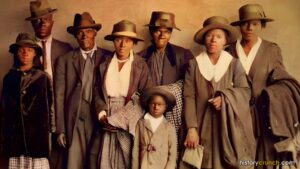
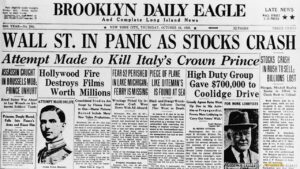
The Great Depression was a significant event in world history and was of particular importance to American history. It was a worldwide economic recession that occurred primarily during the 1930s. A recession is a term that refers to a general economic downturn resulting in high levels of unemployment and a loss in consumer spending. As a result, during the Great Depression, many people struggled to find work while businesses struggled to survive with an overall reduction in the sales of goods and services. Historians have identified several different causes of the Great Depression, including the stock market crash of 1929, the purchasing of stocks on margin, the wide income gap between the wealthy and the poor, the loss of consumer spending, the failure of banks to deal with the crisis, protectionism, and the weather conditions of the American Midwest. The Smoot-Hawley Tariff Act was one of the most damaging examples of protectionism during this period, and its effects helped turn a serious economic downturn into a global catastrophe.
SMOOT-HAWLEY TARIFF ACT – BACKGROUND
The roots of the Smoot-Hawley Tariff Act go back to the 1920s, before the Great Depression began. American farmers had struggled throughout the decade. After World War I, European farmers recovered and began producing more food, which increased competition and drove down prices for American agricultural products. Farmers pushed the federal government to protect them from this foreign competition by raising import taxes, which are called tariffs. A tariff makes imported goods more expensive and encourages consumers to buy domestic products instead.
The United States already had high tariffs in place. In 1922, Congress had passed the Fordney-McCumber Act, which raised average import taxes to around 40 percent. Despite these already high rates, agricultural groups continued to lobby for more protection. During his 1928 presidential campaign, Republican candidate Herbert Hoover promised to raise tariffs on farm products if elected. After he won, Senators Smoot and Hawley introduced a bill in Congress to do exactly that.
What started as a modest effort to help farmers quickly grew into something much larger. Other industries and special interest groups flooded Congress with requests to have their own products protected as well. By the time the bill reached the Senate it had expanded to cover rate increases on more than 20,000 individual imported goods. The stock market crash of October of 1929 hit while the bill was still working its way through Congress, and rather than pulling back, many members of Congress pushed harder for the tariff as a way to shield American industry from the worsening economy.
SMOOT-HAWLEY TARIFF ACT – OPPOSITION AND PASSAGE
The Smoot-Hawley Tariff Act faced strong opposition before it was ever signed into law. In May of 1930, more than 1,000 American economists signed an open letter urging President Hoover to veto the bill. The economists warned that higher tariffs would raise prices for ordinary Americans, provoke retaliation from trading partners, and make the economic situation worse rather than better. Prominent business leaders joined the opposition. Automobile executive Henry Ford visited the White House personally to argue against the bill, calling it an economic mistake. The head of J.P. Morgan’s operations said he almost got on his knees to beg Hoover to reject it.
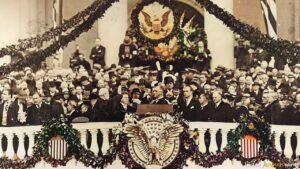
Despite this, Hoover signed the bill into law on June 17th, 1930. The House of Representatives had passed it by a vote of 264 to 147, and the Senate by the narrow margin of 44 to 42. Hoover had his own doubts about the bill but felt politically unable to reject it after making tariffs a campaign promise. The law raised average tariff rates by roughly 20 percentage points, pushing duties on many agricultural goods up by around 57 percent. It was the second-highest tariff in American history.
SMOOT-HAWLEY TARIFF ACT – INTERNATIONAL RETALIATION
The most damaging consequence of the Smoot-Hawley Tariff Act was the retaliation it triggered from other countries. Even before Hoover signed the bill, 23 trading partners had formally protested the impending tariff increases. Once the law took effect, countries around the world responded by raising their own tariffs on American goods.
Canada, one of the largest buyers of American products, quickly passed legislation raising tariffs on a range of American imports. France and Spain placed new taxes on American automobiles. Within two years of the law’s passage, roughly two dozen countries had enacted their own retaliatory tariffs. American exports, which had already been weakened by the onset of the Depression, were now being actively shut out of foreign markets. American imports from Europe fell from $1.3 billion in 1929 to just $390 million in 1932. American exports to Europe dropped from $2.3 billion in 1929 to $784 million in 1932. Overall, world trade declined by roughly 66 percent between 1929 and 1934.
This collapse in trade hurt American farmers and manufacturers more than foreign competition ever had. The industries the tariff was designed to protect found themselves losing overseas markets rather than gaining domestic ones.
SMOOT-HAWLEY TARIFF ACT – IMPACT ON THE GREAT DEPRESSION
Historians and economists debate exactly how much the Smoot-Hawley Tariff Act contributed to the depth and length of the Great Depression. The Depression had already begun before the act was signed, with the stock market crash of October of 1929 and a banking crisis already underway. The tariff did not cause the Depression. However, most economists agree that it made the Depression significantly worse.
By raising prices on imported goods, the act hit American consumers who were already struggling with unemployment and falling wages. By triggering international retaliation, it destroyed export markets that American farmers and manufacturers depended on. American exports declined from about $5.2 billion in 1929 to $1.7 billion in 1933. The collapse of international trade also weakened foreign economies, making it harder for European countries to repay their war debts to the United States, which put additional strain on American banks. When major banks in Europe began failing, beginning with the Austrian Creditanstalt bank in 1931, the banking crisis spread further around the world.
By 1933, American unemployment had reached roughly 25 percent. The gross national product of the United States had fallen from $103 billion in 1929 to just $55.6 billion in 1933. The Smoot-Hawley Tariff Act did not create those numbers alone, but it contributed to them by shutting down the trade that might otherwise have helped the economy recover faster.
SMOOT-HAWLEY TARIFF ACT – REPEAL AND LEGACY
The political consequences for those who passed the act were swift. Both Willis Hawley and Reed Smoot were voted out of office in 1932, swept out in the Democratic wave that also brought Franklin D. Roosevelt to the presidency. Roosevelt recognized that the tariff policy had been a failure, and in 1934 he signed the Reciprocal Trade Agreements Act, which gave the president the authority to negotiate lower tariffs with other countries through bilateral agreements. This marked a major shift in American trade policy, away from the high protective tariffs that had defined the Republican era and toward the lower-tariff, free-trade approach that would shape American economic policy for much of the rest of the twentieth century.
The Smoot-Hawley Tariff Act became a lasting symbol of the dangers of protectionism. It is still cited by economists and historians today as a warning about what can happen when a government responds to economic hardship by raising barriers to trade rather than working with other nations to find shared solutions.
SIGNIFICANCE OF THE SMOOT-HAWLEY TARIFF ACT
The Smoot-Hawley Tariff Act is one of the most studied and debated pieces of economic legislation in American history. It was intended to help American workers and farmers survive the early years of the Great Depression. In reality, it deepened the crisis by collapsing international trade, raising consumer prices, and triggering a global trade war that hurt the very people it was meant to protect.
The act demonstrated that economic decisions made by one country can have powerful effects on the rest of the world, especially when that country is the United States. It shifted American trade policy permanently away from high protective tariffs, and it remains a cautionary example of how good intentions and bad policy can combine to make a difficult situation much worse.