Thomas Malthus was an English scholar from the timeframe of the Industrial Revolution. Today he is best remembered for writing about issues related to the economy and human populations. In particular he famously wrote about the potential crisis of the human population outpacing food production.
THOMAS MALTHUS – EARLY LIFE
Thomas Malthus was born in Surrey, England on February 13th, 1766. Although he was born Thomas, he only ever used his middle name Robert. As a young child, Malthus was mostly educated at home, however he did receive private instruction from a tutor. He also attended Warrington Academy for a short period of time. In 1784, Malthus went to Cambridge, where he studied English literature, Latin, Greek and mathematics. He obtained his Master of Arts Degree in 1791. After graduating he became a professor of history and political economy.
THOMAS MALTHUS – THEORIES ON POPULATION
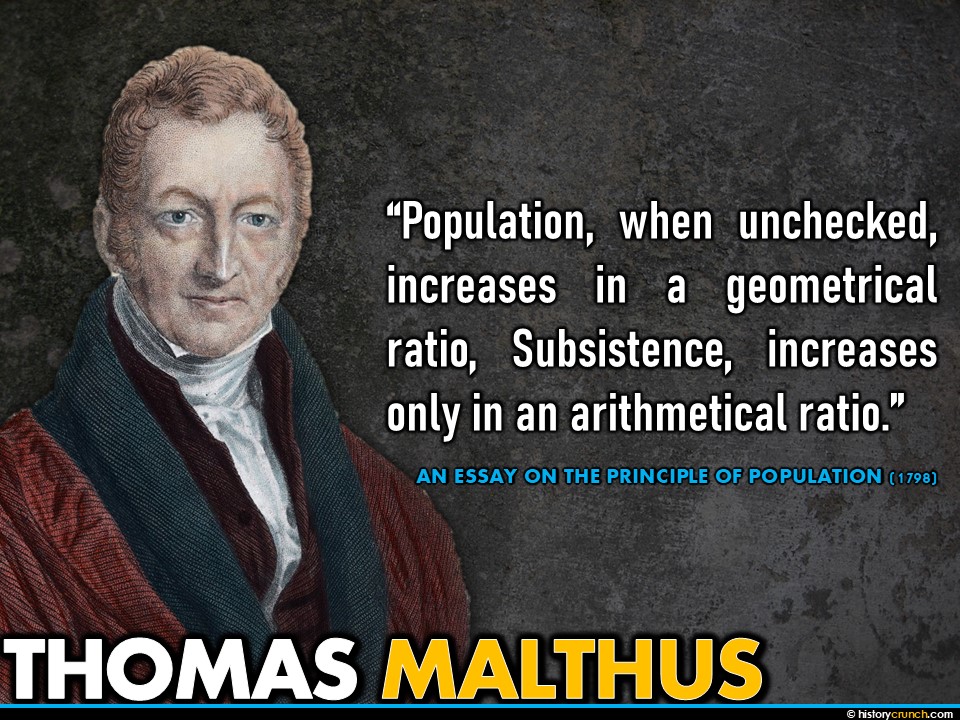
Malthus developed an interest in population growth whilst at Cambridge. In 1798, he published a paper titled ‘An Essay on the Principle of Population’ that pushed him into the public eye. In the paper, he argued that when food supply increases the population size grows accordingly in order to eliminate the abundance. Furthermore, he insisted that while food production increased at a linear rate, human reproduction occurred at an exponential rate. As such, he argued that eventually, there would be a crisis in which human reproduction outpaced available food production. He suggested that this crisis would lead to starvation and public turmoil. He published a number of editions of the paper, each time adding more information and new material. The paper gave rise to the Malthusian controversy, which prevailed for the next few decades. The controversy centered on Malthus’ theory for preventing the crisis point. Essentially, Malthus argued that there should be some checks in place in order to prevent over population and the crisis point of human reproduction outpacing food production. For instance, he referred to positive checks, which caused the death rate to increase. For Malthus, the positive checks included things such as war, disease and hunger. As well, he referred to preventive checks, which lowered the birth rate. For Malthus, these included things such as birth control and celibacy.
Malthus wrote about this concept in ‘An Essay on the Principle of Population’. For example he wrote:
“If the subsistence for man that the earth affords was to be increased every twenty-five years by a quantity equal to what the whole world at present produces, this would allow the power of production in the earth to be absolutely unlimited, and its ratio of increase much greater than we can conceive that any possible exertions of mankind could make it … yet still the power of population being a power of a superior order, the increase of the human species can only be kept commensurate to the increase of the means of subsistence by the constant operation of the strong law of necessity acting as a check upon the greater power.”
THOMAS MALTHUS – CRITICISM OF MALTHUS’ IDEAS
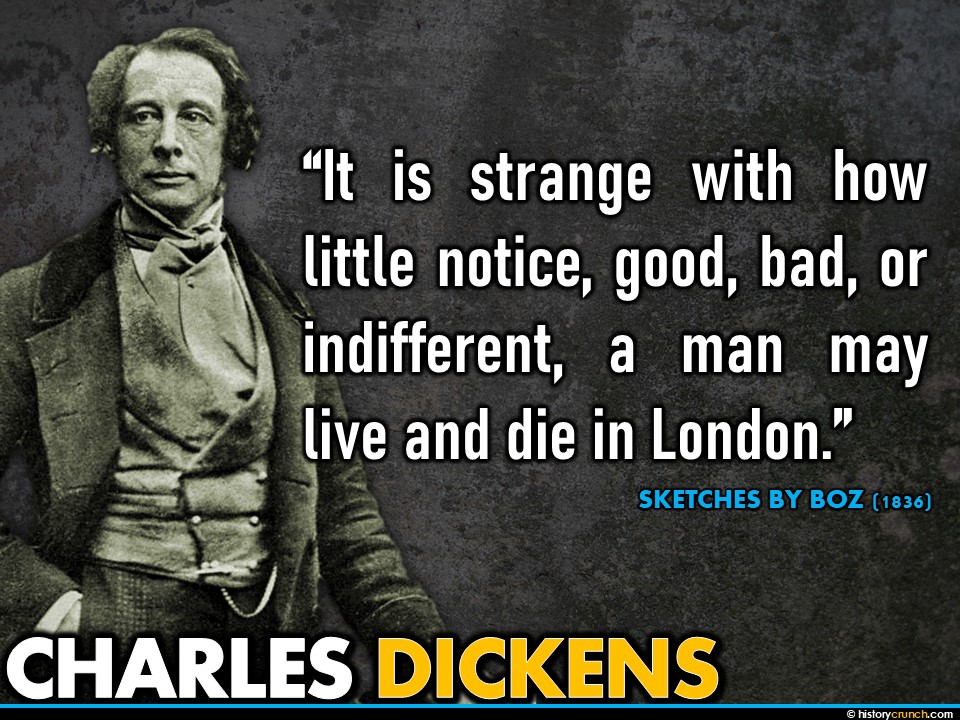
Many viewed Malthus’ ideas as cold-hearted and viewed the Malthusian Population Theory as justification for the exploitation of the working-class people in the Industrial Revolution. For example, in Charles Dickens’ famous story ‘A Christmas Carol’ the character of Ebenezer Scrooge expressed Malthus’ ideas in an early scene. For instance, when approached by two men collecting donations for the poor, Scrooge responded by suggesting that the poor should die and “decrease the surplus population”. ‘A Christmas Carol’ was first published by Dickens in 1843, and is generally viewed as a critique of the social system present in England at the time. As such, Dickens’ portrayal of Ebenezer Scrooge is viewed as a criticism of Malthus’ ideas.
THOMAS MALTHUS – DEATH AND LEGACY
Malthus was elected as a fellow of the Royal Society and later formed some other academic clubs in London. For example, he was a founding member of the Political Economy Club in 1821. He continued to write and published several more works. Malthus died on December 23rd, 1834 from a heart attack. Today, he is best remembered for his views on the economy, politics and society that shaped the Industrial Revolution in England.