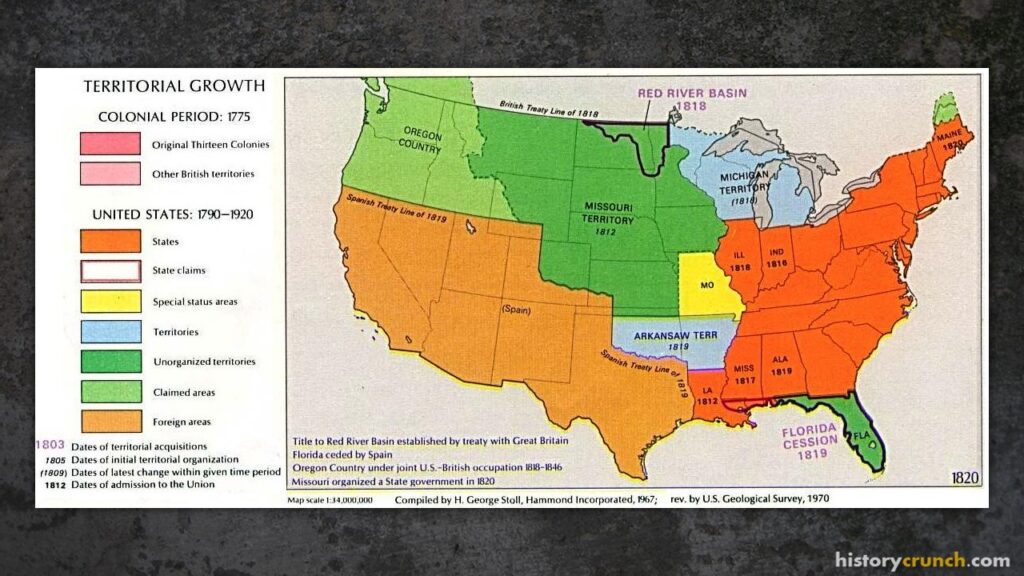
The Missouri Compromise was an act of federal legislation from 1820 that came to play an important role in American history. In general, the Missouri Compromise dealt with the issue of slavery and created a divide between the Northern and Southern states on the practise of slavery in the United States. For instance, while the Missouri Compromise occurred in 1820, it had a profound impact on the United States and played an important role well into the mid-1800s. As such, historians consider the Missouri Compromise an important event when discussing other topics, such as: slavery in the United States, American Civil War and the American Abolitionist Movement.
BEFORE THE MISSOURI COMPROMISE
The territory of Missouri first came under the control of the United States government following the Louisiana Purchase in 1803. The Louisiana Territory was a large section of land in the central regions of the United States that was originally controlled by France. Historically, the territory of the Louisiana Purchase had been controlled by France since 1699. Although, it should be noted that Spain also held control over the region for a period of time as well. Regardless, the French Louisiana Territory was sold to the United States government in 1803 by French leader, Napoleon Bonaparte. The Louisiana Purchase is significant to the history of the Missouri Compromise because, the state of Missouri was eventually carved out of this land. First however, the state of Louisiana was created in the newly acquired lands in 1812, and allowed the practise of slavery. The economic growth of Louisiana as a state was based on the practise of slavery and the cotton industry.
The Missouri territory was established just north of the new state of Louisiana, and quickly came under pressure to allow slavery. This was because, slave owners in Louisiana saw economic potential in creating plantations in the region of the Missouri territory.
In fact, by 1818, the territory of Missouri had a population large enough to allow it to become a new state in the United States. At this time in history, many Americans wanted the country to expand west, but the issue of slavery in these new regions created a debate in the nation.
TALLMADGE AMENDMENT
At first, the idea that Missouri would become a ‘slave’ state was not necessarily controversial. However, during the Congressional Debate on the status of Missouri’s statehood in 1819, it became a major issue due to United States Representative James Tallmadge Jr. of New York. Tallmadge was politically against the practise of slavery and during the debates over Missouri’s statehood, proposed an amendment against allowing slavery in the new state.
The Tallmadge Amendment was immediately met with support from fellow Northerners who supported the American Abolitionist Movement. The American Abolitionist Movement is the name for the advancements made in the United States towards ending the practise of slavery. For instance, the term ‘abolition’ means to stop or end something. As such, an abolitionist is someone who was working to ban slavery. The American Abolitionist Movement is considered to have occurred from the late 1700s until 1865 when the American government abolished slavery following the end of the American Civil War. On the other hand, Southern slave owners argued that the practise of slavery was economically necessary and sought to protect their own way of life. As such, the Tallmadge Amendment highlighted a divide in the country over the issue of slavery.
One of the central issues at the time, was that the Southern ‘slave’ states wanted to maintain equality in power with the Northern ‘free’ states in terms of political representation. In fact, ‘slave’ states feared that if the ‘free’ states outnumbered them, then the ‘free’ states could use this power to change laws that went against the practise of slavery. Furthermore, the ‘slave’ states were angered by the Tallmadge Amendment because it allowed Congress to have a say over a state’s laws. As such, many ‘slave’ states argued that states should be allowed to decide for themselves if they wanted to allow slavery.
OVERVIEW OF THE MISSOURI COMPROMISE
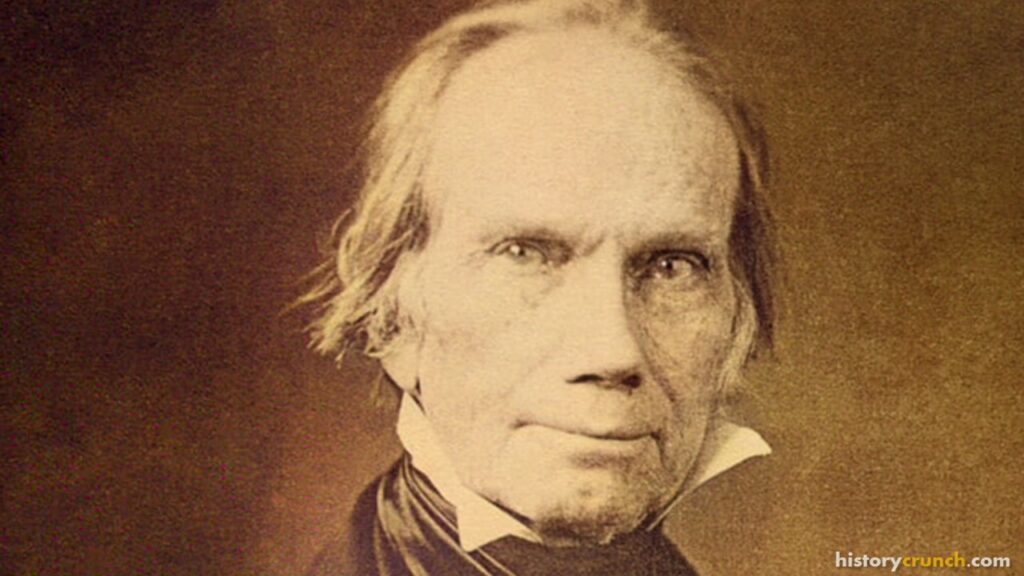
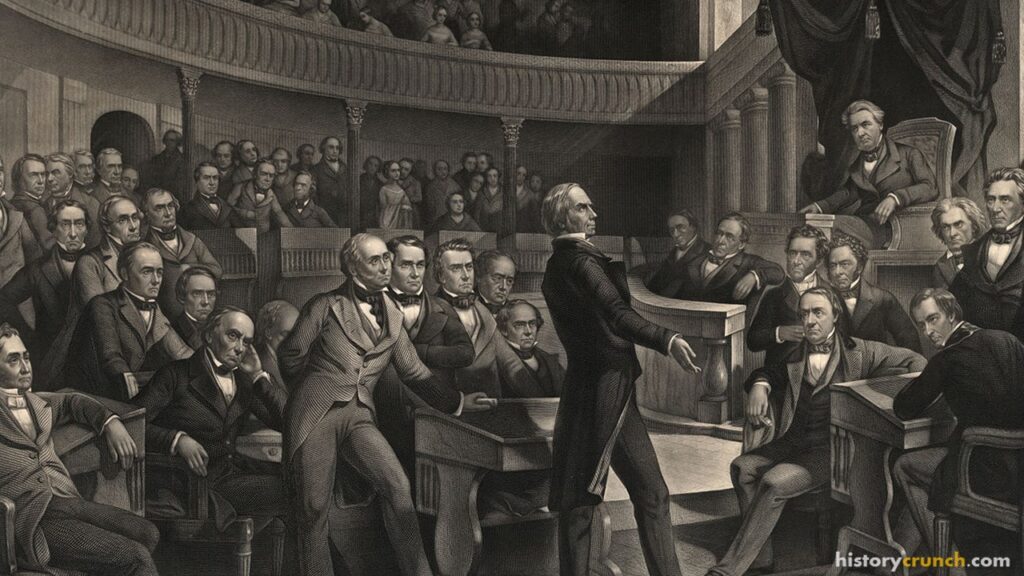
To overcome this political divide, a compromise was proposed that became known as the Missouri Compromise. An important figure in the Missouri Compromise was Henry Clay. Clay was a lawyer who also was a representative for the state of Kentucky in the House of Representatives and the Senate. During the timeframe of the Missouri Compromise, which was 1819 to 1820, Clay also served as the Speaker of the House. From this role, Clay proposed a compromise to Missouri’s statehood and slavery problem.
Clay argued that Missouri should be added as a ‘slave’ state, while Maine should be added as a ‘free’ state. At the time, Maine had wanted to separate from Massachusetts and gain its own statehood. Clay argued that the addition of Maine as a ‘free’ state alongside Missouri as a ‘slave’ state would maintain the balance in the country. Furthermore, the compromise also included a rule that no new slave states could be added in the western regions of the Louisiana Territory that were located north of the latitude ‘36°30’ line. The bill of the Missouri Compromise was eventually passed in March of 1820 and signed by President James Monroe on March 6th, 1820.
SIGNIFICANCE OF THE MISSOURI COMPROMISE
The Missouri Compromise of 1820 was a vitally important event in American history of the 19th century. It highlighted the growing divide in the country over the issue of slavery. In fact, while some viewed the Missouri Compromise of 1820 a success at maintaining peace within the United States, others thought that it was delaying an eventual conflict between those who supported slavery and those who were against it. For instance, In April of that year, Thomas Jefferson commented that:
“This momentous question, like a fire bell in the night, awakened and filled me with terror. I considered it at once as the knell of the Union. it is hushed indeed for the moment. but this is a reprieve only, not a final sentence. A geographical line, coinciding with a marked principle, moral and political, once conceived and held up to the angry passions of men, will never be obliterated; and every new irritation will mark it deeper and deeper.”
As such, many historians view the Missouri Compromise of 1820 as an imperfect piece of legislation that eventually led to the outbreak of violence with events, such as Bleeding Kansas and the American Civil War. For example, tensions surrounding slavery eventually resurfaced with the Compromise of 1850 and the Kansas-Nebraska Act.
END OF THE MISSOURI COMPROMISE
The provisions of the Missouri Compromise lasted until 1854 and the passage of the Kansas-Nebraska Act. At the time, there was a conflict over whether slavery should be allowed in the new state of Kansas. Furthermore, the federal government of the United States also wanted to create the Transcontinental Railroad, which would pass through the new state of Kansas. With these issues, the Kansas-Nebraska Act was created to help solve some of the issues and conflicts facing the country. Essentially, the Kansas-Nebraska Act of 1854, proposed a solution in which two new states would be created: Nebraska and Kansas. This would solve the crisis in that one state (Nebraska) would be located above the 36°30’ line, while Kansas would be located below. Essentially, the main issue at the time, was the limitation of the 36°30’ line that was created in the Missouri Compromise of 1820. Therefore, Nebraska would lie above the latitudinal line (and be a ‘free’ state) while Kansas would reside below (and be a slavery state). Furthermore, it was proposed that the Missouri Compromise of 1820 be abolished, and instead individual states would get to decide if they would allow slavery or not. This idea became known as ‘popular sovereignty’. As such, with the passage of the Kansas-Nebraska Act in 1854, the Missouri Compromise of 1820 was effectively ended.