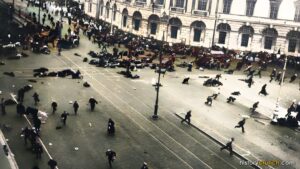
Bloody Sunday of 1905, which is also sometimes referred to as ‘Red Sunday’ occurred on January 22nd, 1905. It was an important event in Russian history and played a significant role in the outbreak of the Russian Revolution of 1917. The events of Bloody Sunday marked a turning point in the relationship between the Russian people and the autocratic government of Tsar Nicholas II. This article explores the causes, major events, and significance of Bloody Sunday, shedding light on its profound impact on the course of the Russian Empire and its journey towards revolution.
What Caused Bloody Sunday of 1905?
Historians have identified several significant causes for the events of Bloody Sunday. These include: the lingering effects of economic hardship on Russian peasants, social inequalities, the governance of Tsar Nicholas II, the failure of the Russo-Japanese War and growing political unrest in Russia in the late 19th and early 20th centuries.
At the start of the 20th century, Russian peasants and the working class often faced difficult lives that were marked by poverty. Furthermore, workers often endured harsh working conditions, low wages, and lacked basic labor rights. This created a climate of anger among many Russians who wanted to see change and improvements to their way of life. As such, this created political unrest among the people of Russia and pushed many to want to revolt, such as in the events of Bloody Sunday.
Furthermore, Tsar Nicholas II maintained a repressive autocracy, suppressing political dissent and civil liberties. The absence of a democratic system and the refusal to address the demand for political reforms contributed to widespread anger and frustration among many Russians.
The defeat in the Russo-Japanese War (1904-1905) exposed the weaknesses of the Russian military and undermined the government’s credibility. The war further fueled public anger as Russians faced economic hardships and military setbacks.
Finally, revolutionary ideas were simmering among various parts of society, including industrial workers, peasants, and intellectuals. Socialist and revolutionary ideologies gained traction, setting the stage for mass protests.

Major Events of Bloody Sunday of 1905
On January 22nd, 1905, thousands of peaceful demonstrators, including workers, their families, and intellectuals, marched towards the Winter Palace in St. Petersburg, Russia. The march aimed to present a petition to Tsar Nicholas II, calling for political reforms, improved working conditions, and civil liberties.
However, the peaceful march turned into a massacre when the Imperial Guards of Nicholas II opened fire on the unarmed protesters. Estimates of the casualties vary, but hundreds were killed, and thousands were injured. The violence of Bloody Sunday shocked the nation and intensified anti-government sentiments.
Bloody Sunday had a profound impact on public opinion. The brutality of the government’s response led to widespread anger and fueled a wave of strikes and protests across Russia. Workers in various industries went on strike, demanding better conditions and political reforms.

Significance of Bloody Sunday of 1905
Bloody Sunday was an incredibly significant event for the history of Russia and was one of the major steps towards the eventual Russian Revolution of 1917. For instance, it highlighted the growing anger and frustration that many Russians had for the tsar. The use of force against peaceful demonstrators essentially destroyed any goodwill that Nicholas II had among his people.
The events of Bloody Sunday also gave rise to various revolutionary movements, including the Social Democrats and Social Revolutionaries. The massacre contributed to the radicalization of political forces, setting the stage for the Russian Revolution of 1917.
In response to the unrest, Tsar Nicholas II reluctantly agreed to establish the State Duma, a legislative body with limited powers. While the Duma represented a concession to demands for political reforms, it fell short of creating a constitutional monarchy.
Most importantly, the events of Bloody Sunday served as a precursor to the larger revolutionary events that unfolded in 1917. The anger and demands voiced by the protesters in 1905 persisted and resurfaced in the February Revolution of 1917 and the eventual end of the Romanov dynasty.