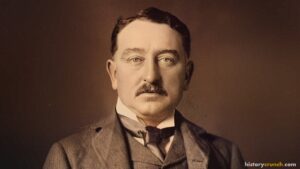
Jimmy Carter was the 39th president of the United States, serving from January 20th, 1977, to January 20th, 1981, and he is remembered for the Camp David Accords, the energy crisis of the 1970s, the Iran Hostage Crisis, and his long post-presidency focused on peace and human rights. Due to the timeframe of his presidency he was also important in the overall Cold War.
JIMMY CARTER – EARLY LIFE
James Earl Carter Jr. was born on October 1st, 1924, in Plains, Georgia. He grew up in a rural farming community, and his early life was shaped by family, religion, and small-town southern culture. After attending local schools, he studied at Georgia Southwestern College and the Georgia Institute of Technology before receiving an appointment to the United States Naval Academy at Annapolis. He graduated in 1946 and began a career in the United States Navy.
Carter’s naval service was an important part of his early development. He eventually served in the nuclear submarine program and was influenced by Admiral Hyman Rickover, who became an important model for discipline and high standards. However, after the death of his father, Carter returned to Plains to help manage the family peanut business. Therefore, before entering national politics, he had experience in both military service and small-town business life.
JIMMY CARTER – RISE IN POLITICS
Carter first built his political reputation in Georgia. For instance, he became active in community affairs, then won election to the Georgia Senate in 1962. He lost a campaign for governor in 1966, but he stayed involved in public life and later won the governorship, taking office on January 12th, 1971. As governor of Georgia, he pushed government reorganization, education improvements, criminal justice reform, mental health programs, and greater civil rights protections.
Carter’s rise mattered because he presented himself as a new kind of Democrat during a time when many Americans were frustrated with national politics. In the years after the Watergate Scandal, he campaigned as an outsider who promised honesty, efficiency, and moral seriousness in government. This message helped him win the presidential election of 1976.
JIMMY CARTER – PRESIDENT OF THE UNITED STATES
Jimmy Carter became president on January 20th, 1977. His administration quickly faced several serious problems, including inflation, energy shortages, Cold War pressures and instability overseas. One of his main domestic priorities was energy policy. Carter treated the energy crisis as a major national problem and pushed for conservation and government action, including the creation of the Department of Energy. Even so, many Americans continued to associate his presidency with economic frustration and a sense of national unease.
In foreign policy, Carter achieved one of the most important diplomatic successes of the era. In September of 1978, he helped bring together Egyptian President Anwar Sadat and Israeli Prime Minister Menachem Begin at Camp David. The Camp David Accords created the framework for the peace treaty signed between Egypt and Israel in March of 1979. This was significant because it produced a major breakthrough in the Middle East and became the most famous foreign-policy achievement of Carter’s presidency.
Carter also remained involved in Cold War diplomacy with the Soviet Union. During his presidency, SALT II continued the effort to limit strategic nuclear weapons, and Carter signed the agreement with Soviet leader Leonid Brezhnev on June 18th, 1979. However, the treaty was never ratified by the United States Senate after the Soviet invasion of Afghanistan later that year. Therefore, Carter’s presidency included both efforts at détente and the return of greater Cold War tension.
At the same time, Carter’s presidency was badly damaged by the Iran Hostage Crisis. On November 4th, 1979, Iranian students seized the United States Embassy in Tehran, Iran and held American diplomats hostage. The crisis lasted 444 days and became one of the defining issues of Carter’s final year in office. It also hurt his public image because many Americans saw the situation as a sign of American weakness and presidential failure. The hostages were finally released on January 20th, 1981, after Ronald Reagan had been sworn in as president.
Jimmy Carter lost the election of 1980 to Ronald Reagan after serving only one term. His presidency was often judged harshly at the time because of inflation, the hostage crisis, and broader public dissatisfaction. However, later historians and commentators have often taken a more balanced view, noting that Carter faced unusually difficult circumstances and pursued several important long-term goals with determination.
JIMMY CARTER – LATER YEARS AND DEATH
After leaving office, Carter built one of the most active and influential post-presidencies in American history. Following his defeat in 1980, he founded the Carter Center in Atlanta, which became known for work related to peace, democracy, election monitoring, health, and human rights. In 2002, he received the Nobel Peace Prize for his decades of work to find peaceful solutions to international conflicts and to advance democracy, human rights, and social development. As such, many people came to admire Carter even more after his presidency than during it. For instance, Carter often gave much of his time to supporting causes such as Habitat for Humanity.
Jimmy Carter died on December 29th, 2024, at his home in Plains, Georgia, at the age of 100. He was the longest-lived president in American history. His death led to widespread recognition of both his presidency and his humanitarian work in the decades that followed.
JIMMY CARTER – SIGNIFICANCE
Jimmy Carter was significant because he represented a transitional moment in modern American history. He led the country during a difficult time marked by economic troubles, energy concerns, and Cold War uncertainty, and he helped achieve an important Middle East peace agreement through the Camp David Accords.
At the same time, Carter remains a debated historical figure. Some people focus on the problems of his presidency, especially the Iran hostage crisis and the economic struggles of the late 1970s. Others emphasize his integrity, his commitment to human rights, and his extraordinary post-presidential work. Regardless, Jimmy Carter stands out as both a major Cold War-era president and one of the most influential former presidents in American history.