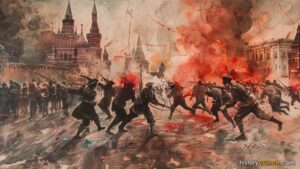
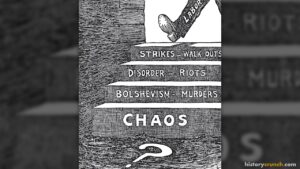
The Red Terror was a period of intense political violence and repression that took place in Soviet Russia after the events of the Russian Revolution of 1917. Beginning in the aftermath of the Bolshevik seizure of power of Russia in 1917, the Red Terror unfolded as a series of events from August, 1918 to February, 1922. For example, the Red Terror aimed at eliminating political opposition to the Bolsheviks. This article explores the history and significance of the Red Terror, especially in relation to the Russian Revolution.
What Caused the Red Terror?
In general, the Red Terror emerged as a result of the Russian Revolution of 1917 and the Russian Civil War. The revolution and resulting civil war plunged the country into a period of violence as the Bolsheviks (led by Vladimir Lenin) attempted to establish socialist principles based on Marxist-Leninism. However, the country was in chaos due to a civil war between the Bolsheviks (Reds) and their opponents (Whites), along with foreign interventions.
Further to this idea, The Bolsheviks were deeply concerned about the possibility of counter-revolution, where anti-Bolshevik forces might overthrow the socialist government. This fear intensified as the Civil War escalated, leading to a perception that severe measures were necessary to eliminate any potential threat to the revolutionary state.

Formation of the Cheka and the Red Terror
The All-Russian Extraordinary Commission for Combating Counter-Revolution and Sabotage, known as the Cheka, was established in December of 1917. Initially created to combat counter-revolution, it evolved into a formidable instrument of repression during the Red Terror. In fact, It became a powerful and feared organization.
In September of 1918, the Bolshevik government issued a decree which set the events of the Red Terror in motion. This decree granted the Cheka extraordinary powers, including the authority to execute individuals suspected of counter-revolutionary activities without a trial.

Repression in the Red Terror
As stated above, the Red Terror was a time of political repression in Russia. Repression refers to the use of governmental power to control or silence dissent, opposition, or political activism. This can involve censorship, restrictions on free speech, arrests, imprisonment, and other measures to limit the activities of individuals or groups perceived as a threat to the ruling authority. For instance, the Bolsheviks carried out several aspects of repression during the Red Terror, including: executions, arrests, and forced labor.
The Red Terror was characterized by mass executions. Suspected counter-revolutionaries, former Tsarist officials, intellectuals, and other perceived enemies of the state were executed without a trial, which contributed to a climate of terror and intimidation.
Also, thousands of Russian citizens faced arrests and imprisonment during the Red Terror. The Cheka operated with a broad mandate, leading to widespread detentions based on political beliefs or associations.
Finally, the Red Terror also saw the establishment of forced labor camps and mass deportations of certain individuals. For instance, those deemed threats to the state were sent to these camps or exiled to remote regions, leading to immense human suffering.
Significance of the Red Terror
The Red Terror played an important role in strengthening Bolshevik power over Russia during a violent and difficult time. By eliminating opposition and instilling fear, the Bolsheviks sought to secure their hold on the state and prevent any challenges to their revolutionary agenda. For instance, it contributed to the development of a highly centralized and authoritarian state, setting the stage for future political practices and repression under leaders like Joseph Stalin.