Moctezuma II was the ninth and most significant emperor of the Aztec Empire. Coming to power in 1502, he expanded the empire to its greatest extent and ruled over one of the most powerful civilizations in the Americas. He is best remembered today for being the Aztec ruler at the time of the Spanish conquest, and for his controversial response to the arrival of Hernan Cortes in 1519. His reign ended in 1520 under circumstances that remain debated by historians to this day. This infographic was designed for students to visually summarize the key aspects of Moctezuma II’s life and significance and is based on the History Crunch article titled Moctezuma II.
Moctezuma II – Infographic
About This Infographic
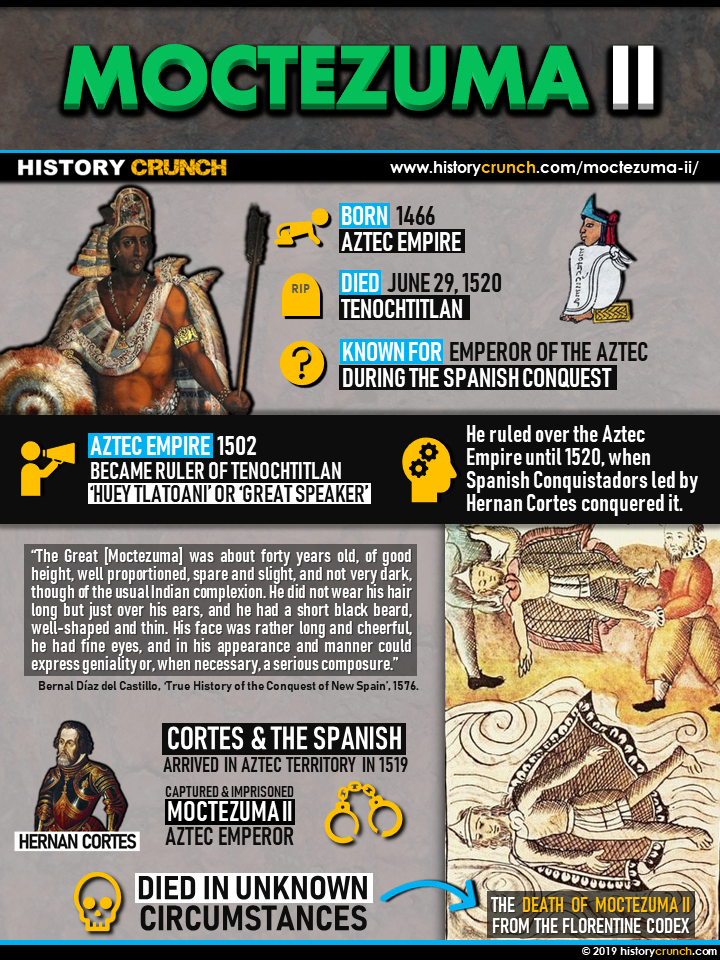
This Moctezuma II infographic was created by the History Crunch team to help students and teachers quickly understand the life and significance of the most famous ruler of the Aztec Empire. It is designed as a visual learning and study tool, summarizing the essential information covered in our full article on Moctezuma II. Teachers may use it as a classroom display, a discussion prompt, or a study aid for students preparing for assessments.
What This Infographic Covers
Moctezuma II became the ninth tlatoani and ruler of Tenochtitlan in 1502, taking over an already powerful empire and expanding it even further. During his early reign he continued the campaigns of conquest that had characterized the Aztec Empire under his predecessors, adding several new Mesoamerican city-states to the empire. He also strengthened Aztec society internally, reinforcing the social class system and making it more difficult for commoners to move up in status. As tlatoani he was treated with enormous reverence — he was carried by guards so that his feet would not touch the ground, and commoners were not permitted to look directly at him. He built new temples and public buildings in Tenochtitlan and oversaw a period of significant growth and power for the Aztec Empire. However, bitter rivals including the Tlaxcala and Huexotzinco remained unconquered, continuing the ongoing ritual conflict known as the Flower Wars.
The infographic covers the defining event of Moctezuma II’s reign: the arrival of Hernan Cortes and the Spanish conquistadors in 1519. Moctezuma II had been aware of Spanish presence on the edges of Aztec territory since 1517 and had monitored their movements carefully. When Cortes arrived in 1519, Moctezuma II faced a difficult decision about how to respond. His uncertainty was compounded by an Aztec prophecy about the return of the god Quetzalcoatl, who was said to have white skin and was predicted to arrive at approximately the same time as the Spanish. Unsure of whether Cortes was the god or a human enemy, Moctezuma II chose to receive him with gifts and honor rather than military resistance, allowing the Spanish to enter Tenochtitlan as guests.
The infographic also covers the capture and imprisonment of Moctezuma II by Cortes. Shortly after arriving in Tenochtitlan, Cortes took Moctezuma II captive and used him to control the city and the empire. Moctezuma II continued to rule in name from his imprisonment, but the Aztec nobility and religious leaders grew increasingly angry, viewing their emperor as weak for allowing the Spanish to take over. This anger among the Aztec people would eventually contribute to the chaos that followed.
Finally the infographic covers the disputed death of Moctezuma II. Spanish accounts claim he was killed by his own people while trying to calm an Aztec uprising against the Spanish. Aztec accounts claim he was killed by the Spanish themselves as they fled the city during Noche Triste. Historians remain unsure which account is true. Regardless, his death destabilized Aztec leadership at a critical moment and contributed significantly to the eventual fall of the empire in 1521.
How to Use This Infographic in the Classroom
This infographic works well as a visual introduction to Moctezuma II before students read the full biography article. It can also be used as a review tool before an assessment, or as a discussion prompt asking students to evaluate whether Moctezuma II made the right decisions in responding to the Spanish arrival, and what alternatives he might have chosen. Teachers may also use it alongside the Spanish Conquest of the Aztec Empire infographic and the Hernan Cortes infographic to give students a complete picture of the conquest from multiple perspectives.
Related Articles
To learn more about the topics covered in this infographic, visit the following History Crunch articles:
- Moctezuma II
- Aztec Empire Overview
- Spanish Conquest of the Aztec Empire
- Hernan Cortes
- Aztec Emperors
- Flower Wars in the Aztec Empire
- Aztec Omens
- Quetzalcoatl
- Noche Triste
- Tenochtitlan