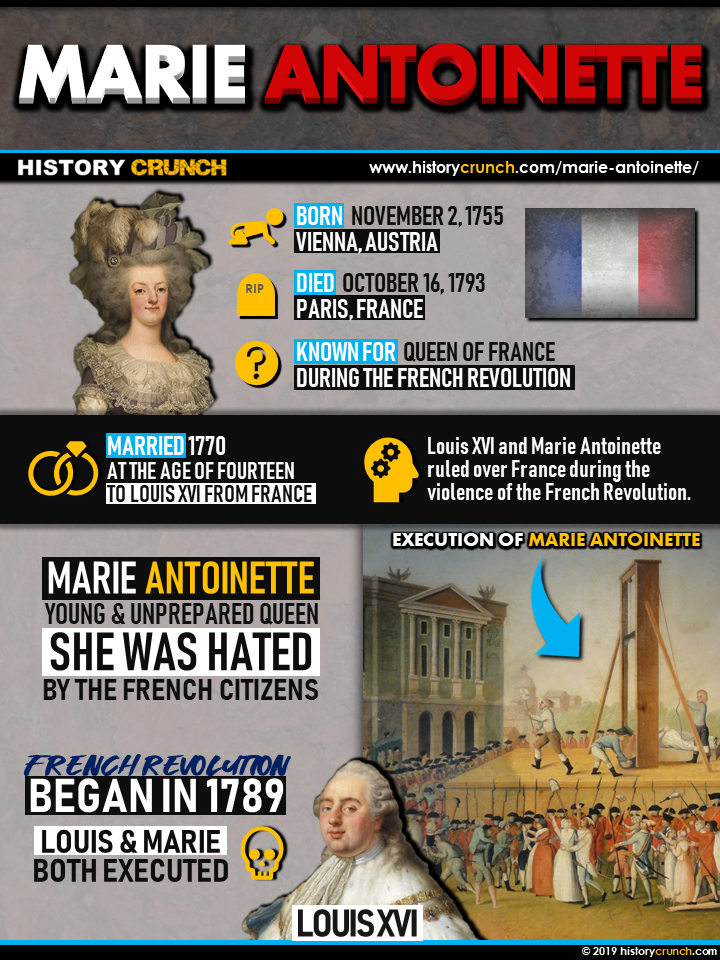
Marie Antoinette was the Queen of France as the wife of King Louis XVI and one of the most iconic and controversial figures of the French Revolution. Born on November 2nd, 1755 at the Hofburg Palace in Vienna, Austria, she was married to the future King of France at the age of 14 in a politically arranged union designed to strengthen the alliance between France and Austria. She became queen in 1774 and quickly became a symbol of the perceived extravagance and inequality of the French monarchy. She was executed by guillotine on October 16th, 1793, nine months after the execution of her husband. This infographic was designed for students to visually summarize the key aspects of Marie Antoinette’s life and significance and is based on the History Crunch article titled Marie Antoinette.
Marie Antoinette – Infographic
About This Infographic
This Marie Antoinette infographic was created by the History Crunch team to help students and teachers quickly understand the life and significance of one of the most famous figures of the French Revolution. It is designed as a visual learning and study tool, summarizing the essential information covered in our full article on Marie Antoinette. Teachers may use it as a classroom display, a discussion prompt, or a study aid for students preparing for assessments.
What This Infographic Covers
The infographic begins with Marie Antoinette’s early life and background. She was born on November 2nd, 1755 at the Hofburg Palace in Vienna, Austria, the daughter of the Emperor and Empress of Austria. She grew up in the Austrian royal court and received the kind of education typical for an aristocratic girl of the 18th century. In 1770, at the age of 14, she married the future Louis XVI of France in a politically arranged union designed to strengthen the alliance between France and Austria. She became Dauphine of France upon her marriage and Queen of France in 1774 when Louis XVI inherited the throne from his grandfather Louis XV.
The infographic covers her growing unpopularity in France. During the early years of her marriage, Marie Antoinette struggled to adapt to life at the French court and became the target of widespread criticism and rumors. Her youth and fondness for extravagant spending on jewels, clothes and parties did not sit well with the working class people of France who were struggling under the burden of the Estates System. She earned the nickname Madame Deficit as the French people began to blame her for the country’s financial woes. In 1785 she was falsely accused of purchasing an enormously expensive diamond necklace, and though she was eventually proved innocent, the scandal further destroyed her reputation. Pamphlets and cartoons attacking her character spread widely across France, and by the time the French Revolution began in 1789 she had become one of the most hated figures in the country.
The infographic covers her role during the revolution. Following the storming of the Bastille in 1789, the royal family was forced to return to Paris from Versailles after a mob of Parisian working class women marched to the palace in protest. Louis XVI and Marie Antoinette were effectively held as prisoners in the Tuileries Palace in Paris. In June 1791, the royal family attempted to flee France in secret, disguised as servants, hoping to reach Austria and gather foreign support against the revolution. The carriage was stopped in the small town of Varennes and the family was recognized and returned to Paris. This failed flight was decisive in convincing revolutionaries that Marie Antoinette was a traitor acting on behalf of Austria against France.
The infographic concludes with her trial and execution. Following the abolition of the monarchy and the execution of Louis XVI in January 1793, Marie Antoinette was imprisoned and eventually put on trial in October 1793 on charges of treason. She was convicted and executed by guillotine on October 16th, 1793 at the Place de la Revolution in Paris. She was 37 years old at the time of her death. Her execution, along with that of Louis XVI, marked the definitive end of the French monarchy and became one of the most dramatic and defining moments of the French Revolution.
How to Use This Infographic in the Classroom
This infographic works well as a visual introduction to Marie Antoinette before students read the full biography article. It can also be used as a discussion prompt asking students to consider the extent to which Marie Antoinette was personally responsible for the anger of the French people, or whether she was primarily a symbol onto which existing resentments about the monarchy and inequality were projected. It pairs particularly well with the Louis XVI infographic and the French Revolution Overview infographic to give students a complete picture of the royal family’s role in the events of the revolution.
Related Articles
To learn more about the topics covered in this infographic, visit the following History Crunch articles:
- Marie Antoinette
- Louis XVI
- French Revolution Overview
- Causes of the French Revolution
- Estates System of France
- Reign of Terror
- Execution of Louis XVI
- Guillotine and the French Revolution
- Palace of Versailles
- National Convention