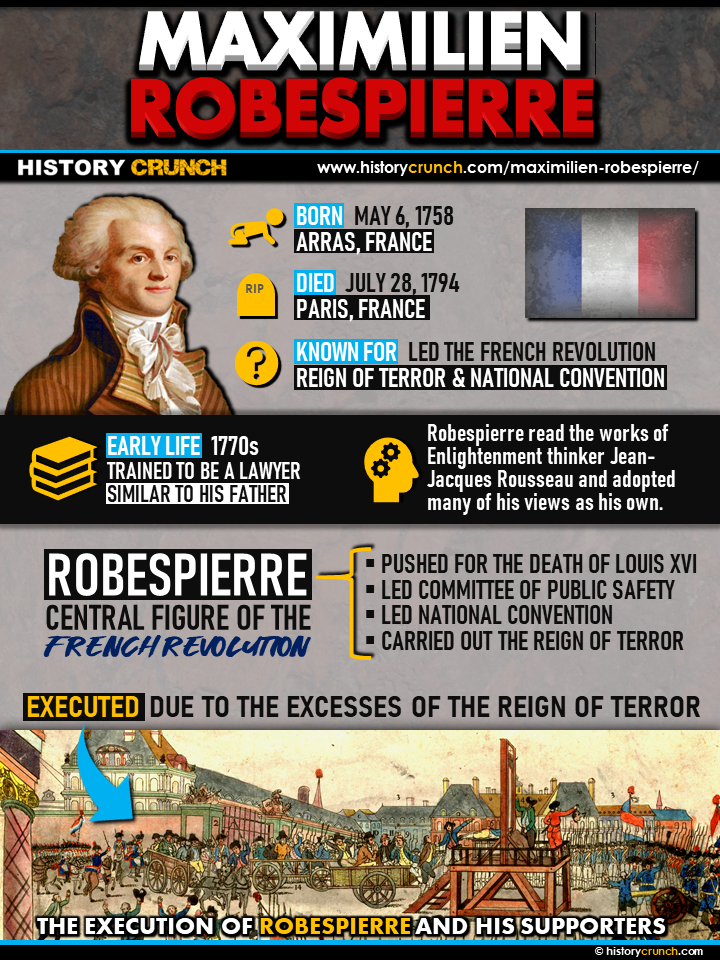
Maximilien Robespierre was one of the most powerful and controversial figures of the French Revolution. Born on May 6th, 1758 in Arras, France, he rose from a modest background to become the dominant force behind the most violent phase of the revolution, leading the Committee of Public Safety and overseeing the Reign of Terror from 1793 to 1794. Known as the Incorruptible for his unwavering commitment to his principles, Robespierre helped transform France from a monarchy to a republic before his own arrest and execution by guillotine on July 28th, 1794 ended the Terror. This infographic was designed for students to visually summarize the key aspects of Robespierre’s life and significance and is based on the History Crunch article titled Maximilien Robespierre.
Maximilien Robespierre – Infographic
About This Infographic
This Maximilien Robespierre infographic was created by the History Crunch team to help students and teachers quickly understand the life and significance of one of the most important and debated figures of the French Revolution. It is designed as a visual learning and study tool, summarizing the essential information covered in our full article on Maximilien Robespierre. Teachers may use it as a classroom display, a discussion prompt, or a study aid for students preparing for assessments.
What This Infographic Covers
The infographic begins with Robespierre’s early life and background. He was born on May 6th, 1758 in Arras, in the Artois region of France, the oldest of four children. His mother died in 1764 and his father abandoned the family to travel Europe, leaving Robespierre and his siblings to be raised by their paternal aunts. Showing academic promise from an early age, he trained as a lawyer, following in his father’s footsteps. During his education he was exposed to the ideas of the Age of Enlightenment and was deeply influenced by the writings of Jean-Jacques Rousseau, whose ideas about the rights and capacities of ordinary people shaped Robespierre’s political outlook throughout his life. His strong and unwavering commitment to his principles earned him the enduring nickname the Incorruptible.
The infographic covers Robespierre’s rise through the early stages of the French Revolution. When Louis XVI called the Estates-General in May 1789, Robespierre was elected as a representative of the Third Estate. He helped establish the National Assembly and frequently spoke about his ideals of liberty and equality, with his speeches influencing the principles of the Declaration of the Rights of Man and of the Citizen. Following the National Assembly, he joined the radical Jacobin Club and worked as a public prosecutor in Paris. He opposed the war against Austria that was debated in the Legislative Assembly, arguing that the revolution needed to focus on internal threats rather than foreign wars. When the more radical National Convention replaced the Legislative Assembly, Robespierre was elected as first deputy for Paris and quickly became one of its most influential members. He famously declared that Louis XVI must die so the nation may live, and the king was executed by guillotine on January 21st, 1793.
The infographic covers Robespierre’s role in the Reign of Terror, the most violent phase of the French Revolution. He became the head of the Committee of Public Safety, the executive body of the National Convention, and used this position to direct the Reign of Terror from September 1793 to July 1794. Under his leadership, thousands of people were arrested, tried and executed by guillotine as perceived enemies of the revolution. No one was safe from suspicion. Even fellow revolutionaries were targeted, including the prominent revolutionary Georges Danton, who was guillotined after calling for an end to the Terror. Robespierre was elected president of the National Convention on June 4th, 1794, reaching the peak of his power.
The infographic concludes with Robespierre’s downfall and execution. His growing power and increasingly erratic behavior, including his announcement of a new state religion called the Supreme Being and his threats to release a list of enemies within the convention, alarmed his fellow revolutionaries. The National Convention voted to arrest him. On July 28th, 1794, soldiers stormed where he was staying and Robespierre attempted to shoot himself in the head but only succeeded in shattering his jaw. He was held captive for the rest of the day and guillotined without a trial that afternoon. His death ended the Reign of Terror and led to the replacement of the National Convention by the more moderate Directory in 1795.
How to Use This Infographic in the Classroom
This infographic works well as a visual introduction to Robespierre before students read the full biography article. It can also be used as a discussion prompt asking students to consider whether Robespierre was a true defender of the revolution who went too far, or whether his actions during the Reign of Terror made him a tyrant no different from the monarchy he helped overthrow. Teachers may also use it alongside the French Revolution Overview infographic and the Reign of Terror article to give students a complete picture of the most violent phase of the revolution.
Related Articles
To learn more about the topics covered in this infographic, visit the following History Crunch articles:
- Maximilien Robespierre
- French Revolution Overview
- Jacobins
- National Convention
- Committee of Public Safety
- Reign of Terror
- Execution of Louis XVI
- Guillotine and the French Revolution
- Directory
- Louis XVI
- Marie Antoinette