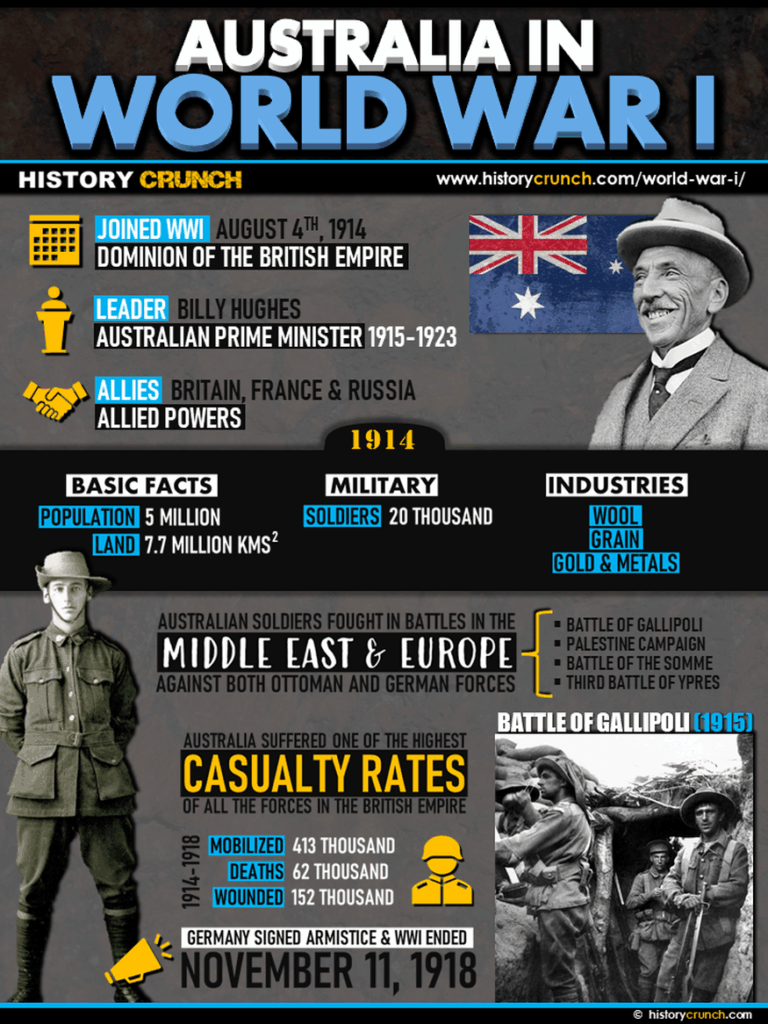
Australia played a significant and often overlooked role in World War I. As a Dominion of the British Empire, Australia was automatically drawn into the war when Britain declared war on Germany on August 4th, 1914. Over the course of the conflict more than 413,000 Australians served and approximately 62,000 died, representing some of the highest casualty rates by percentage of any nation involved in the war. Australian forces fought across multiple theaters including German New Guinea, the Gallipoli Peninsula, the Middle East and the Western Front in Europe. This infographic was designed for students to visually summarize Australia’s role in World War I and is based on the History Crunch article titled Australia in World War I.
Australia in World War I – Infographic
About This Infographic
This Australia in World War I infographic was created by the History Crunch team to help students and teachers quickly understand the significance of Australia’s contribution to the First World War. It is designed as a visual learning and study tool, summarizing the essential information covered in our full article on Australia in World War I. Teachers may use it as a classroom display, a discussion prompt, or a study aid for students preparing for assessments.
What This Infographic Covers
The infographic begins with why Australia entered the war. In 1914 Australia was a Dominion of the British Empire, meaning it was a partially independent nation under the wider control of Britain. When Britain declared war on Germany, Australia was automatically pulled into the conflict. Support for the war was widespread across Australia due to strong ties of national identity to Britain. Prime Minister Joseph Cook stated that when the Empire is at war so is Australia at war, and offered Britain a force of 20,000 men before Britain had even officially declared war. Opposition leader Andrew Fisher made his famous pledge that Australians would stand beside the mother country to help and defend her to the last man and the last shilling. To mobilize for war, Cook created the Australian Imperial Force on August 15th, 1914, which became the main armed force Australia deployed throughout the war. Over the course of the conflict more than 413,000 Australians eventually participated.
The infographic covers the major campaigns Australian forces participated in. The first was a series of missions in German-controlled New Guinea in the South Pacific, where Australian forces destroyed German wireless radio stations that were vital to German naval operations. The second and most significant in terms of Australian national identity was the Gallipoli Campaign, which took place from February 1915 to January 1916 on the Gallipoli Peninsula in southeastern Europe near modern-day Turkey. Australian forces formed part of the ANZAC corps alongside New Zealand troops and suffered over 26,000 casualties including 8,100 deaths in a campaign that ultimately failed to achieve its objectives. The Gallipoli Campaign became one of the defining moments in Australian national identity and is commemorated every year on April 25th as ANZAC Day.
Australian forces also participated in the Sinai and Palestinian Campaign in the Middle East from 1915 to 1918, where the ANZAC Mounted Division fought a series of battles against the Ottoman Empire to protect the Suez Canal and British-controlled Egypt. On the Western Front in Europe, Australian forces fought in some of the most significant battles of the entire war including the Battle of the Somme, the Battle of Messines, the Third Battle of Ypres and the Hundred Days Offensive. Australian forces suffered approximately 181,000 casualties on the Western Front alone, including around 46,000 deaths.
The infographic also covers the Australian home front, including the important role of women in supporting the war effort, the use of government propaganda for recruitment and rationing, and the controversial conscription referendums of 1916 and 1917. Unlike other major powers, Australia never introduced conscription. Prime Minister Billy Hughes held two separate referendums on the issue and both narrowly failed, meaning every Australian who fought in World War I was a volunteer.
How to Use This Infographic in the Classroom
This infographic works well as a visual introduction to Australia in World War I before students read the full article. It can also be used as a review tool before an assessment, or as a discussion prompt asking students to consider why the Gallipoli Campaign had such a profound impact on Australian national identity despite being a military failure. Teachers may also use it alongside the WWI map and Western Front map to help students understand the geographic scope of Australia’s contribution to the war.
Related Articles
To learn more about the topics covered in this infographic, visit the following History Crunch articles:
- Australia in World War I
- Gallipoli Campaign
- Western Front of World War I
- ANZAC
- World War I Overview
- Allied Powers of World War I
- Trench Warfare in World War I
- Life in the Trenches
- Battle of the Somme
- Causes of World War I