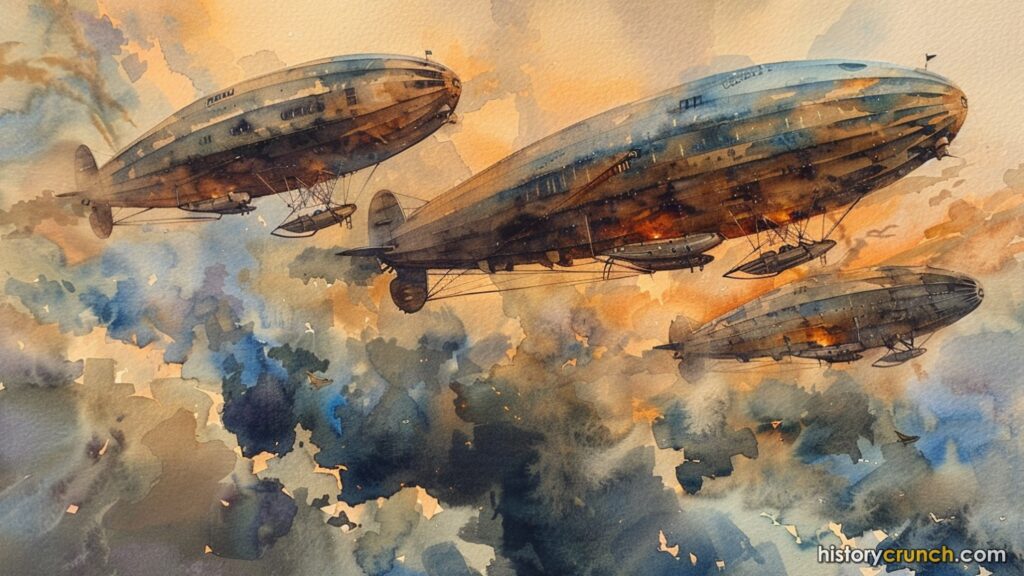
Airships in World War I a significant role alongside other new aircraft technology, such as airplanes. An airship is any aircraft that is ‘lighter-than-air’ and can operate under its own powers. Also commonly known as ‘blimps’, airships were first used in the 19th century and the technology of airship construction continued to improve in the decades before World War I. This included the use of rigid-airships, which had a strong frame under the canopy of the airship. World War I was a deadly conflict as shown by the millions of military and civil casualties it caused.
The large number of casualties was the result, in part, of the development and use of weaponry that took place during the war. In all, airships were one of the most significant weapons of World War I alongside other important weapons, such as: airplanes, machine guns, poison gas, rifles, submarines and tanks.

ROLE OF AIRSHIPS IN WORLD WAR I
Airships in World War I played a variety of important roles. For instance, airships in World War I were primarily used for either reconnaissance missions or bombing runs. Many of the European Powers of World War I used airships for these different purposes. With that said, airships never reached the popularity or versatility of airplanes in World War I. This was due to the limitations of airships in the war.
The first main limitations of the airships in World War I, was that the airships were generally filled with hydrogen, which gave them their ‘lighter-than-air’ quality. While helium was safer, hydrogen was more often used because it was cheaper and more readily available. However, hydrogen is incredibly flammable and when combined with bombs and other weapons from World War I, it made the airships dangerous vehicles on the frontlines. As such, countries generally did not use airships during the frontline battles of World War I.
Second, airships were slow to maneuver and struggled to make quick adjustments, which is often needed in situations of war. This made the targeting capabilities of the airships poor. As such, while some countries used airships on bombing runs, they were most commonly used as lookouts and for reconnaissance of enemy positions.
With all of that noted, Germany still famously used airships (Zeppelins) in World War I as a means of carrying out bombing raids against Britain. These raids first began in 1915 and continued until 1917, when airplanes replaced the airships. The Zeppelin bombing raids had little impact on the militaristic outcome of World War I, but proved effective in terms of creating fear and panic among the general British population. Britain ultimately countered the German bombing raids with effective defensive measures. Regardless, historians estimate that Germany carried out 51 different airship bombing raids in World War I against Britain. In all the raids killed 557 people and injured another 1,358 more.

ZEPPELIN AIRSHIPS IN WORLD WAR I
As stated above, most countries made use of airships during the timeframe of World War I. With that said, likely the most famous airships of World War I were the Zeppelins produced by Germany. In fact, the Zeppelins became so well known that people often used the term Zeppelin as interchangeable for airship.The Zeppelin airships were produced by Ferdinand von Zeppelin, who was a German inventor. He introduced the development of rigid-airships for use in passenger air travel.
However, in World War I, the Zeppelin airships were used extensively by Germany in their bombing raids against Britain. Germany also used the Zeppelins as scouts in the war, in order to keep an eye out for enemy troops and artillery positions.