The Battle of Spotsylvania Court House was an important battle of the American Civil War. It was the second major battle of General Ulysses S. Grant’s Overland Campaign and took place from May 8th to May 21st, 1864, near the town of Spotsylvania Court House in Virginia. The battle lasted nearly two weeks and included some of the most intense fighting of the entire war. In total, the battle resulted in approximately 30,000 casualties on both sides.
What Was the American Civil War?
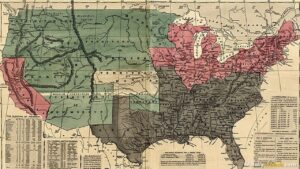
The Battle of Spotsylvania Court House took place during the American Civil War, which was one of the most significant conflicts in the history of the United States. The Civil War was fought between the Northern states, known as the Union, and the Southern states, known as the Confederacy, from 1861 to 1865. The war was mainly fought over the issue of slavery, which had divided the country for many years. By the spring of 1864, General Ulysses S. Grant had been named the overall commander of all Union armies. Grant developed a plan called the Overland Campaign, which was designed to push his army south through Virginia and destroy General Robert E. Lee’s Confederate army. The Battle of Spotsylvania Court House was the second major engagement of this campaign, coming just after the Battle of the Wilderness.
Battle of Spotsylvania Court House – Background and Causes
After two days of fighting in the dense forests of the Wilderness in early May of 1864, Grant made the decision to continue moving his army south rather than retreating. His goal was to reach the small town of Spotsylvania Court House, which sat on the main road toward Richmond, the Confederate capital. If Grant could place his army between Lee’s forces and Richmond, he would force Lee into a difficult position.
Both armies raced to reach Spotsylvania first. Lee’s forces arrived ahead of the Union army and quickly began building a strong network of trenches and fortifications. When the Union forces arrived on May 8th, they found the Confederates already dug in and waiting for them. The first Union attacks on the Confederate position were pushed back with heavy casualties. Both sides continued to build their defensive lines and the battle settled into a series of attacks and counterattacks over the following days.
Battle of Spotsylvania Court House – Major Events
In the first days of the battle, Grant launched several attacks along the Confederate line but was unable to break through. The Confederate fortifications were strong and well-positioned, making it very difficult for the Union forces to advance. During this time, the Union army suffered two significant losses. On May 9th, General John Sedgwick, one of the most respected Union corps commanders, was killed by a Confederate sharpshooter. He was the highest-ranking Union officer to be killed during the entire war. Shortly after, on May 11th, Confederate cavalry commander General J.E.B. Stuart was mortally wounded at a nearby battle called the Battle of Yellow Tavern. Stuart had been one of Lee’s most valuable officers and his death was a serious blow to the Confederate army.
On May 10th, Grant ordered attacks across the entire Confederate line. Most of these attacks failed, but one stood out as particularly significant. A Union officer named Colonel Emory Upton led an attack using a new approach. Instead of advancing in a wide line, Upton organized his soldiers into a compact column and had them rush forward without stopping to fire. This allowed them to reach the Confederate trenches quickly and break through before the defenders could respond. The attack initially succeeded and Union soldiers broke through the Confederate line, but they were eventually pushed back when Confederate reinforcements arrived. Although the attack did not hold its gains, it showed Grant that a large-scale assault using the same approach might be able to break the Confederate line for good.
The Confederate defensive line at Spotsylvania included a large section that bulged outward in the shape of a half-moon. Because of its shape, soldiers called it the Mule Shoe Salient. On May 12th, 1864, Grant organized a massive assault on this section of the Confederate line. He gathered approximately 20,000 soldiers from General Hancock’s Second Corps and prepared them to attack the tip of the Mule Shoe at dawn.
Lee received reports of the Union buildup but made a critical mistake. He believed that Grant was preparing to retreat rather than attack, so he ordered his artillery removed from the salient. When Hancock’s soldiers attacked in the early morning hours of May 12th, they found the Confederate infantry defending the position without artillery support. The attack was immediately successful. In the first hour, Union soldiers broke through the Confederate line and captured approximately 3,000 prisoners and 20 artillery pieces. The Confederate line was nearly split in two.
Lee quickly sent reinforcements into the salient while Grant pushed more soldiers forward. For the next 22 hours, soldiers from both sides fought at extremely close range along the Confederate earthworks. The fighting at one section of the line, which became known as the Bloody Angle, was some of the most intense combat of the entire Civil War. Soldiers fired at each other from just a few feet away, and the fighting often became hand-to-hand. The rain poured throughout the battle and the ground became covered with mud and casualties. During the fighting, musket fire was so heavy that it cut down a large oak tree through the sheer volume of bullets. The Confederates held on throughout the day and night while their engineers built a new defensive line further back. In the early hours of May 13th, the Confederate soldiers pulled back to the new line, ending the fighting at the Bloody Angle.
Battle of Spotsylvania Court House – Aftermath
After the horror of May 12th, the fighting at Spotsylvania continued for several more days. Grant launched additional attacks on the Confederate line on May 18th, but these were pushed back by Confederate artillery fire. By May 21st, Grant concluded that no further progress could be made at Spotsylvania and ordered his army to continue moving south. During the battle, Grant sent a famous message to Washington stating that he intended to fight it out on this line if it took all summer, showing his determination to keep up pressure on Lee regardless of the cost.
In total, the Union suffered approximately 18,000 casualties at Spotsylvania while the Confederates suffered approximately 12,000. Despite the heavy losses, Grant kept his army moving south. The Overland Campaign continued with further battles at Cold Harbor and eventually the long Siege of Petersburg.
Significance of the Battle of Spotsylvania Court House
The Battle of Spotsylvania Court House is remembered as one of the most significant battles of the final year of the American Civil War. The fighting at the Bloody Angle on May 12th stands as one of the most intense single days of combat in the entire war. The battle showed that Grant was committed to keeping pressure on Lee’s army regardless of the losses suffered, which was a very different approach from earlier Union commanders in the Eastern Theater. Each battle of the Overland Campaign cost the Confederate army soldiers and resources it could not replace, while the Union army was able to continue filling its ranks. The Battle of Spotsylvania Court House was an important part of the strategy that would eventually lead to the end of the Civil War in April of 1865.