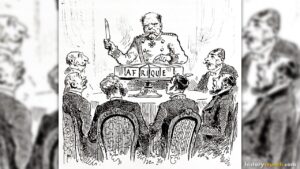
Scramble for Africa

Scramble for Africa

Scramble for Africa: A Detailed Overview

The Scramble for Africa was a major historical event during the time of the
Age of Imperialism. It saw the European powers of the 19th century colonize Africa for its economic opportunities, among other things.
Congo Free State Leopold II

Leopold II and the Congo Free State: A Detailed Summary

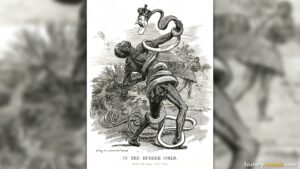
King Leopold II of Belgium ruled over the Congo Free State throughout the period of Imperialism in Africa. Leopold II’s actions in the Congo have come to symbolize the brutality of the period of the Age of Imperialism, and how it created a differing set of legacies for Europe and Africa.

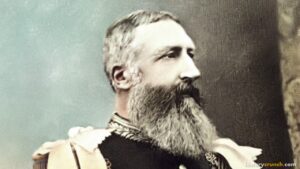
King Leopold II

Leopold II: A Detailed Biography

Leopold II of Belgium was notorious for his brutal exploitation of the Congo Free State in the late 19th and early 20th centuries, where his regime led to widespread atrocities, forced labor, and the deaths of millions of Congolese people.

Social Darwinism

Social Darwinism: A Detailed Summary

Social Darwinism is a theory that applies the concept of ‘survival of the fittest’ from Charles Darwin’s theory of natural selection to human societies, often justifying inequality, imperialism, and social hierarchy. It is most commonly seen in history in terms of economic, the Age of Imperialism and Nazi Germany.

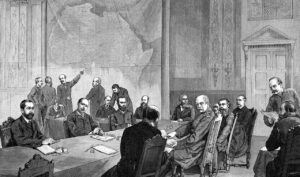
Berlin Conference

Berlin Conference of 1884: A Detailed Summary

The Berlin Conference of 1884 was one of the most important events of the Scramble For Africa. It was a key event in the division of Africa among the European powers and played an important role in the Age of Imperialism.

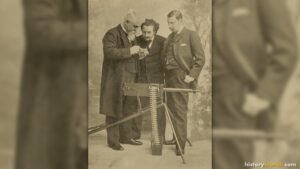
Maxim Gun

Maxim Gun and the Age of Imperialism: A Detailed Summary

The Maxim gun, invented by Hiram Maxim in 1884, was the first fully automatic machine gun, significantly impacting warfare by providing European colonial forces with a powerful weapon that contributed to their dominance during the Scramble for Africa.

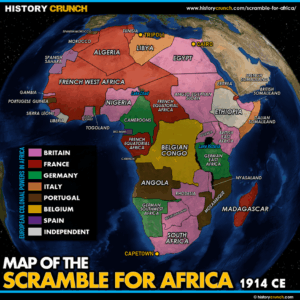
Scramble for Africa Map

Scramble for Africa Map

This Scramble for Africa map was created by History Crunch to help students and teachers understand the geographic extent of European colonization of the African continent between approximately 1870 and 1914. It shows which European powers controlled which regions of Africa and the small number of territories that remained independent. Designed for students in grades 5 to 12.