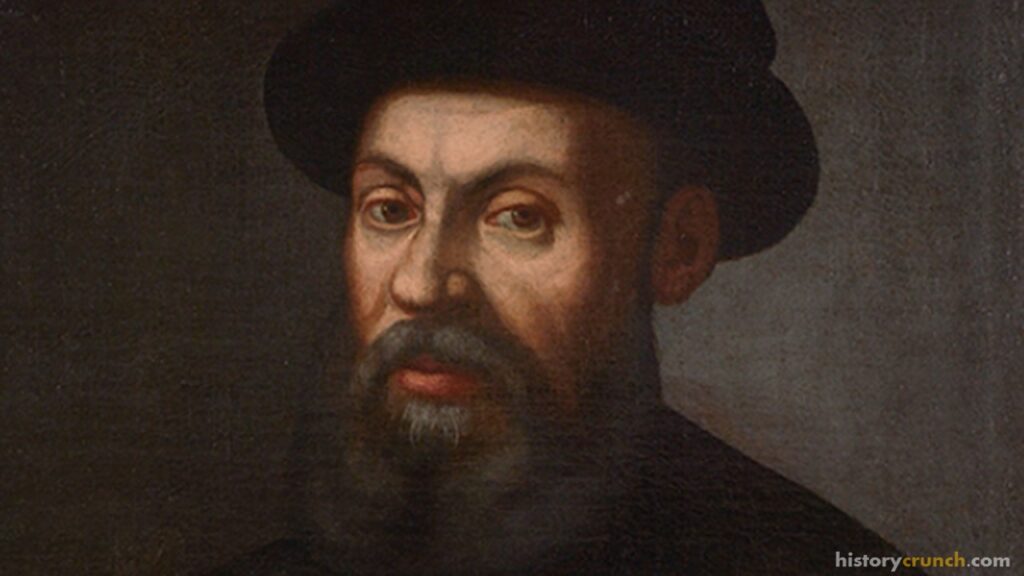
Ferdinand Magellan was one of the most significant figures from the time of the Age of Exploration. He was an explorer and is best known for leading the first expedition to circumnavigate the globe. Although he did not live to complete the journey, his voyage was a significant event in world history. It not only proved that the Earth was round and that all oceans were connected, but it also impacted the history of the world in terms of trade and exploration.
FERDINAND MAGELLAN – EARLY LIFE
Ferdinand Magellan was born around 1480 in Sabrosa, Portugal, into a noble family. The exact date of his birth is unknown. As a young man, he served as a page at the Portuguese court and later joined the navy. This gave him access to an education in navigation, astronomy, and map-reading. All of these were important skills for his future explorations during the Age of Exploration.
In fact, Magellan gained firsthand experience of overseas travel and combat during expeditions to India under Portuguese command. Magellan was a skilful officer with very good navigational skills (his skills have since been acknowledged by naming stars and galaxies after him such as the Martian crater of Magelhaens.) When he was 25 he was enlisted in the fleet of ships that were sent to India. He stayed in India for over 8 years and during that time he participated in many battles.
FERDINAND MAGELLAN – VOYAGE TO CIRCUMNAVIGATE THE EARTH
Upon returning to Europe, as a result of his skills, and bravery in the Indian battles, Magellan was selected by King Charles I of Spain to command the fleet of vessels that set sail for the Maluku Islands, which are located in the modern nation of Indonesia. This move reflected the fierce competition among European powers during the Age of Exploration, as nations sought new routes to Asia and access to lucrative trade in spices, gold, and other goods. In fact, the Maluku Islands are also known as the ‘Spice Islands’, and are known historically for spices such as: nutmeg, mace, and cloves. These spices which fueled European colonial interests in the 16th century.
Regardless, the voyage for the Maluku Islands was set off in order to find a new, and alternative trading route to Christopher Columbus’ route, between Europe and Asia. In fact, Magellan set out to find a western route to the Maluku Islands, bypassing the Portuguese-controlled eastern routes. On September 20th, 1519, Magellan set sail from Seville, Spain with a fleet of five ships and around 270 men.
Magellan’s expedition faced incredible hardships. Furthermore, after crossing the Atlantic and reaching the coast of South America, his fleet searched for a passage through the continent. In October of 1520, they discovered a narrow waterway—later named the Strait of Magellan—which connected the Atlantic to the Pacific Ocean. The crossing was treacherous, but it marked a breakthrough in global navigation.
Once in the Pacific, Magellan underestimated the ocean’s vastness. His ships endured three months of starvation, scurvy, storms and death as they crossed the world’s largest ocean without resupply. Finally, they reached the Maluku Islands in March of 1521. There, Magellan attempted to convert local leaders to Christianity, which was a common goal for many explorers during the period European exploration. However, he became entangled in local conflicts and was killed in the Battle of Mactan on April 27th, 1521.
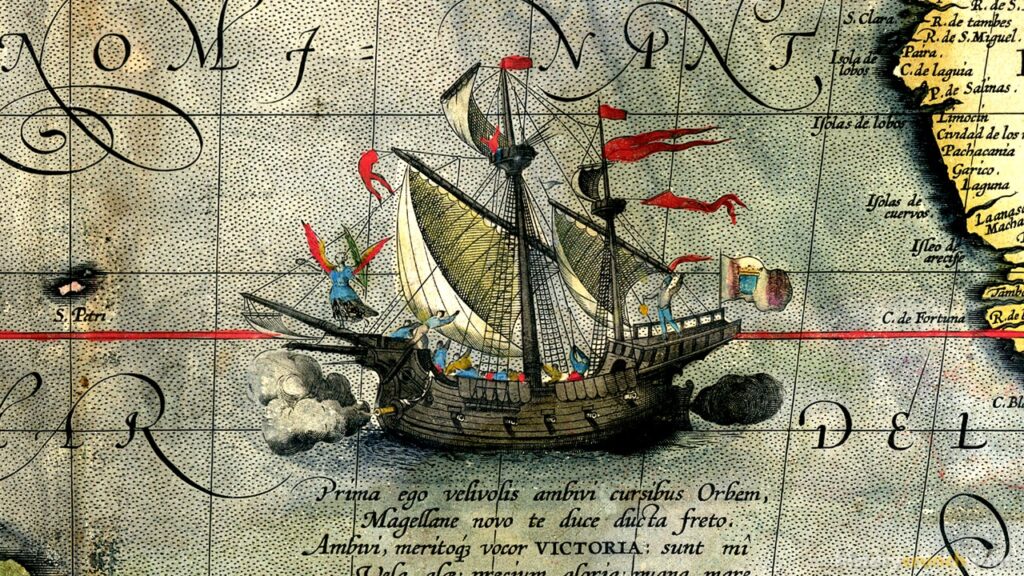
Despite his death, the expedition, now led by Juan Sebastián Elcano, continued westward via the Indian Ocean. One ship, the Victoria, completed the journey and returned to Spain in 1522. This voyage was the first ever circumnavigation of the globe and it was led by Juan Elcano.
FERDINAND MAGELLAN – DEATH AND SIGNIFICANCE
As stated above, Ferdinand Magellan died on April 27th, 1521, as part of the Battle of Mactan. The battle occurred in the Philippines after he attempted to convert native leaders to Christianity. This created a conflict between local groups and Magellan underestimated the resistance of the islanders. As a result, Magellan was struck down by warriors. His death was significant in terms of the expedition, but it continued without him and ultimately completed the first circumnavigation of the globe.
Ferdinand Magellan’s voyage had profound and lasting impacts on the Age of Exploration. Though people had long believed the Earth was round, Magellan’s expedition demonstrated it by sailing continuously west and returning to the starting point. As a result, it confirmed that the world’s oceans were interconnected. This had a significant impact on people’s understanding of the world and cartography.
As well, Magellan’s voyage had a profound impact on the economics of trade and exploration. For instance, by finding a western sea route to Asia, Magellan opened new opportunities for global trade. In fact, Magellan’s success bolstered Spain’s ambitions in the Pacific and Southeast Asia, which ultimately intensified the Spanish-Portuguese rivalry. It also laid the groundwork for the Spanish colonization of the Philippines, which would last for over 300 years.
Finally, the voyage was significant because it highlighted the human cost and harsh reality of life for sailors in the Age of Exploration. For instance, of the original 270 men, only 18 returned to Spain. The high death toll displayed the risks of exploration, which included: shipwreck, storms, disease, starvation, and conflict. In fact, Ferdinand Magellan’s own death highlights the dangers of exploration.