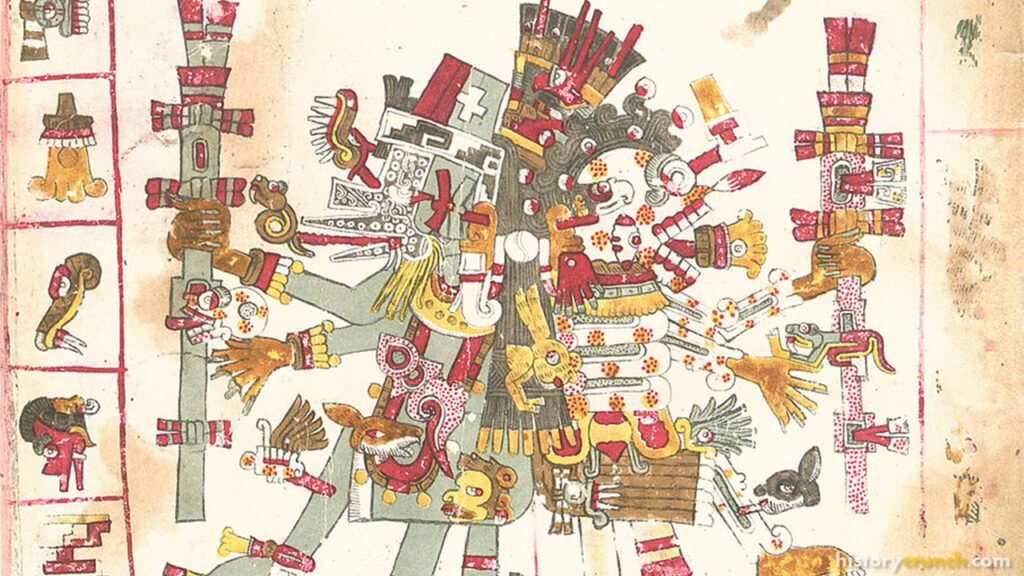
Mictlantecuhtli was the Aztec god of death and the ruler of the underworld, where the Aztec believed that souls journeyed to after death. He was usually shown as a skeletal figure, symbolizing his connection to the afterlife. Mictecacihuatl governed the fate of the dead and played a key role in Aztec beliefs about the afterlife and the cycle of life and death.
AZTEC GODS – OVERVIEW
The concept of ‘god’ in Aztec society is referred to as ‘Teotl’ in Nahuatl, the language of the Aztec. The Aztecs, like other Mesoamerican societies, had a wide pantheon of gods. The gods in the Aztec religion represented different aspects of life and the world for the Aztec people. The aspects that the gods represented included: culture of Aztec society and Mesoamerica, nature and the natural world, creation stories, fertility, food, death and the underworld, trade and excess or entertainment. Each god had different attributes and personality traits and were usually represented in distinct ways by the Aztec. Some could take human or animal form and were celebrated in festivals and rituals. There were many gods in the Aztec religion but some of the most prominent included: Huitzilopochtli, Quetzalcoatl, Tezcatlipoca, Mictlāntēcuhtli, Tlaloc, and Chicomecōātl.
MICTLANTECUHTLI – SUMMARY
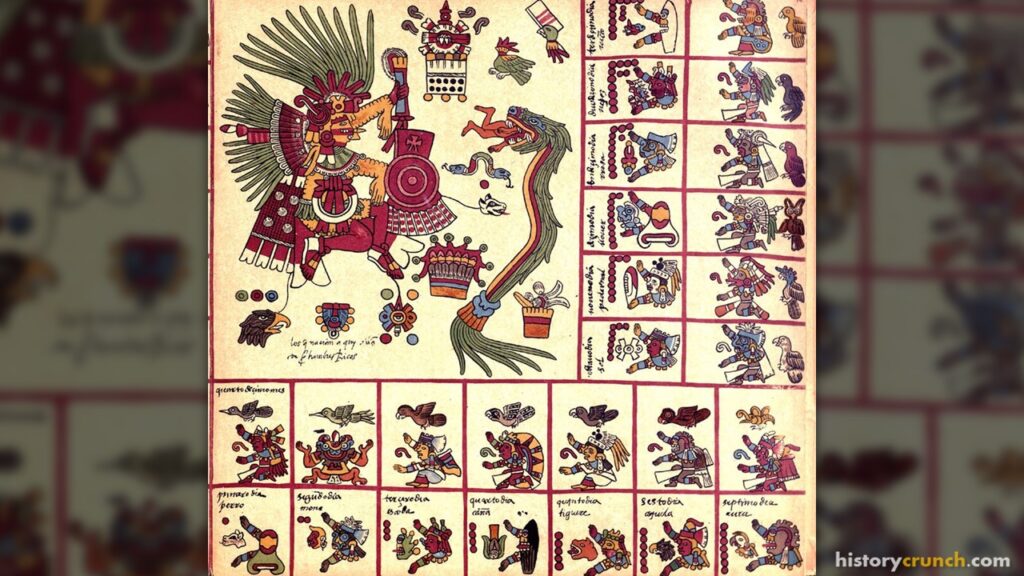
A significant god of the Aztec was Mictlāntēcuhtli. His name means ‘Lord of Mictlan’ in Nahuatl, the language of the Aztec. In Aztec religious beliefs, Mictlāntēcuhtli was considered to be the god of the dead and king of the northernmost section of the underworld. He is often represented as a skeleton with eyeballs. As well, he wore a headdress made of owl feathers and a necklace of human eyeballs. It was common for gods in Aztec mythology to be represented by skeletons as its symbolized the connection between life and death for the Aztec people. When an Aztec person died they were often buried with different objects which were said to help them on their journey to the underworld. In fact, the objects were supposed to be given to Mictlāntēcuhtli upon their arrival to the underworld.
Mictlāntēcuhtli is also important to Aztec mythology in that he played an important role in the creation story of human beings. For example, in the story, Quetzalcoatl is sent into the underworld to gather the bones of previous generations of gods. As the story goes, Mictlāntēcuhtli tried to stop Quetzalcoatl from fleeing with the bones and caused him to trip and fall. This led to Quetzalcoatl dropping the bones and they were broken into many small pieces. Quetzalcoatl picked them up and returned to the land of the living where the bones were transformed into human beings.