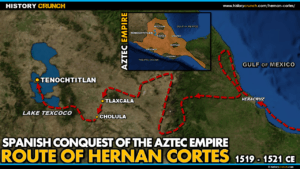
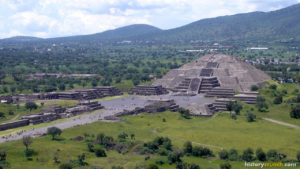
The Spanish conquest of the Aztec Empire is one of the most significant and dramatic events in the history of the Americas. Beginning in 1519 when Hernan Cortes arrived in Mexico with approximately 500 men, the conquest unfolded over two years and ended with the fall of the magnificent Aztec capital Tenochtitlan on August 13th, 1521. The defeat of the Aztec Empire opened the door to Spanish colonization of the Americas and transformed the history of the entire region. This infographic was designed for students to visually summarize the key events and causes of the Spanish conquest and is based on the History Crunch article titled Spanish Conquest of the Aztec Empire.
Spanish Conquest of the Aztec – Infographic
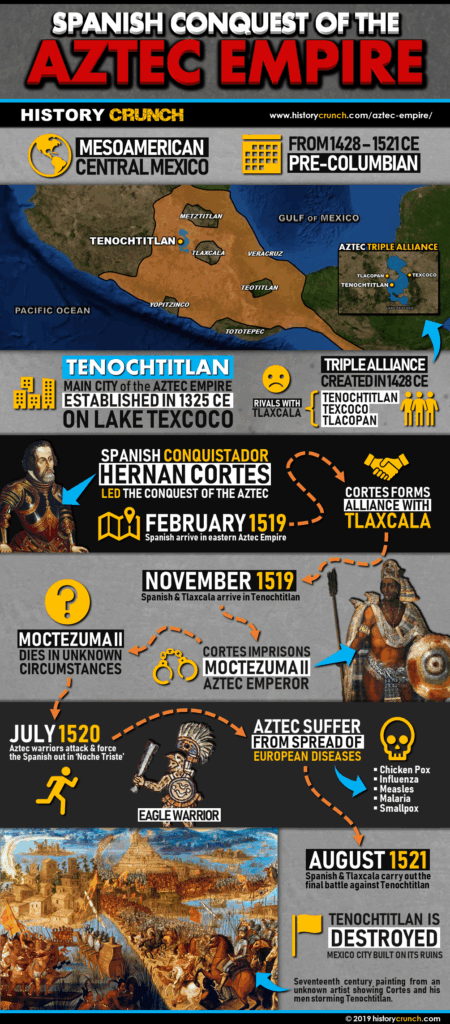
About This Infographic
This Spanish Conquest of the Aztec Empire infographic was created by the History Crunch team to help students and teachers quickly understand the key events and causes of one of the most significant conquests in world history. It is designed as a visual learning and study tool, summarizing the essential information covered in our full article on the Spanish Conquest of the Aztec Empire. Teachers may use it as a classroom display, a discussion prompt, or a study aid for students preparing for assessments.
What This Infographic Covers
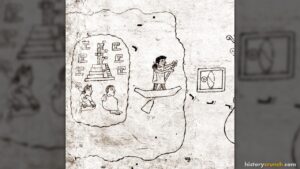
The infographic begins with the context leading up to the Spanish arrival. The Aztec Empire was ruled by Moctezuma II when the Spanish first appeared on the edges of Aztec territory in 1517. Spain had been actively exploring the Americas during the Age of Exploration, driven by a desire for gold and the expansion of Spanish power. Hernan Cortes set sail for Mexico in 1519 with approximately 11 ships and just over 500 men, eventually making his way toward the Aztec heartland in the Valley of Mexico.
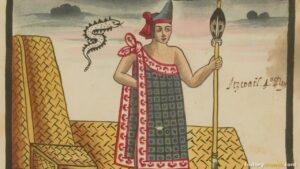
The infographic covers the critical role of alliances in the conquest. As Cortes traveled through Mesoamerica he encountered the Tlaxcala, a powerful city-state that was a traditional enemy of the Aztec. The Tlaxcala allied with the Spanish against their mutual rival, giving Cortes thousands of additional warriors and a deep knowledge of Aztec territory. This alliance proved decisive. Moctezuma II, meanwhile, was uncertain how to respond to the Spanish arrival, in part because it coincided with an Aztec prophecy about the return of the god Quetzalcoatl, who was said to have white skin. This uncertainty led him to initially welcome the Spanish with gifts and hospitality rather than military resistance.
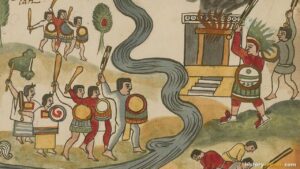
The infographic also covers the key events within Tenochtitlan. Cortes eventually took Moctezuma II captive and controlled the city through him for several months. The situation escalated dramatically when the Spanish commander Pedro de Alvarado massacred unarmed Aztec people during a religious festival, an event known as the Massacre of the Aztec in the Great Temple. This triggered a full Aztec uprising and the Spanish were forced to flee the city on the night of July 1st, 1520 in a chaotic retreat known as Noche Triste, during which hundreds of Spanish soldiers and thousands of Tlaxcala allies died.
A critical factor covered in the infographic is the devastating impact of European diseases on the Aztec population. Smallpox spread rapidly through Tenochtitlan between September and November of 1520, killing enormous numbers of Aztec people including their new ruler Cuitlahuac. The disease severely weakened Aztec resistance at the most critical moment of the conflict. Cortes returned in early 1521 with reinforcements, additional indigenous allies and newly constructed ships for use on Lake Texcoco. The final siege of Tenochtitlan began in the spring of 1521. The Spanish destroyed the city’s aqueducts, cut off its food supply and launched a brutal assault that ended with the fall of the city on August 13th, 1521. The last Aztec ruler Cuauhtemoc was taken prisoner and the Aztec Empire was no more.
How to Use This Infographic in the Classroom
This infographic works well as a visual introduction to the Spanish conquest before students read the full article. It can also be used as a review tool before an assessment, or as a discussion prompt asking students to identify which factor they think was most important in explaining why the Aztec Empire fell: Spanish military technology, the Tlaxcala alliance, European diseases, or Aztec political instability. Teachers may also use it alongside the map of the route of Hernan Cortes and the map of the Aztec Empire to help students understand the geographic dimensions of the conquest.
Related Articles
To learn more about the topics covered in this infographic, visit the following History Crunch articles: