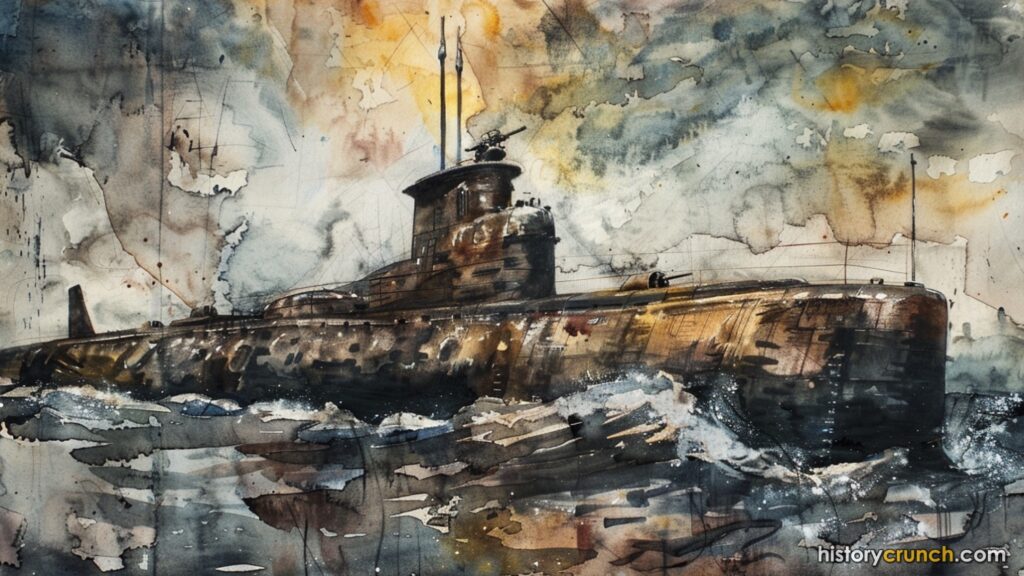
Submarines in World War I were an important weapon and played a significant role in the history of the conflict, especially in the northern Atlantic Ocean. In particular, Germany used submarines (U-Boats) extensively throughout the naval battles of World War I. World War I was a deadly conflict as shown by the millions of military and civil casualties it caused. The large number of casualties was the result, in part, of the development and use of weaponry that took place during the war. In all, the submarine was one of the most significant weapons of World War I alongside other important weapons, such as: airplanes, airships, machine guns, poison gas, rifles, and tanks.
GERMAN SUBMARINES (U-BOATS) IN WORLD WAR I
As stated above, Germany used submarines in World War I to wage naval war against its rivals: Britain and France. In German, these submarines were called ‘Unterseeboot’, which is usually shortened to ‘U-Boats’. In general, the Germany navy produced several classes of U-Boats. For instance, some were produced with diesel engines, while others were powered by kerosene. As well, some German U-Boats were classified as merchant types, while others were classified as attack types. Finally, some were minelayers and placed naval mines in strategic locations to defend sites against Allied naval forces. Regardless, German U-Boats wreaked havoc on the Allied naval and merchants ships in the North Atlantic Ocean. For instance, an important factor of the German Navy during World War I was its U-Boat Campaign from 1914 until 1918. In general, the U-Boat Campaign by Germany was an attack against the merchant shipping routes of the Allied nations.
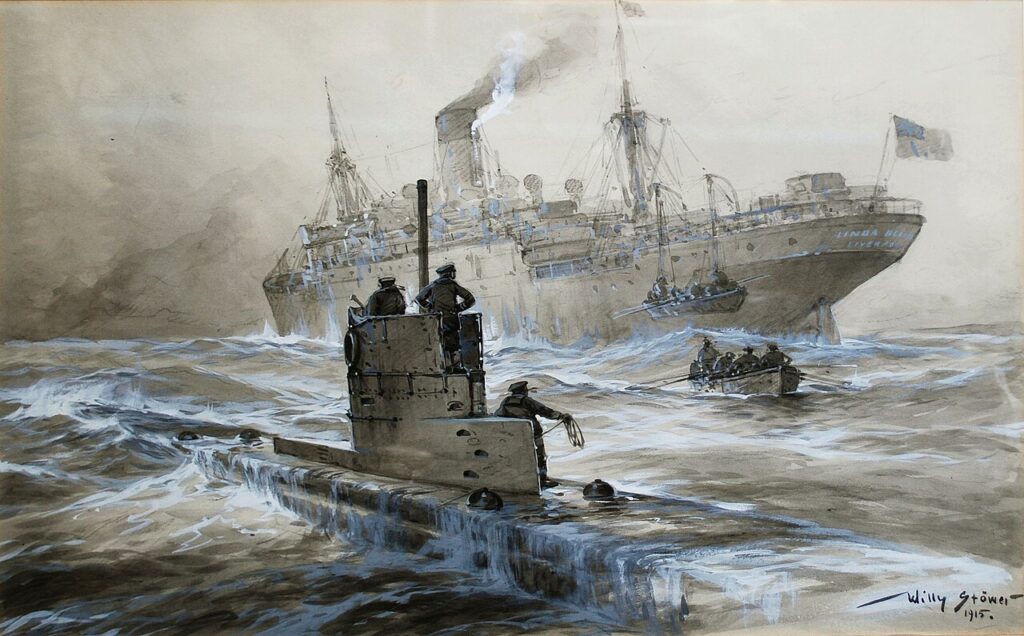
The clearest example of German submarine warfare during World War I and its impact was the sinking of the Lusitania in May of 1915. The ship left New York City on May 1st, 1915 and was bound for Liverpool, England. While the Lusitania was a passenger liner that operated in the North Atlantic it was also being used, as was common practice at the time, to ferry war time munitions and supplies from American to Britain. Germany was aware of the munitions and supplies aboard the ship and on May 7th, 1915, a German submarine (U-Boat U-20) fired on the Lusitania just off the coast of Ireland. In all, 1,924 aboard the ship died as it took just 18 minutes for the passenger liner to sink beneath the surface. The dead included 114 Americans who had been aboard the ship at the time.

As the war progressed, Germany attempted to push the war in its favor by limiting the supplies and raw materials that Britain and France received from their colonies. As such, Germany used its U-Boats to attack and sink merchant ships as a means of hurting the war effort of these nations. In fact, since Britain was an island nation it required a steady supply of outside resources and shipments. As such, the goal of the British Royal Navy was to maintain these supply lines, while the German Navy attempted to sink transport ships as a means of hurting the British war effort. Historians estimate that as many as 5,000 transport or merchant ships were lost to German U-Boat attacks in World War I. The British, and their allies, responded by grouping merchant ships into convoys that were defended by ships from the British Royal Navy.
SIGNIFICANCE OF GERMAN SUBMARINES IN WORLD WAR I
Historians consider the German U-Boat Campaign to be one of the main reasons that the United States entered the fighting of World War I. The war caused American trade to increase dramatically to both Britain and France but the British naval blockade against Germany caused American trade to the Central Powers to decrease. Ultimately, this could not be tolerated by the Germans and Germany responded by carrying out submarine warfare in the North Atlantic against the British navy and merchant ships.
In all, the use of submarines in World War I was significant and the German U-Boat Campaign played an important role in the war. In total, Germany built 373 U-Boats in World War I and lost 178 of them to enemy action. However, historians estimate that the German U-Boats sank over 5,000 Allied merchant ships along with numerous other naval ships, such as battleships. Furthermore, it is estimated that as many as 15,000 Allied sailors died as a result of German submarine warfare.