The Spanish-American War was fought between the United States and Spain in 1898 and was a short but significant conflict. For instance, it marked the emergence of the United States as a global power and had significant consequences for both nations involved. From an American perspective, the war was significant to the era of American Imperialism alongside other events including the Philippine-American War. More specifically, this era was part of the Gilded Age in American history. This article explores the Spanish-American War, including its causes and major events.
SPANISH-AMERICAN WAR – CAUSES
The Spanish-American War was a result of several factors including the United States’ growing interest in overseas expansion and the ongoing Cuban struggle for independence from Spanish rule. As such, historians have identified the causes of the Spanish-American War, such as: the Cuban War of Independence, the role of the media, American economic interests, and the explosion of an American battleship.
The first main cause of the Spanish-American War was the Cuban War of Independence. Spain had taken control over sections of the world from its time as a leading nation during the Age of Exploration and the Age of Imperialism. However, in the late 19th century, Spain (and other European nations) began to lose control over these regions. For instance, the Cuban rebellion against Spanish colonial rule began in 1895. At the time, many Americans sympathized with the Cuban rebels. Also, Reports of Spanish atrocities against Cuban civilians, often exaggerated by the press, fueled public outrage in the United States against Spain. This led to increased tensions between the United States and Spain, which was important in the outbreak of the Spanish-American War.
The next main cause of the Spanish-American War was the role of the media. For instance, sensationalist newspapers, particularly those led by William Randolph Hearst and Joseph Pulitzer, published exaggerated stories about Spanish brutality in Cuba. This played a crucial role in swaying public opinion towards supporting an American intervention in Cuba. As well, in February of 1898, a private letter written by the Spanish Ambassador to the United States, Enrique Dupuy de Lôme, was intercepted and published by the American press. The letter criticized American President William McKinley which further angered the American public.
Also, American economic interests played an important role in the outbreak of the Spanish-American War. In fact, American businesses had significant investments in Cuba, particularly in the sugar industry. The instability in Cuba, brought about by the Cuban War of Independence, threatened these investments, which prompted American business leaders to push for American intervention to protect their economic interests.
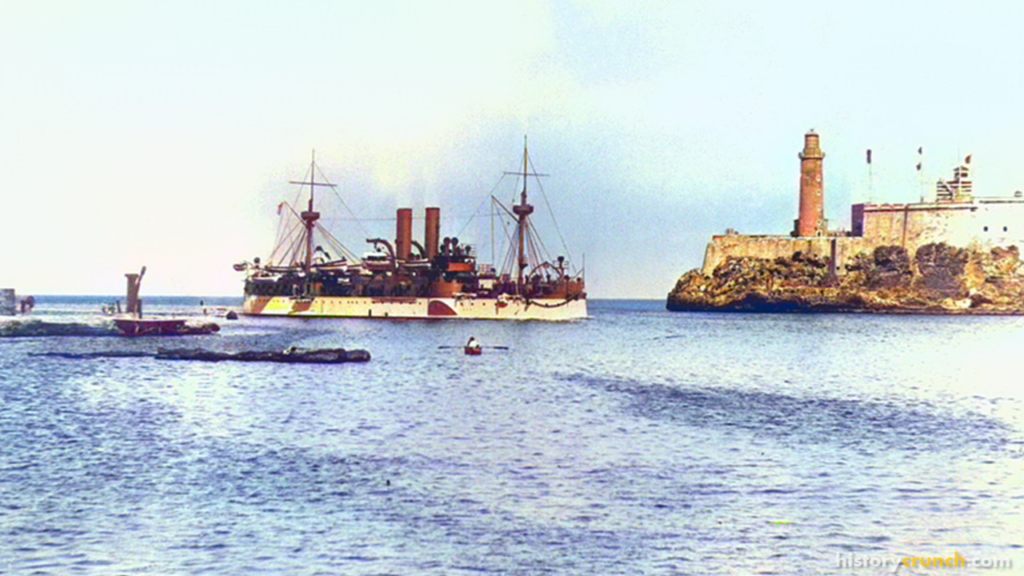
The final main cause of the conflict was the USS Maine incident on February 15th, 1898. This is when the USS Maine, an American battleship anchored in Havana Harbor of Cuba, exploded. The explosion was devastating and killed 266 sailors. While the cause of the explosion was unclear, the American public and media quickly blamed Spain. Historians consider this to the the spark that led to the outbreak of the Spanish-American War.
SPANISH-AMERICAN WAR – MAJOR EVENTS
As stated above, the Spanish-American War was relatively short, lasting from April 21st to December 10th in 1898. With that said, it included several significant battles and campaigns in both the Caribbean and the Pacific. For instance, much of the action took place in the following locations: Cuba, Puerto Rico, Guam and the Philippines.
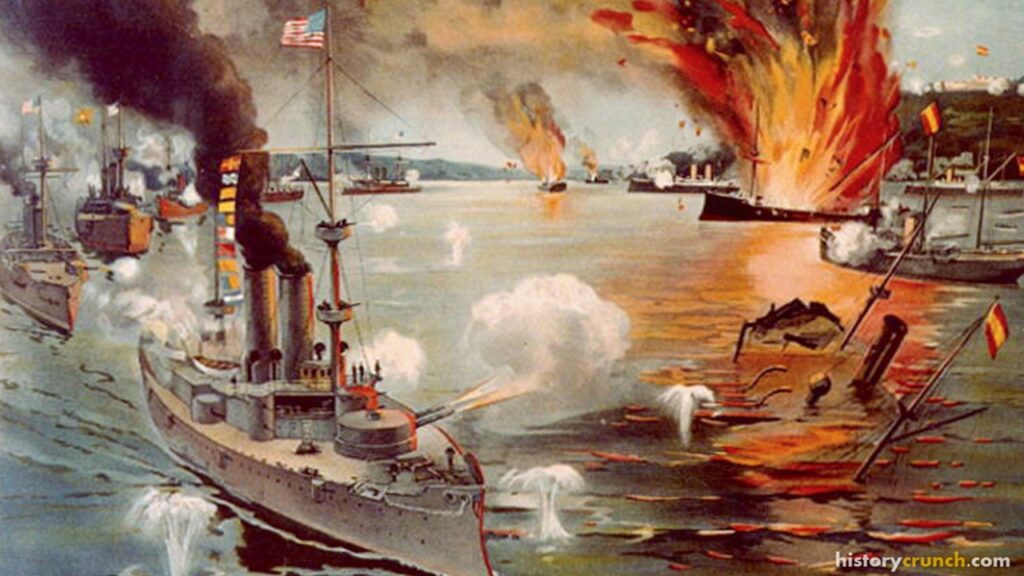
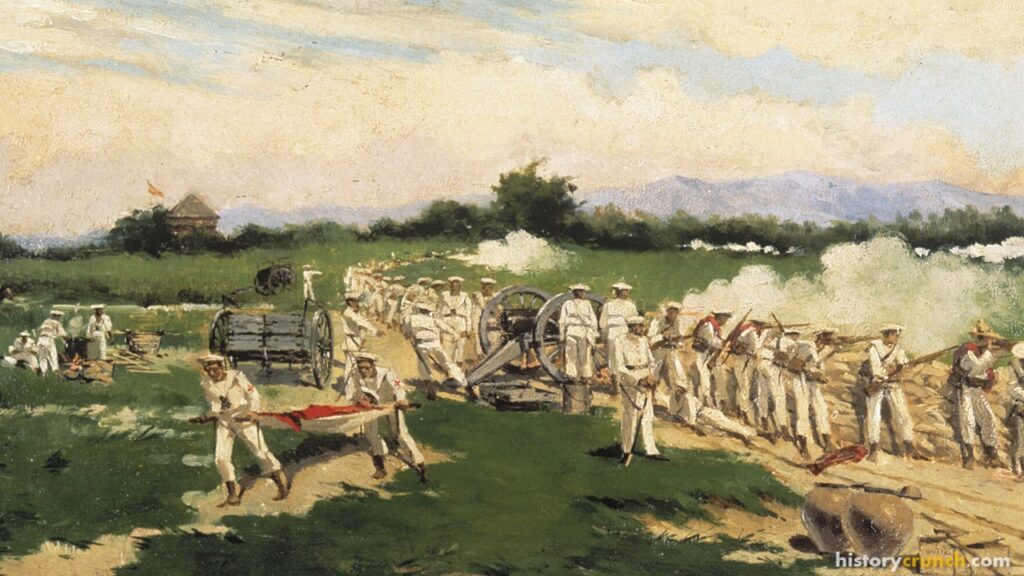
The first main conflict was the Battle of Manila Bay. This major battle occurred in the Philippines on May 1st, 1898. Commodore George Dewey led the United States Navy to a decisive victory over the Spanish fleet in Manila Bay, effectively weakening Spain’s naval power in the Pacific.
Next was the Cuban Campaign. In June of 1898, American forces landed on the island nation of Cuba. The first American landings in Cuba occurred on June 10th in Guantanamo Bay. One of the most famous battles was the Battle of San Juan Hill, where future President Theodore Roosevelt and his Rough Riders played a significant role. The successful capture of strategic positions in Cuba forced Spain to consider peace negotiations.
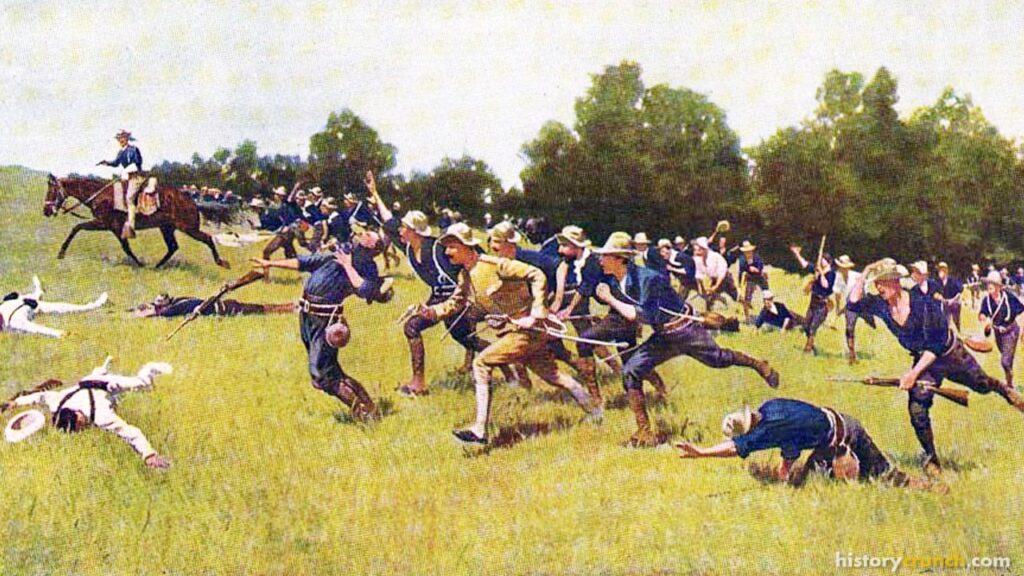
Frederic Remington. (1909)
Also of significance was the Puerto Rico Campaign. American troops landed in Puerto Rico, facing little resistance from Spanish forces. The offensive began on May 12th, 1898, when the United States Navy attacked the Puerto Rican capital, San Juan. This campaign further demonstrated the United States’ military capabilities and expanded its territorial ambitions.
SPANISH-AMERICAN WAR – TREATY OF PARIS
The Spanish-American War officially ended with the signing of the Treaty of Paris on December 10th, 1898. The terms of the treaty had significant impacts for both Spain and the United States. For instance, Spain gave up control of Cuba, which became a protectorate of the United States. Although Cuba gained formal independence in 1902, the United States retained significant influence over its affairs through the Platt Amendment.
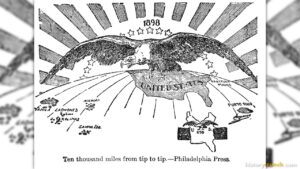
Also, the United States acquired several of Spain’s territories, including Puerto Rico, Guam, and the Philippines. These acquisitions marked the beginning of American imperialism and established the United States as a colonial power alongside other powerful nations of the time. For its parts, Spain received $20 million from the United States as compensation for the Philippines.
SPANISH-AMERICAN WAR – IMPACTS AND LEGACY
The Spanish-American War was a significant event and had far-reaching consequences for both the United States and the world. First, the war marked the United States’ transition from a relatively isolated nation to an influential global power with overseas territories. This shift had lasting implications for American foreign policy into the 20th century and beyond.
As well, the conflict highlighted the need for a modernized and capable military for the United States. In fact, the successes of the United States Navy and the challenges faced by the Army prompted significant military reforms and investments. These investments proved and reforms proved to be important with the major conflicts of the 20th century, such as World War I.
Next, the acquisition of overseas territories sparked a national debate in America over the role and importance of imperialism. While some Americans supported expansion, others, including prominent figures like Mark Twain and Andrew Carnegie, formed the Anti-Imperialist League to oppose colonialism. As such, the issue of imperialism and colonialism was a controversial topic in the early part of the 20th century. For instance, the Philippine-American War was a significant event that followed the Spanish-American War in the era of American Imperialism.
Finally, the Spanish-American War also had social and cultural impacts. In fact, the war fostered a sense of national pride and unity in the United States. However, it also exposed underlying racial and cultural tensions. For example, the treatment of newly acquired territories and their citizens raised questions about American values and democracy.