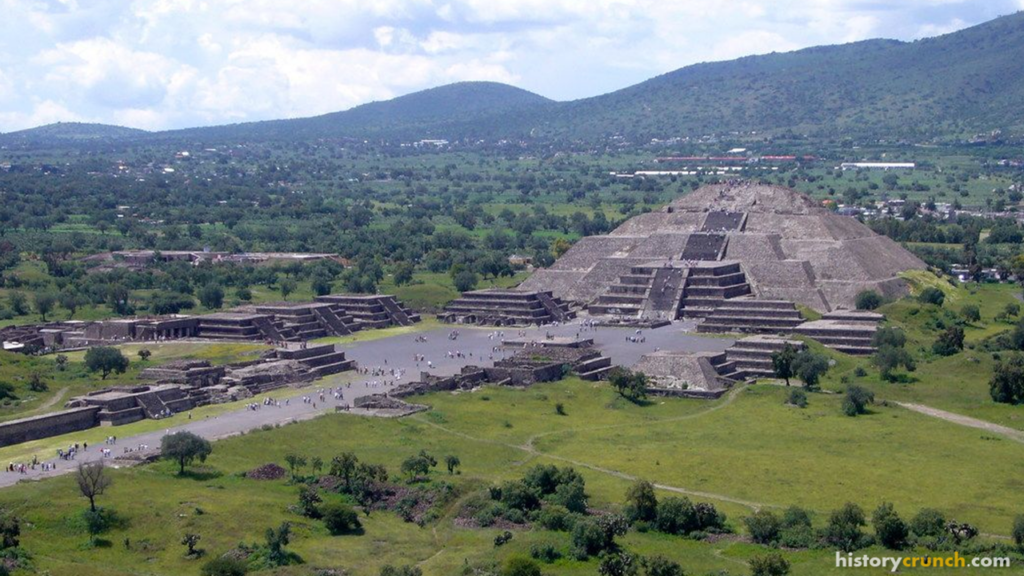
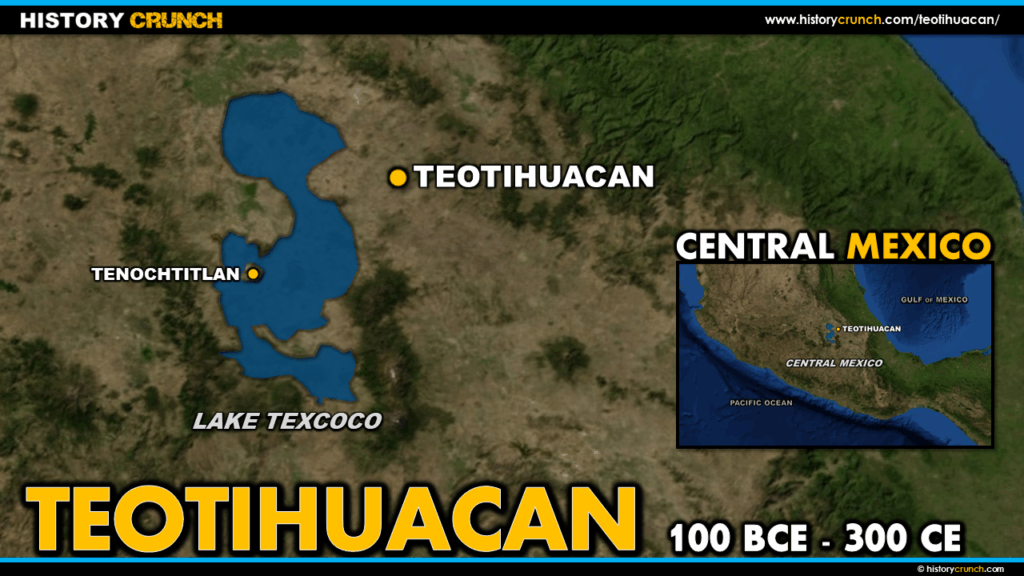
Teotihuacan, located in the central Basin of Mexico, was one of the largest cities in the ancient world, flourishing between 100 BCE and 750 CE. It is known today for its monumental architecture, including the Pyramid of the Sun and the Pyramid of the Moon, which highlight its advanced engineering and urban planning. The city’s layout is organized along a central avenue called the Avenue of the Dead.
Teotihuacan was a major cultural and economic center, influencing surrounding regions through trade and the spread of its artistic and religious practices. As such, historians consider the city of Teotihuacan as significant to later Mesoamerican civilizations such as the Aztec.
TEOTIHUACAN – HISTORY
Teotihuacan is a Mesoamerican society and city-state that is located northeast of modern-day Mexico City. Historians are unsure of exactly how or when the city-state was founded but believe that it emerged to prominence around 100 BCE to 300 CE, nearly 1000 years before the height of the Aztec civilization. There is a debate among historians about who the original creators of the city-state were, and several have put forth different theories. For example, for a number of years ago it was believed that the Toltec people were responsible for its creation, but now it is generally believed that it was a group of distinct people who were influenced by other civilizations including the Totonac and Maya.
Archeologists studying the ruins of Teotihuacan estimate that it reached its peak as a city-state around 450 CE. At its height it may have had a population of around 150,000 people and the influence of the city likely extended throughout much of Mesoamerica. However, historians and archeologists are unsure as there is no concrete information or evidence.
TEOTIHUACAN – PYRAMIDS
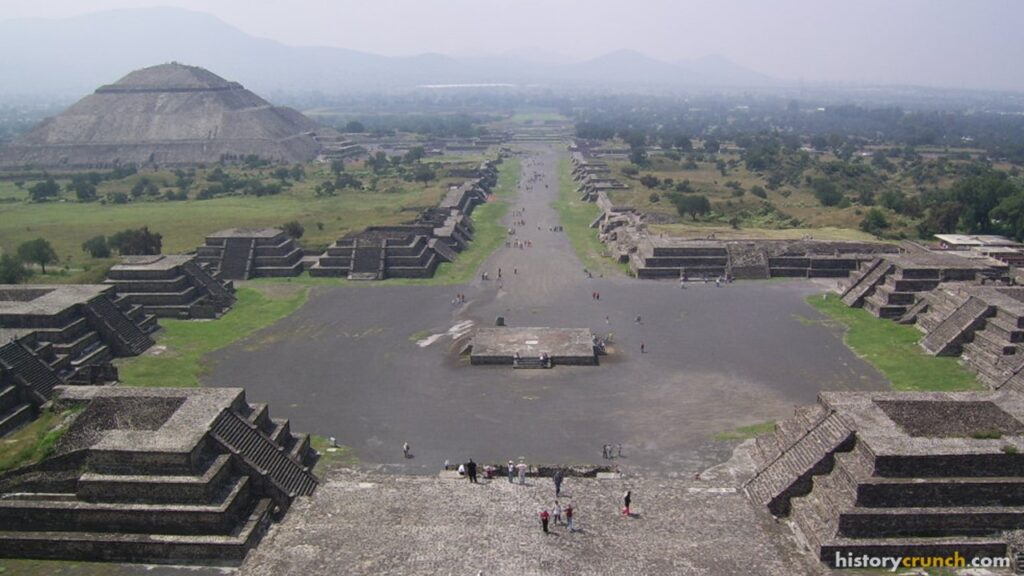
The city is famous for its magnificent ruins, which are among some of the best preserved in all of Mexico. The central avenue of the city if referred to as the ‘Avenue of the Dead’ and is surrounded by large pyramids and complexes. For example, the Pyramid of the Sun is the largest on the site and extends to 215 feet (65.5 meters) in height. This makes it the third largest pyramid in the world, only behind the Great Pyramid of Cholula in Mexico and the Great Pyramid of Giza in Egypt. It is estimated that it was created in 200 CE. At the end of the Avenue of the Dead is also placed the Pyramid of the Moon. It is the second largest pyramid at the site and extends to about 141 feet (43 meters) high. It is estimated that the pyramid was built between 200 CE and 250 CE, but appears to have been renovated several times which added to its overall size and height. In front of the Pyramid of the Moon is a large plaza which was used for festivals and ceremonies. The layout of the city became characteristic throughout Mesoamerica as other city-states copied the methods used in Teotihuacan. For example, the Aztec mirrored their capital city (Tenochtitlan) after the main features of Teotihuacan. This includes the construction of the major pyramids and temples inside of Tenochtitlan but also the use of a grid system and a main avenue with courtyards.
TEOTIHUACAN – COLLAPSE
Historians are still unsure as to why but Teotihuacan seems to have collapsed around 750 CE. The leading theory for a long time was that another society invaded the city and destroyed it by burning it. Archaeologists came to this conclusion after finding archeological evidence of fires in many of the temples and buildings at Teotihuacan. For examples, some historians have suggested that the Toltec civilization, which rose to power in the time period after Teotihuacan, may have been responsible for burning and destroying the city. However, this has been heavily debated by historians. For instance, new archeological evidence suggests that not all of Teotihuacan was burned. In fact, the burning appears to be limited to temples and palaces which would have been occupied by the ruling elite of Teotihuacan. For this reason, some historians have suggested that an internal conflict such as a civil war is more likely the reason behind the burning. They suggest that the people of Teotihuacan burned the ruling class’s building in a form of protest or revolt. Regardless, the site of Teotihuacan appears to have been abandoned around 750 CE.
TEOTIHUACAN – CONNECTION TO THE AZTEC
The word ‘Teotihuacan’ is a Nahuatl word (language of the Aztec) for ‘city of the gods’. The Aztec gave the city this name and believed it to be a particularly important site in Mesoamerica. For example, as part of the Aztec religious beliefs, they believed that Teotihuacan was where the gods created the universe. As such, Teotihuacan was a very significant religious and cultural place for Aztec people.