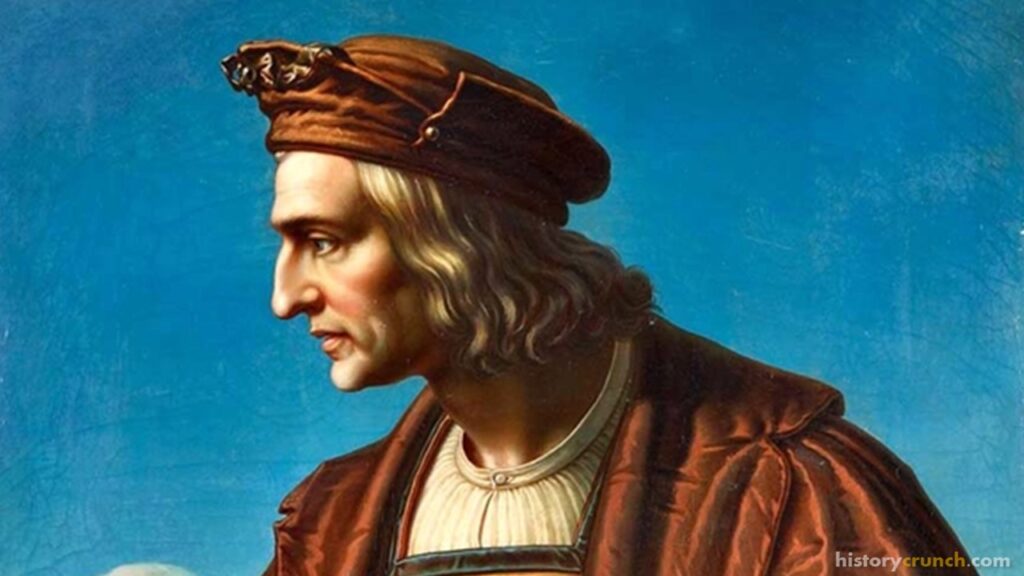
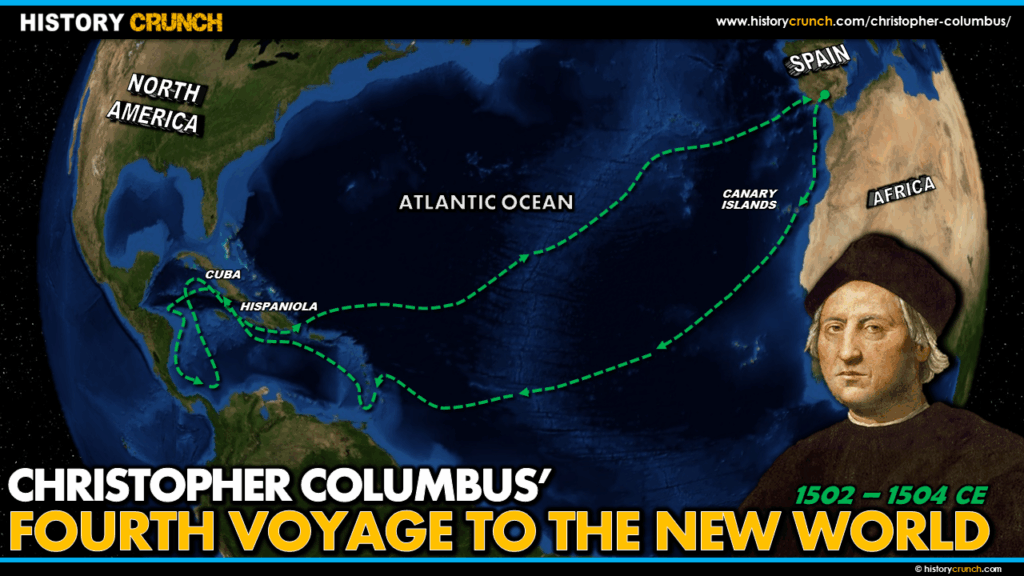
Christopher Columbus’s fourth and final voyage to the New World began in 1502 CE, with the goal of finding a westward passage to Asia. He explored parts of Central America, including the coasts of Honduras, Nicaragua, Costa Rica, and Panama.
CHRISTOPHER COLUMBUS – FOUR VOYAGES TO THE NEW WORLD
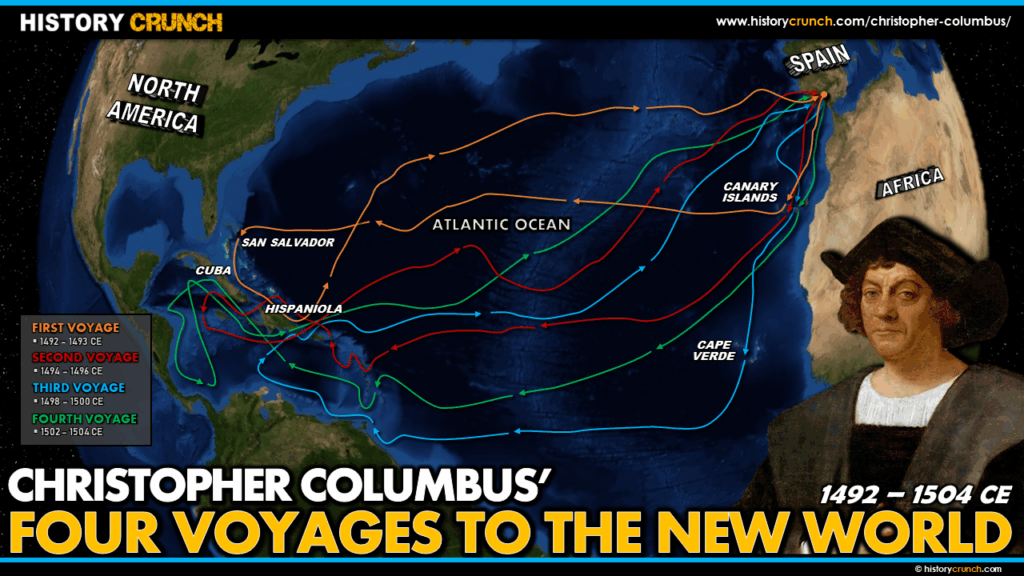
Christopher Columbus carried out four voyages to the New World between 1492 and 1503. These four voyages are incredibly significant in the history of the world, as they mark the beginning of European exploration in the New World and led to other major events, such as: the Columbian Exchange, and the mass migration of European settlers to the Americas. All four voyages were financed by the Spanish monarchs and caused other powerful European nations such as England, France and Portugal to carry out their own explorations of the New World.
COLUMBUS’ FOURTH VOYAGE – LEAVING SPAIN
The fourth voyage that Christopher Columbus undertook to the New World was also his final one. He left Spain on May 11th, 1502 with four ships, and went in search of the Strait of Malacca to the Indian Ocean. This was due to his false belief that in his three previous voyages to the New World he had actually arrived on the coast of Asia. He did not realize that he was actually in an area that had previously been unexplored by Europeans. On the fourth voyage he was accompanied by his brother Bartholomew and his 13-year-old son Fernando, along with approximately 140 other men.
COLUMBUS’ FOURTH VOYAGE – ARRIVAL IN THE NEW WORLD
After a short stop in Morocco, Columbus and crew arrived at the island of Hispaniola on June 29th, 1502. This was the island in the Caribbean that Columbus had first explored on his three earlier voyages and had established a settlement. In fact, when Columbus arrived at Hispaniola he immediately went to the settlement of Santo Domingo, which was first established by his brother Bartholomew Columbus in 1496. Today, Santo Domingo is the capital and largest city in the Dominican Republic. Upon arriving, Columbus sought to enter the port of the city, but was denied by Francisco de Bobadilla, who was the current Governor. In fact, Bobadilla had replaced Columbus as Governor over the colonies of the New World after reports emerged of Columbus’ mismanagement and cruelty towards the people there. Furthermore, Columbus and his two brothers were sent home to Spain at the end of his third voyage in chains, as they were arrested for their abuses against the settlers and indigenous peoples.
COLUMBUS’ FOURTH VOYAGE – STORMS
Regardless, Columbus warned the settlement about an incoming hurricane that he had witnessed on his crossing of the Atlantic Ocean and anchored his ships. The governor did not listen to Columbus’ warning and sailed out of the harbor. As a result, on July 1st, nearly 30 ships from the settlement were lost to the storm of the hurricane. As well, Francisco de Bobadilla, died in the hurricane and sank with the fleet. Columbus and his crew survived with relatively little damage to their ships.
Following the storm, Columbus went to the island a Jamaica and then headed south to the island of Guanaja, which is just north of the Central American country of Honduras. His brother Bartholomew supposedly witnessed local indigenous peoples with a large canoe that suggested that there was larger settlements of indigenous people nearby. As such they continued south and on August 14th Columbus arrived at the mainland of Central America in modern day Honduras. This was the first time, in all of his earlier voyages, that Columbus had made contact with the mainland of Central America. Following his arrival, Columbus spent the next couple of months exploring the coasts of Honduras, Nicaragua, and Costa Rica. He and his crew arrived at a site in modern day Panama on October 16th.
Soon after, he and the crew withstood a terrible storm. Columbus wrote about the storm in his December 5th, 1502 journal entry: “For nine days I was as one lost, without hope of life. Eyes never beheld the sea so angry, so high, so covered with foam. The wind not only prevented our progress, but offered no opportunity to run behind any headland for shelter; hence we were forced to keep out in this bloody ocean, seething like a pot on a hot fire. Never did the sky look more terrible; for one whole day and night it blazed like a furnace, and the lightning broke with such violence that each time I wondered if it had carried off my spars and sails; the flashes came with such fury and frightfulness that we all thought that the ship would be blasted. All this time the water never ceased to fall from the sky; I do not say it rained, for it was like another deluge. The men were so worn out that they longed for death to end their dreadful suffering.”
COLUMBUS’ FOURTH VOYAGE – CENTRAL AMERICA
Regardless, during his explorations of Central America, Columbus learned from local indigenous peoples that there was another ocean on the other side of the land. This information, combined with the different gold items that the indigenous peoples possessed proved in his mind that he had reached Asia. As a result, in January of 1503, he constructed a garrison at the mouth of the Belén River in modern day Panama. He did this as a means of further exploring the area. However, his ships and crew soon began to suffer. For instance, his ships were heavily damaged and leaking while the crew had to contend with attacks from the local indigenous peoples. In fact, he had to abandon one of his ships in the river due to excessive damage. While the other three were also leaking, he and his crew left on April 16th, 1503 and made their way to Cuba.
COLUMBUS’ FOURTH VOYAGE – STRANDED AND RETURN TO SPAIN
While on route to Cuba, Columbus was again hit by another storm and his three remaining ships took on even more water. As a result, he and the crew abandoned ship on the northern coast of Jamaica on June 25th, 1503. They remained stranded on the island for over a year, as there were no Spanish settlements there at the time. The crew and Columbus survived with help from a local indigenous tribe. Eventually, one of Columbus’ crew, Diego Méndez, used a canoe and paddled to Hispaniola in order to seek help from the Spanish settlement there. In the meantime, Columbus continued to gain support from the indigenous peoples on the island of Jamaica by predicting a lunar eclipse on February 29th, 1504. He did this by using charts he had learned about in Spain.
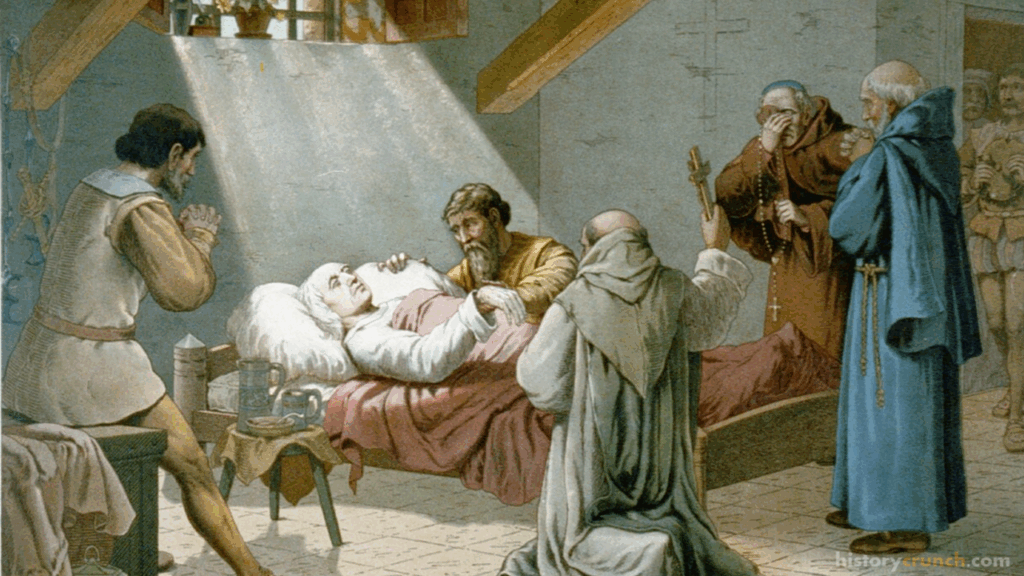
Eventually, Diego Méndez, arrived in Hispaniola. The governor there at the time did not like Columbus and did not imminently want to send help. However, finally on June 29th, 1504, Columbus and the crew that were stranded in Jamaica were rescued. Columbus returned to Spain and arrived on November 7th. Columbus’ final voyage to the New World was over. He died only two years later.