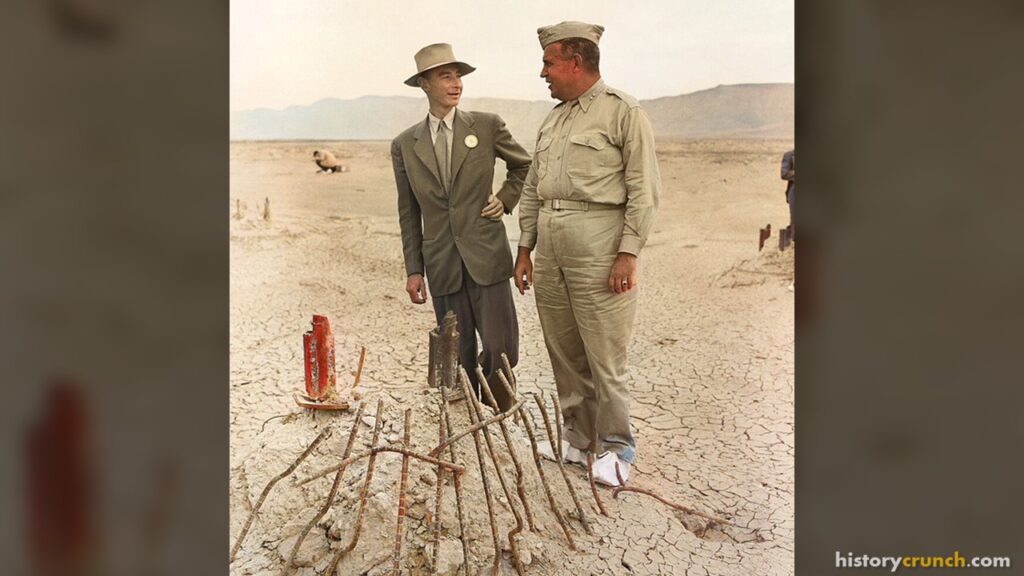
The Manhattan Project was the codename for the secret American program to create the first atomic weapon during the end of World War II. The project was overseen by Robert Oppenheimer, an American physicist who was the head of the Los Alamos Laboratory in New Mexico, where the first atomic bombs were designed. Eventually, the Manhattan Project resulted in the atomic bombings of Hiroshima and Nagasaki in Japan, to end World War II. Furthermore, the creation of the atomic bomb had a profound impact on the Cold War, which unfolded in the decades after the Second World War.
MANHATTAN PROJECT – CAUSES
The Manhattan Project had its beginnings in 1939 after it was determined that Nazi German scientists had discovered nuclear fission in 1938. Nuclear fission, it was feared, would allow Germany to begin the process of constructing an atomic bomb. These fears caused physicists Leó Szilárd and Albert Einstein to draft a letter in August of 1939 warning the United States of the consequences of Nazi Germany having access to atomic weaponry. The letter was delivered to United States President Franklin D. Roosevelt and urged him to undertake the process of having the United States stockpile large amounts of uranium ore, which could be used as a source for possible atomic bombs. The hope was that the United States could develop an atomic weapon before Nazi Germany.

MANHATTAN PROJECT – SUMMARY
The Manhattan Project gained momentum in 1942 under the leadership of General Leslie Groves and scientific director Robert Oppenheimer. Furthermore, it brought together some of the world’s most brilliant scientists, including physicists such as: Enrico Fermi, Niels Bohr, and Richard Feynman. American scientists began the difficult work of organizing the secret program. Initially, much of the research and scientific work was completed at colleges throughout the United States. More specifically, the project’s research and production facilities were spread across multiple secret sites in the United States, including Los Alamos, New Mexico (where the bombs were designed and assembled), Oak Ridge, Tennessee (uranium enrichment), and Hanford, Washington (plutonium production). Scientists worked in secrecy to understand the processes of nuclear fission and to develop the weapons using enriched uranium-235 and plutonium-239. This research continued until the first ever atomic test in 1945.
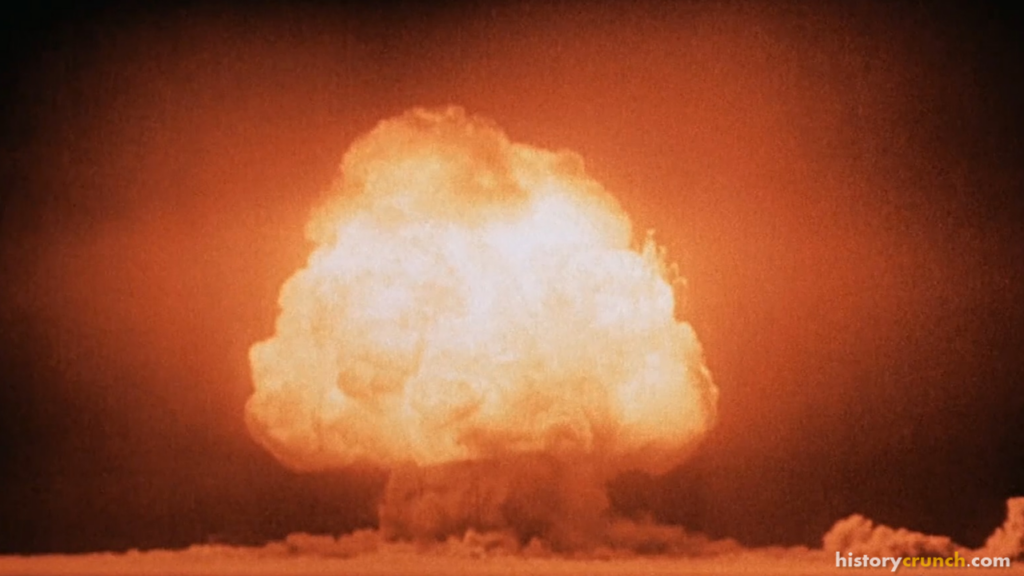
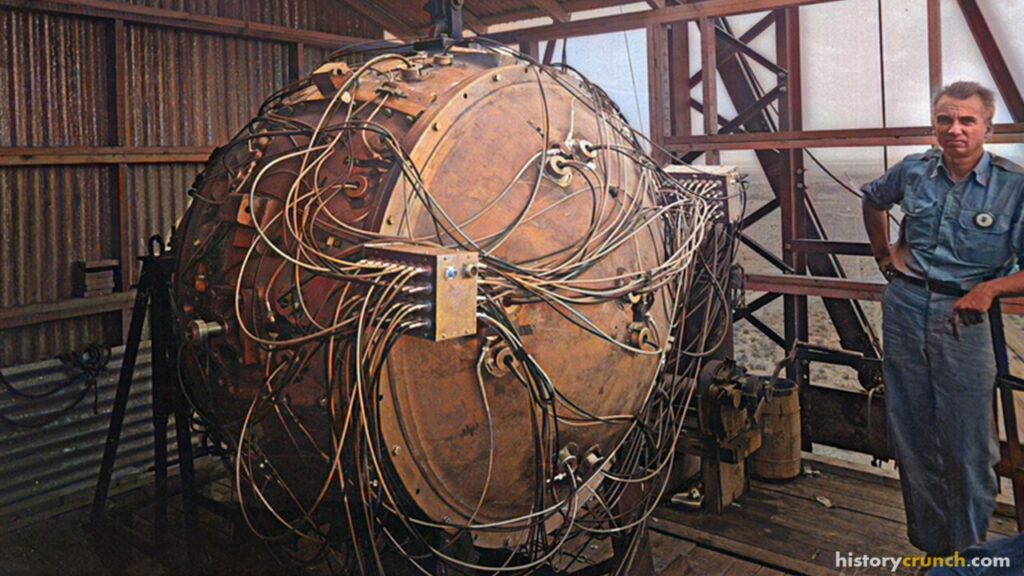
The first ever test of an atomic weapon was codenamed ‘Trinity’ and took place in the desert of New Mexico near Los Alamos on July 16th, 1945. The site was chosen for its remote nature so as to limit any impact on civilian populations. At the Trinity Site, a platform was created in which a tower was constructed that would hold the weapon component of the first atomic test. The device was called the ‘gadget’ and when exploded it was considered to be a full-scale atomic test. The explosion was equivalent to approximately 20 kilotons of TnT. The United States had entered the atomic age and set the stage for the end of World War II and the start of the Cold War.
MANHATTAN PROJECT – SIGNIFICANCE
Less than a month after the Trinity Site test, the United States dropped two atomic bombs on Hiroshima and Nagasaki, Japan. These two atomic bombings forced Japan to surrender, which effectively ended World War II. As such, historians consider the Manhattan Project to be a significant aspect of World War II and its ultimate end. Furthermore, the two atomic bombings in Japan set the stage for the ‘atomic age’ and the tensions of the later half of the 20th century. This is because the Manhattan Project had profound historical significance.
For instance, it demonstrated the destructive power of nuclear weapons, led to the nuclear arms race of the Cold War, and sparked ethical debates about the ethics surrounding the use of atomic weapons. For instance, historians have long debated the use of the atomic bombs in Japan, and questioned the validity of their use. Some historians have argued in favor of their use, while other have argued against it. Click on the links to read more detailed information on the reasons for and against the use of the atomic bombs against Japan.