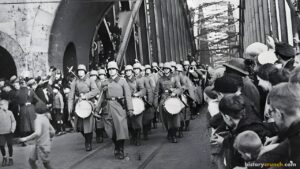
The SA, which stood for Sturmabteilung, was the original paramilitary organization of the Nazi Party in Germany. It emerged in the early 1920s and became one of the main forces that helped Adolf Hitler and the Nazis rise to power during the unstable years of the Weimar Republic. The SA was also known as the ‘Brownshirts’ because of the brown uniforms worn by its members. This is significant because the SA gave the Nazi movement something that many other political parties did not have, which was an organized force of men who could protect Nazi meetings, intimidate opponents and use violence in the streets to support the party’s political goals.
WHAT WAS THE NAZI PARTY?
To understand the SA, it is first necessary to understand the Nazi Party. The Nazi Party, formally known as the National Socialist German Workers’ Party or NSDAP, was a far-right political party in Germany led by Adolf Hitler. After taking control of the party in July of 1921, Hitler worked to make it more powerful by attracting supporters, giving dramatic speeches, and building organizations that could spread Nazi ideas. This is important because the SA developed as part of Hitler’s larger effort to turn the Nazi Party into a disciplined and aggressive political movement.
Germany in the early 1920s was deeply unstable. Many Germans were angry about defeat in World War I, bitter about the Treaty of Versailles, and frustrated by economic crisis and political conflict. In this atmosphere, extremist groups gained support by promising national revival and stronger leadership. This is significant because the SA grew in a society where many people had become used to political violence and where armed groups could play an important role in public life. Historians generally consider this to be an example of the failure of the Weimar Republic following the events of World War I.
WHAT WAS THE SA?
The SA was the original paramilitary wing of the Nazi Party, and by the end of 1921 it had become an important part of the Nazi movement. Its members acted as guards at Nazi rallies, fought political opponents, and helped break up meetings held by rival parties, especially communists and socialists. In practical terms, the SA was the muscle of the Nazi Party. This is significant because the SA helped transform the Nazis from a small extremist group into a movement that could physically dominate opponents in public spaces. As such, this allowed the Nazis to terrorize and suppress other political movements and parties.
The SA stressed loyalty, obedience, commitment, and action, rather than education or social class. Many of its members were former soldiers, unemployed men, or people drawn to the excitement and military nature of Nazi politics. This is important because the SA appealed to people who were angry, frustrated, or eager to belong to a movement that promised strength and national renewal.
THE SA AND HITLER’S RISE TO POWER
The SA played a major role in Hitler’s rise to power during the 1920s and early 1930s. As Hitler built the Nazi Party, he also built organizations that could spread Nazi ideology and create order within the movement. The SA was central to that effort because it protected Nazi speakers, marched in parades, and attacked opponents in the streets. This is significant because the Nazis used fear and intimidation alongside propaganda and elections, and the SA was one of the clearest examples of that strategy.
The SA also took part in the Beer Hall Putsch in November of 1923, when Hitler and the Nazis attempted to seize power in Munich by force. The putsch failed, and Hitler was arrested and later imprisoned. However, the event remained important in Nazi memory, and the SA continued to be associated with Hitler’s early revolutionary movement. This is important because it shows that the SA was not just a supporting organization. It was deeply involved in Hitler’s earliest attempts to overthrow the existing government.
As Nazi popularity grew during the years of economic crisis, the SA also expanded. By 1932, the Nazi Party had become the largest party in the Reichstag, and the SA helped create the impression that the Nazis were disciplined, energetic, and unstoppable. This is significant because the SA gave Hitler a visible presence across Germany and helped the Nazi Party project power well before it had full control of the state.
ERNST RÖHM AND THE SA
The most important leader of the SA was Ernst Röhm, one of Hitler’s early allies. Röhm was a veteran of World War I and believed strongly in militarism, force, and revolutionary politics. Under his leadership, especially after he returned to direct the SA in January of 1931, the organization grew rapidly and became far more powerful. This is significant because Röhm helped turn the SA into a mass movement rather than a small bodyguard unit.
Röhm wanted the SA to play a larger role in the future of Nazi Germany, and he hoped it might even replace or dominate the regular German army. This alarmed conservative elites, military leaders, and some of Hitler’s other supporters. By the time Hitler and the Nazis had destroyed democracy and taken control of the government, the SA had grown to around 4 million members. This is important because the size of the SA made it both useful and threatening. It had helped Hitler seize power, but it had also become too large and too radical for many of the people Hitler now needed to keep on his side.
THE SA AND THE NIGHT OF THE LONG KNIVES
The turning point in the history of the SA came during the Night of the Long Knives, which began on June 30th, 1934 and continued into July of 1934. By this point, Hitler had become Chancellor on January 30th, 1933, and had greatly strengthened his control through measures such as the Enabling Act on March 23rd, 1933. However, he still needed the support of the army and conservative leaders. When tensions with Röhm and the SA increased, Hitler chose to side against his old allies. This is significant because it shows how Hitler used violence not only against opponents, but also against members of his own movement.
During the purge, Hitler ordered the arrest and killing of Röhm and other SA leaders. Historians do not know the exact number killed, but estimates often range from about 250 to 1,000 people. The purge destroyed the political power of the SA and strengthened Hitler’s relationship with the regular army. This is important because the Night of the Long Knives helped Hitler move closer to total dictatorship, while also reducing the SA from a major revolutionary force to a much less powerful organization.
After the purge, the SA continued to exist, but it never regained its earlier importance. Its power declined sharply, while the SS, which had originally been a smaller organization connected to the SA, rose in influence under Heinrich Himmler. This is significant because it marked a major shift inside Nazi Germany. The SA had helped the Nazis rise, but the SS became much more important in maintaining the dictatorship and carrying out terror in the years that followed.
Regardless, the SA still played an important role in Nazi violence. One clear example came during Kristallnacht on November 9th and 10th, 1938, when SA members attacked Jewish homes, businesses, and synagogues across Germany. In total, 91 Jewish people were murdered and another 30,000 Jewish men were arrested and imprisoned. This is important because it shows that the SA remained involved in Nazi persecution, especially against Jewish people, even after its position inside the Nazi power structure had weakened.
THE SA – WAS WAS IT SIGNIFICANT?
The SA was significant because it was one of the main organizations that helped Adolf Hitler and the Nazi Party rise to power. It brought violence into politics in a direct and organized way, and it helped the Nazis intimidate opponents, influence public life, and present themselves as a force of action and discipline. Without the SA, Hitler’s movement would have been much weaker in its early years.
The SA is also important because its history reveals a central truth about Nazi Germany. The regime was built through violence, and that violence did not stop once the Nazis gained power. Instead, it turned inward as well, as shown by the purge of June 30th, 1934. Overall, the SA was both a tool of Hitler’s rise and a victim of Hitler’s dictatorship, which makes it one of the most revealing organizations in the history of Nazi Germany.