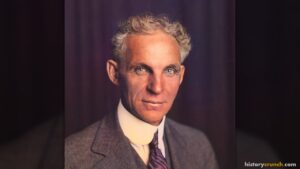
George S. Patton was a general in the United States Army during World War II who played major roles in North Africa, Sicily, France, and the Battle of the Bulge, and his leadership style made him both admired and controversial. In fact, he became famous for his aggressive battlefield leadership.
GEORGE S. PATTON – EARLY LIFE
George Smith Patton Jr. was born on November 11th, 1885, in San Gabriel, California. He came from a family with a strong military tradition, and from a young age he was deeply interested in war, leadership, and military history. Patton attended the Virginia Military Institute for a short time before entering the United States Military Academy at West Point, where he graduated on June 11th, 1909.
Patton was also an excellent athlete. In 1912, he competed for the United States in the modern pentathlon at the Stockholm Olympics, where he finished fifth. This was important because it showed the intense discipline and competitive spirit that later became central parts of his military image.
GEORGE S. PATTON – EARLY MILITARY CAREER
Before World War II, Patton had already built a strong military record. He served in the Pancho Villa Expedition of 1916 under General John J. Pershing, which gave him early combat experience, and then served in World War I as part of the new American tank forces in France. During that war, he helped lead the United States tank school in France, commanded tanks in combat, and was wounded late in the fighting. Therefore, Patton entered the interwar years with a reputation as an officer who believed strongly in speed, movement, and armored warfare.
In the years between the world wars, Patton continued developing ideas about mechanized warfare. He became an important supporter of armored forces at a time when many military leaders still thought in older ways. As such, when World War II began, Patton was well prepared to take command in a fast-moving modern war.
GEORGE S. PATTON – WORLD WAR II
Patton rose to major importance during World War II. In November of 1942, he commanded the Western Task Force in Operation Torch, the Allied landings at Casablanca in North Africa. After the Allied defeat at Kasserine Pass, he was given command of II Corps and quickly imposed stricter discipline and stronger battlefield leadership. This helped rebuild American confidence in North Africa and raised Patton’s standing as a combat commander.
In July of 1943, Patton commanded the Seventh Army in the invasion of Sicily. His troops advanced across the island and reached Messina, but his reputation was damaged by the slapping incidents in August of 1943, when he struck soldiers suffering from battle fatigue. Eisenhower forced Patton to apologize, and the controversy temporarily hurt his career. This is significant because it showed both sides of Patton’s leadership: he could inspire speed and aggression, but he could also act harshly and impulsively.
Patton returned to major command in 1944 as leader of the Third Army in France after the Normandy campaign had begun. His forces drove rapidly across France, and during the Battle of the Bulge in December of 1944 he famously turned the Third Army north toward Bastogne, helping stop the German offensive. In fact, this became one of the most famous achievements of his career and helped strengthen his image as a commander who moved quickly and attacked hard.
Even so, Patton remained a debated figure even during the war itself. Many soldiers respected his energy, confidence, and willingness to lead from the front, while others criticized his temper and harsh methods. Regardless, by the end of the war in Europe he had become one of the most well-known American generals of the conflict.
GEORGE S. PATTON – DEATH
After the German surrender, Patton remained in occupied Germany. On December 9th, 1945, he was seriously injured in a car accident near Speyer, Germany, and he died from those injuries in Heidelberg on December 21st, 1945, at the age of 60. In accordance with his wishes, he was buried with his men at Luxembourg American Cemetery.
GEORGE S. PATTON – SIGNIFICANCE
George S. Patton was significant because he helped demonstrate the military value of fast armored warfare and became one of the most famous American battlefield commanders of World War II. His leadership in North Africa, Sicily, and France made him central to several major Allied successes, especially the relief of Bastogne during the Battle of the Bulge.
At the same time, Patton remains a complicated historical figure. Some people remember him as a brilliant and aggressive general who pushed his armies forward at crucial moments, while others focus on his temper, controversies, and hard treatment of subordinates. Regardless, George S. Patton remains one of the most influential and recognizable military leaders in modern American history.