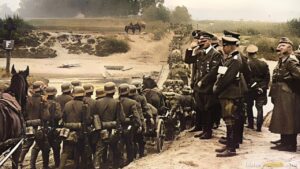
The Battle of Moscow was one of the most important battles of the Eastern Front of World War II. Fought from October 2nd, 1941 to January 7th, 1942, the battle saw Nazi German forces push to within approximately 12 miles (19 kilometers) of the Soviet capital before being halted and driven back by a combination of fierce Soviet resistance, severe supply shortages, and the brutal conditions of the Russian winter. The Battle of Moscow was part of the overall Nazi German invasion of the Soviet Union, which was codenamed Operation Barbarossa and had begun in June of 1941. In general, historians consider the Battle of Moscow to have been a significant turning point in World War II, as it marked the first major defeat of Nazi German forces on the Eastern Front and shattered the belief that the Soviet Union could be quickly and decisively conquered.
WHAT WAS THE EASTERN FRONT OF WORLD WAR II?
The Eastern Front of World War II refers to the campaigns and conflicts fought between Nazi Germany and the Soviet Union across the vast territory of Eastern Europe and the western Soviet Union from 1941 to 1945. The Eastern Front began on June 22nd, 1941, when Nazi Germany launched a surprise invasion of the Soviet Union in an operation codenamed Operation Barbarossa. In general, the Eastern Front was the largest and deadliest theater of the entire war, involving millions of soldiers on both sides and resulting in casualties on a scale unmatched anywhere else in the conflict. As such, the Battle of Moscow was one of the most significant early conflicts of the Eastern Front and played an important role in determining the overall course of the war.
BATTLE OF MOSCOW – BACKGROUND
To fully understand the Battle of Moscow, it is first important to understand the events that led to it. Operation Barbarossa began on June 22nd, 1941, when over 3 million Nazi German troops, along with thousands of tanks and aircraft, launched a massive surprise attack against the Soviet Union across a front stretching approximately 1,800 miles (2,900 kilometers). The Nazis divided their forces into three main army groups, each with a different objective. The northern army group targeted the Soviet city of Leningrad, the southern army group advanced toward Ukraine, and the central army group advanced directly toward the Soviet capital of Moscow.
In the opening months of Operation Barbarossa, Nazi German forces achieved a series of rapid and devastating victories against the Soviet military using blitzkrieg tactics. Blitzkrieg, meaning ‘lightning war’, was a German military strategy characterized by rapid, highly mobile attacks combining air power, armored units, and infantry that aimed to overwhelm the enemy before they could mount an effective defense. For instance, in the Battle of Kiev in August and September of 1941, Nazi German forces encircled and captured over 600,000 Soviet soldiers. As such, by the autumn of 1941, the central army group had advanced deep into Soviet territory and Moscow lay directly in its path.
It should also be noted that before launching the direct assault on Moscow, Hitler had made the controversial decision in August of 1941 to redirect significant forces from the central army group southward to support the Battle of Kiev. Many German commanders argued that this delay was a serious strategic error, as it cost the central army group several critical weeks of good campaigning weather before winter arrived. As a result, the offensive toward Moscow did not begin until October of 1941, significantly later than originally planned.
BATTLE OF MOSCOW – OPERATION TYPHOON
The Nazi German offensive toward Moscow was codenamed ‘Operation Typhoon’ and began on October 2nd, 1941. The operation was launched with a large concentration of Nazi German forces, including three Panzer groups and several infantry armies totaling approximately 1.9 million soldiers, supported by over 1,000 tanks and nearly 1,400 aircraft. The initial German advance was rapid and achieved several major encirclements of Soviet forces. For instance, in the Battle of Vyazma and the Battle of Bryansk, which took place in early October of 1941, Nazi German forces encircled and captured approximately 670,000 Soviet soldiers, leaving the road to Moscow seemingly open.
The Soviet position appeared desperate in early October of 1941. The loss of so many soldiers in the encirclements had left large gaps in the Soviet defensive lines, and panic spread in Moscow as the German advance continued. For instance, on October 16th, 1941, large numbers of civilians and government officials began to flee the city. However, Soviet leader Joseph Stalin made the decision to remain in Moscow, which was an important signal to both the Soviet military and the broader Soviet population that the capital would be defended.
In response to the crisis, the Soviet government recalled General Georgy Zhukov from the Leningrad Front and placed him in command of the defense of Moscow. Zhukov immediately set about organizing a new defensive line and rushing whatever reserves could be assembled to halt the German advance. As well, the Soviet government mobilized the civilian population of Moscow to construct defensive fortifications around the city, including anti-tank ditches, barricades, and other obstacles. For instance, hundreds of thousands of Moscow civilians, the majority of whom were women, worked through the autumn of 1941 to build these defenses.
BATTLE OF MOSCOW – NAZI GERMAN ADVANCE HALTED
By mid-October of 1941, the Nazi German advance had begun to slow for several reasons. First, the autumn rains had turned the unpaved roads and fields of the Soviet Union into deep mud that brought wheeled and tracked vehicles to a near standstill. This period of mud and difficult movement became known among German soldiers as the ‘Rasputitsa’, or mud season, and it severely limited the mobility that had been central to the success of blitzkrieg tactics. Second, the extended supply lines of the advancing German forces were struggling to keep pace with the front, meaning that forward units were frequently short of fuel, ammunition, and food.
Despite these difficulties, the German offensive resumed in mid-November of 1941 after the ground had frozen solid and movement became easier again. Nazi German forces pushed forward and came closest to Moscow in late November and early December of 1941, with some forward units reaching positions approximately 12 miles (19 kilometers) from the city center. For instance, German soldiers reportedly were able to see the towers of the Kremlin through binoculars from their forward positions. At this point, however, the German forces were exhausted, severely depleted in strength, and wholly unprepared for the extreme cold of the Russian winter, with temperatures dropping to as low as minus 40 degrees Fahrenheit (minus 40 degrees Celsius).
It should also be noted that German military planners had assumed that the Soviet Union would be defeated before winter arrived, and as a result German troops had not been equipped with adequate winter clothing or cold-weather equipment. In contrast, Soviet forces were far better prepared for the conditions and had been reinforced by fresh divisions transferred from Siberia, where they had been stationed in anticipation of a potential Japanese attack in the east. As such, by early December of 1941, the balance of strength along the Moscow front had shifted significantly in favor of the Soviet defenders.
BATTLE OF MOSCOW – SOVIET COUNTEROFFENSIVE
On December 5th, 1941, the Soviet Union launched a major counteroffensive against the exhausted and overstretched Nazi German forces along the Moscow front. The counteroffensive was planned and directed by General Georgy Zhukov and involved fresh Soviet divisions attacking the weakened flanks of the German advance. The Soviet attack achieved immediate results, pushing German forces back from their forward positions along a wide front. For instance, within days of the counteroffensive beginning, Nazi German forces had been pushed back from their closest positions to Moscow and were in retreat along much of the front.
The Soviet counteroffensive continued through December of 1941 and into January of 1942, driving German forces back between 60 and 160 miles (97 and 257 kilometers) from Moscow in several areas. Adolf Hitler responded to the retreat by issuing orders forbidding any further withdrawal, insisting that German forces hold their positions regardless of the military situation. Several experienced German commanders who ordered retreats to avoid encirclement were removed from command. As such, the German army stabilized a new defensive line in the winter of 1941 to 1942, but the offensive against Moscow had definitively failed. The Battle of Moscow officially ended on January 7th, 1942.
BATTLE OF MOSCOW – SIGNIFICANCE
The Battle of Moscow was significant for several important reasons. First, it was the first major defeat suffered by Nazi German forces on the Eastern Front and marked the end of the rapid German advances that had characterized Operation Barbarossa in its opening months. The failure to capture Moscow demonstrated that the Soviet Union could not be quickly conquered and that the war in the east would be a far longer and more costly struggle than Nazi German leaders had anticipated.
Second, the Battle of Moscow had important strategic consequences for the overall course of World War II. The failure of Operation Typhoon meant that Nazi Germany now faced the prospect of a prolonged two-front war, with British forces continuing to fight in the west while Soviet forces remained in the field in the east. This was precisely the strategic situation that German military planners had hoped to avoid.
Third, the Battle of Moscow was significant because of its enormous human cost. Historians estimate that the overall Battle of Moscow resulted in approximately 1 million casualties on the Soviet side and approximately 615,000 casualties on the Nazi German side, making it one of the largest and most costly battles in the history of warfare. As such, the Battle of Moscow stands as one of the defining moments of the Eastern Front and one of the most important battles of World War II.