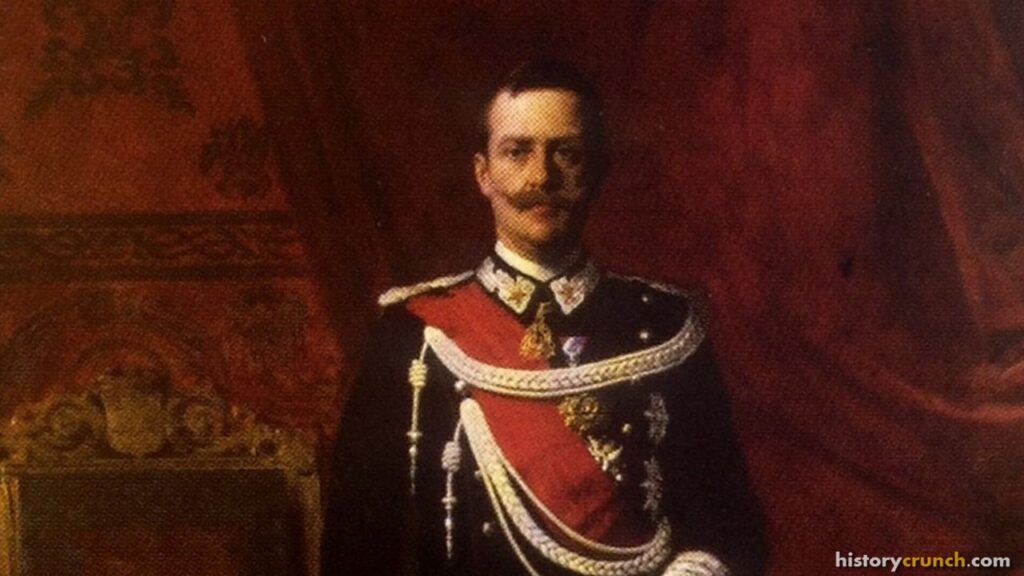
Victor Emmanuel III was the King of Italy from 1900 to 1946 and one of the most significant yet often overlooked figures in the history of both World War I and World War II. He is remembered as a hesitant and indecisive ruler whose willingness to accommodate powerful forces around him, first the military during World War I and then the fascist movement of Benito Mussolini, defined his long reign and ultimately destroyed the Italian monarchy.
Victor Emmanuel III’s Early Life
Victor Emmanuel III was born on November 11th, 1869 CE in Naples, Italy. He was the only son of King Umberto I and Queen Margherita of Savoy. As a child, Victor Emmanuel suffered from physical disabilities that required him to wear orthopedic devices to strengthen his legs, and as an adult he stood just over five feet tall. His solitary childhood gave him a reputation for being shy, reserved and intensely private. He was educated with a strong emphasis on military training and spent much of his early life in the company of army officers, which gave him a lifelong love of military affairs but did little to prepare him for the complex political challenges he would face as king.
Victor Emmanuel became king unexpectedly on July 29th, 1900 CE when his father Umberto I was assassinated by an anarchist in Monza. He was thirty years old at the time. His early years as king were dominated by the powerful Prime Minister Giovanni Giolitti, who oversaw a period of industrialization and democratic reform in Italy, including the introduction of universal male suffrage. As such, Victor Emmanuel entered his reign as a constitutional monarch who largely stayed out of political affairs, a pattern that would have serious consequences later in his reign.
Victor Emmanuel III and World War I
When World War I broke out in August of 1914 CE, Italy initially remained neutral despite being a member of the Triple Alliance with Germany and Austria-Hungary. The Triple Alliance was a defensive military agreement between Italy, Germany and Austria-Hungary, but Italy argued that since Austria-Hungary had started the war aggressively rather than defensively, Italy was not obliged to join. Behind the scenes, Italy was being courted by both sides with promises of territory.
In April of 1915 CE, Italy secretly signed the Treaty of London with Britain, France and Russia, the Allied powers, who promised Italy significant territorial gains in the Adriatic region and beyond in exchange for joining the war on their side. Victor Emmanuel played a decisive role in bringing Italy into the war. The Italian Prime Minister at the time, Antonio Salandra, and much of the cabinet were actually opposed to entering the conflict, but Victor Emmanuel used his royal authority to push for intervention, believing that Italy stood to gain important territories that had long been claimed by Italian nationalists. Italy declared war on Austria-Hungary on May 23rd, 1915 CE.
The Italian war effort proved extremely costly and often disastrous. The Italian army fought a brutal series of battles along the Isonzo River on the border with Austria-Hungary, suffering enormous casualties with very little territorial gain. The worst disaster came at the Battle of Caporetto in October of 1917 CE, when a combined Austro-Hungarian and German force broke through the Italian lines and forced a catastrophic retreat. The Italian army lost approximately 300,000 men as prisoners and suffered massive material losses. Victor Emmanuel remained at the front throughout the war and was widely praised for his visible presence among his troops, but the military leadership he had championed had led the country into one of the worst military disasters in Italian history.
Despite the disaster at Caporetto, Italy recovered and the war ended in November of 1918 CE with the Allied victory. However, the peace settlement deeply disappointed Italy. Many Italians felt that despite their enormous sacrifices, the country had not received the territories it had been promised in the Treaty of London, particularly along the Adriatic coast and in Africa. This sense of betrayal gave rise to the powerful myth of what Italians called the mutilated victory, the idea that Italy had won the war but been cheated of the fruits of its victory at the peace table. As such, the resentment and political instability that followed the war set the stage for one of the most consequential decisions of Victor Emmanuel’s reign.
Victor Emmanuel III and the Rise of Mussolini
The years after World War I were extremely turbulent in Italy. The country faced an economic depression, high unemployment and intense political conflict between socialist and nationalist movements. Benito Mussolini, a former socialist journalist turned nationalist agitator, had founded the Fascist movement in 1919 CE and built a paramilitary force of black-shirted followers who used violence and intimidation against left-wing organizations and trade unions. Fascism was a political ideology that emphasized extreme nationalism, the use of violence to achieve political goals and the rejection of democracy and socialism. It appealed to many Italians who were frightened of communist revolution and angry at the political chaos of the postwar years.
In October of 1922 CE, Mussolini organized what became known as the March on Rome, in which tens of thousands of Fascist supporters marched on the Italian capital as a show of force and a demand that Mussolini be given power. The Prime Minister Luigi Facta asked Victor Emmanuel to declare martial law and use the army to stop the march. Victor Emmanuel refused to sign the decree, even though military commanders reportedly assured him that the army could easily disperse the Fascist marchers. Instead, on October 30th, 1922 CE, Victor Emmanuel invited Mussolini to Rome and appointed him Prime Minister. This decision was one of the most fateful in Italian history. Rather than using his authority to stop Mussolini, Victor Emmanuel handed him the keys to power. Over the following years, Mussolini dismantled Italian democracy and established a fascist dictatorship. As such, Victor Emmanuel’s failure to act against the March on Rome enabled the rise of one of the most destructive political movements of the twentieth century.
Victor Emmanuel III’s Later Reign and Abdication
Victor Emmanuel remained on the throne throughout Mussolini’s dictatorship, increasingly reduced to a ceremonial figure with little real power. He signed the laws that stripped Italian Jews of their rights in 1938 CE and gave his approval to Italy’s entry into World War II alongside Nazi Germany in June of 1940 CE. When the Allied forces invaded Sicily in July of 1943 CE and it became clear that Italy was losing the war badly, Victor Emmanuel finally acted. On July 25th, 1943 CE he had Mussolini arrested and appointed the conservative military commander Marshal Pietro Badoglio as Prime Minister. Italy signed an armistice with the Allies in September of 1943 CE.
However, Victor Emmanuel’s reputation was beyond repair. His decades of collaboration with Mussolini had deeply tainted the Italian monarchy in the eyes of the Italian people. In June of 1944 CE he transferred his powers to his son Crown Prince Umberto, though he retained his title as king. On May 9th, 1946 CE, three weeks before a national referendum on whether Italy should remain a monarchy or become a republic, Victor Emmanuel formally abdicated in favor of Umberto, hoping that removing himself might give the monarchy a better chance of surviving. The move failed. In the referendum held on June 2nd, 1946 CE, fifty-four percent of Italians voted to abolish the monarchy and establish a republic. Victor Emmanuel went into exile in Egypt and died in Alexandria on December 28th, 1947 CE at the age of seventy-eight.
Victor Emmanuel III is remembered as a king whose long reign saw Italy through two world wars but whose indecision and willingness to accommodate dangerous political forces had catastrophic consequences for his country. His refusal to stop Mussolini in 1922 CE remains one of the most consequential failures of political leadership in the history of modern Europe. As such, his legacy is one of lost opportunities and a monarchy ultimately destroyed by its own inability to defend the democratic institutions it was supposed to protect.