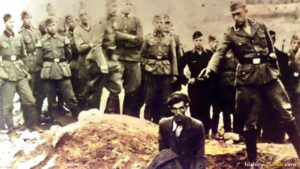
The Soviet Union in World War II had one of the most costly experiences of any nation in the entire conflict. After initially aligning itself with Nazi Germany through a non-aggression agreement in 1939, the Soviet Union was invaded by Nazi Germany on June 22nd, 1941, in one of the largest military operations in history. What followed was four years of devastating warfare on the Eastern Front that resulted in between 26 and 27 million Soviet deaths, the majority of whom were civilians. In total, the Soviet Union suffered higher casualties than any other nation in World War II.
THE SOVIET UNION ENTERS WORLD WAR II
World War II began on September 1st, 1939, when Nazi Germany, under the leadership of Adolf Hitler, invaded the country of Poland. However, the Soviet Union’s relationship with Nazi Germany at that time was not one of opposition. On August 23rd, 1939, just days before the invasion of Poland, the Soviet Union and Nazi Germany had signed a non-aggression agreement known as the Molotov-Ribbentrop Pact. The pact contained a public declaration that the two nations would not attack each other, as well as a secret protocol that divided Eastern Europe into Nazi German and Soviet spheres of influence. Under the terms of the secret protocol, eastern Poland, the Baltic states, and Finland were assigned to the Soviet sphere.
As a result of the Molotov-Ribbentrop Pact, when Germany invaded western Poland on September 1st, 1939, the Soviet Union invaded eastern Poland from the east on September 17th, 1939, and occupied the territory assigned to it under the pact. In the months that followed, the Soviet Union also invaded Finland in November of 1939 in what became known as the ‘Winter War’, and occupied the Baltic states of Estonia, Latvia and Lithuania in June of 1940. As such, the Soviet Union used the period of its non-aggression arrangement with Germany to expand its western borders significantly.
It should also be noted that the Molotov-Ribbentrop Pact was never a relationship of genuine trust between the two nations. Joseph Stalin was aware that a conflict with Nazi Germany was likely eventually, and used the time gained by the pact to attempt to modernize and rebuild the Red Army, which had been severely weakened by the political purges of the late 1930s in which Stalin had executed or imprisoned thousands of experienced military officers.
SOVIET UNION IN WORLD WAR II – ARMY
At the start of World War II, the Soviet military, known as the ‘Red Army’, was the largest army in the world in terms of numbers. However, its effectiveness had been severely damaged by the political purges of the late 1930s, in which Soviet leader Joseph Stalin had executed or imprisoned thousands of experienced military officers. As a result, the Red Army entered the war poorly led, poorly equipped in many areas, and unprepared for the style of warfare that Nazi Germany would bring to the Eastern Front.
Despite the catastrophic losses of the first years of the war, the Soviet military underwent a remarkable transformation throughout the conflict. New commanders emerged who proved highly capable, including Marshal Georgy Zhukov, who played a central role in the defense of Moscow, the victory at Stalingrad, and the final advance on Berlin. At the same time, Soviet industry was reorganized to produce effective weapons, including the T-34 tank, which became one of the most important armored vehicles of the entire war. By 1943 and 1944, the Red Army had become one of the most powerful and effective military forces in the world.
In total, it is estimated that approximately 34 million Soviet men and women served in the armed forces during World War II. The conflict resulted in approximately 8 to 9 million Soviet military deaths, in addition to the approximately 14 to 17 million civilians who were killed as a result of the occupation and the fighting. As such, the Soviet Union bore a greater share of the human cost of World War II than any other nation.
SOVIET UNION IN WORLD WAR II – MAJOR CAMPAIGNS AND BATTLES
The Soviet Union in World War II participated as part of the Allied Powers alongside Britain, the United States, and other nations. On the opposing side were the Axis Powers, primarily Nazi Germany, along with Romania, Hungary, Finland, and other nations that contributed forces to the Eastern Front campaign. The major campaigns and battles of the Soviet Union in World War II included: Operation Barbarossa and the initial German advance, the Battle of Moscow, the Battle of Stalingrad, the Battle of Kursk, Operation Bagration, and the final advance to Berlin.
OPERATION BARBAROSSA
The non-aggression arrangement between the Soviet Union and Nazi Germany ended on June 22nd, 1941, when Nazi Germany launched a massive surprise invasion of the Soviet Union codenamed ‘Operation Barbarossa‘. The operation involved more than three million Nazi German soldiers, supported by forces from Romania, Hungary, Italy, Slovakia and Finland. It was the largest military operation in the history of warfare up to that point.
The initial Nazi German advance was devastating. Nazi German forces achieved almost complete tactical surprise, and the Soviet military was overwhelmed in the opening weeks of the campaign. For instance, the German Luftwaffe destroyed much of the Soviet air force on the ground in the first days of the attack, and large Soviet formations were rapidly encircled and captured. Millions of Soviet soldiers were taken prisoner in the opening months of the campaign. By the autumn of 1941, Nazi German forces had advanced hundreds of miles into Soviet territory, capturing enormous areas of Ukraine, Belarus, and the Baltic region, and were approaching Moscow itself. The Nazi blitzkrieg tactics proved entirely successful in the western regions of the Soviet Union.
The Battle of Moscow, fought from October of 1941 to January of 1942, halted the Nazi German advance at the gates of the Soviet capital. A combination of fierce Soviet resistance, overstretched Nazi German supply lines, and the brutal conditions of the Russian winter stopped the German offensive within approximately 12 miles (19 kilometers) of central Moscow. In December of 1941, the Soviet forces launched a major counteroffensive that pushed Nazi German forces back from Moscow and represented the first significant defeat of German forces on the Eastern Front.
BATTLE OF STALINGRAD
The Battle of Stalingrad, fought from July 17th, 1942 to February 2nd, 1943, was one of the most significant turning points of the entire war. Nazi German forces advanced into southern Russia in the summer of 1942 with the goal of capturing Stalingrad, an important industrial city on the Volga River, and securing the oil fields of the Caucasus region. The German Sixth Army, under General Friedrich Paulus, entered the city in August of 1942 and became engaged in months of brutal street-by-street fighting against Soviet defenders.
At the height of the battle, German forces controlled more than 90 percent of the city, but Soviet forces under General Vasily Chuikov used the rubble of the destroyed buildings to their advantage, fighting the Germans at close quarters in what became known as ‘house-to-house’ combat. In November of 1942, the Soviet Union launched a major counteroffensive known as ‘Operation Uranus’, which encircled the entire German Sixth Army inside Stalingrad. Hitler ordered the Sixth Army to hold its position and refused to allow a breakout. By February of 1943, the surviving German forces, approximately 91,000 soldiers including Field Marshal Friedrich Paulus, surrendered. The Battle of Stalingrad resulted in approximately 2 million total casualties on both sides and is considered by many historians to be the decisive turning point of the war on the Eastern Front.
BATTLE OF KURSK
Following the defeat at Stalingrad, Germany launched one final major offensive on the Eastern Front in the summer of 1943. The Battle of Kursk, fought from July 5th to August 23rd, 1943, was the largest tank battle in history, involving approximately 6,000 tanks, 2 million soldiers, and 4,000 airplanes on both sides. Soviet military intelligence had advance knowledge of the German offensive plan and constructed extensive defensive positions in the Kursk region in anticipation of the attack. The German assault made little progress against the prepared Soviet defenses, and the Soviet forces launched their own counteroffensive that pushed the Germans back along the entire front. The Battle of Kursk ended any possibility of Germany regaining the initiative on the Eastern Front and set the stage for the long Soviet advance westward that would eventually reach Berlin.
OPERATION BAGRATION AND THE ADVANCE TO BERLIN
In the summer of 1944, the Soviet Union launched one of the largest military offensives of the entire war. Operation Bagration, which began on June 23rd, 1944, coordinated to coincide with the Allied D-Day landings in Normandy, was directed against the German Army Group Centre in Belarus. The operation resulted in the near-complete destruction of Army Group Centre, with approximately 300,000 German casualties, and drove Nazi German forces back hundreds of miles to the west. It should also be noted that Soviet casualties in Operation Bagration exceeded 750,000, reflecting the enormous human cost of every major operation on the Eastern Front.
Throughout 1944 and into 1945, Soviet forces advanced steadily westward, liberating Poland, Czechoslovakia, Hungary, Romania, and other Eastern European countries from Nazi German control. The final Soviet offensive of the war was the Battle of Berlin, which began on April 16th, 1945. Soviet forces under Marshals Georgy Zhukov and Ivan Konev attacked Berlin from the east and south, overwhelming the weakened German defenses. Adolf Hitler died by suicide in Berlin on April 30th, 1945, and Nazi Germany formally surrendered on May 8th, 1945. As such, Soviet forces were at the center of the final defeat of Nazi Germany.
THE SOVIET UNION AND JAPAN
It should also be noted that in the final weeks of the war, the Soviet Union declared war on Imperial Japan on August 8th, 1945, two days after the United States dropped an atomic bomb on Hiroshima, Japan. Soviet forces launched a rapid invasion of Japanese-controlled Manchuria in northeastern China, known as ‘Operation August Storm’. The Soviet offensive overwhelmed Japanese forces within days and contributed to Japan’s decision to surrender. As such, the Soviet Union played a role in bringing the war in the Pacific to an end as well as in Europe.
SOVIET UNION IN WORLD WAR II – HOME FRONT
The Soviet home front during World War II was shaped entirely by the extreme demands of total war and the direct impact of the German invasion on Soviet territory. Large areas of the western Soviet Union, including Ukraine, Belarus, and much of European Russia, were occupied by German forces for extended periods. The German occupation was characterized by extreme brutality, including mass executions of Jewish people as part of the Holocaust, the murder of Soviet political commissars, and the deliberate starvation of Soviet prisoners of war. As a result, Soviet civilian deaths during the war were enormous, with approximately 14 to 17 million civilians killed as a result of the German occupation and the fighting.
The Soviet economy was mobilized entirely for war production. One of the most important decisions of the early war period was the relocation of Soviet industrial facilities eastward, beyond the Ural Mountains, to areas beyond the reach of German forces and bombing. For instance, entire factories were dismantled and transported by rail to new locations in Siberia and Central Asia, where they were reassembled and resumed production within weeks. This industrial relocation was a remarkable organizational achievement and ensured that Soviet war production was able to continue even as German forces occupied vast areas of European Russia.
As well, the Soviet Union received important material assistance from the United States and Britain through the Lend-Lease program. Starting from October of 1941, the United States supplied the Soviet Union with large quantities of food, trucks, airplanes, tanks, and raw materials. For instance, American-supplied Studebaker trucks were important for Soviet logistical operations, and the provision of high-octane aviation fuel helped boost Soviet air force capabilities. The total value of Lend-Lease aid to the Soviet Union during the war is estimated at approximately 11 billion dollars.
Women also played a central role in the Soviet war effort. With enormous numbers of men serving at the front, women filled roles in industry, agriculture, and civil defense on a massive scale. As well, the Soviet Union deployed women in active military roles to a far greater extent than any other nation in the war, including as snipers, pilots, and tank crew members. For instance, the 588th Night Bomber Regiment, known as the ‘Night Witches’, flew thousands of combat missions against Nazi German positions throughout the war.
SOVIET UNION IN WORLD WAR II – SIGNIFICANCE
World War II was the most defining and costly event in the history of the Soviet Union. First, the scale of Soviet sacrifice during the war was without parallel among any of the nations involved. Between 26 and 27 million Soviet citizens died as a result of the conflict, representing approximately 14 percent of the total pre-war Soviet population. This level of loss left a profound and lasting mark on Soviet society and continues to shape the way Russia remembers and commemorates the war to the present day.
Second, the Soviet Union’s military contribution to the defeat of Nazi Germany was central to the overall Allied victory. It is estimated that Soviet forces were responsible for approximately 70 percent of the total German military casualties suffered during the war. The Eastern Front was by far the largest theater of fighting in World War II, and the destruction of the majority of Germany’s military strength there was the decisive factor in the Allied victory in Europe.
Third, the Soviet Union’s role in World War II had important consequences for the postwar world. Soviet forces occupied large areas of Eastern Europe at the end of the war, and the Soviet Union used this military presence to install communist governments across the region. This expansion of Soviet influence into Eastern Europe was one of the primary causes of the Cold War that followed, as the United States and its allies viewed Soviet domination of Eastern Europe as a direct threat to the democratic values the war had been fought to defend. As such, the Soviet Union’s experience in World War II was not only the greatest crisis in its history, but also the foundation of its postwar power and the beginning of its conflict with the western world that lasted for the next four decades.