Nazi Germany in World War II was the nation most responsible for starting and escalating the conflict in Europe. Under the leadership of Adolf Hitler, Nazi Germany launched a series of military campaigns that brought most of continental Europe under Nazi German control by 1941. At the same time, the Nazi regime carried out the Holocaust, the systematic murder of approximately six million Jewish people and millions of others across occupied Europe. Nazi Germany fought the war on multiple fronts simultaneously but was ultimately defeated by the Allied Power by May of 1945. In total, German military deaths during the war are estimated at approximately 5.3 million, while German civilian deaths from Allied bombing and other causes are estimated at between 1.5 and 2 million.
NAZI GERMANY ENTERS WORLD WAR II
To fully understand Nazi Germany’s role in World War II, it is important to understand the events that led to the outbreak of the conflict. After World War I ended in 1918, Germany was forced to accept the terms of the Treaty of Versailles, which required Germany to give up territory, pay war reparations, and accept responsibility for starting the war. These terms created widespread anger and humiliation in Germany and contributed to severe economic hardship throughout the 1920s and early 1930s.
Adolf Hitler rose to power in this climate of national anger and economic suffering. In fact, Hitler became Chancellor of Germany on January 30th, 1933, and quickly established a fascist dictatorship. He rebuilt Germany’s military in violation of the Treaty of Versailles, remilitarized the Rhineland in 1936, annexed Austria in March of 1938, and seized Czechoslovakia in 1938 and 1939. The western democracies of Britain and France responded with a policy of appeasement, making concessions to Hitler in the hope of avoiding another major war. This policy failed to stop Hitler’s aggression.
World War II began on September 1st, 1939, when Nazi Germany invaded Poland. Britain and France declared war on Nazi Germany on September 3rd, 1939, in fulfillment of their alliance commitments to Poland. On September 17th, 1939, the Soviet Union, which had signed the Molotov-Ribbentrop non-aggression pact with Germany just weeks earlier, invaded Poland from the east. Poland was defeated within weeks, and its territory was divided between Nazi Germany and the Soviet Union.
NAZI GERMANY IN WORLD WAR II – ARMY
At the outbreak of World War II, the German military, known as the Wehrmacht, was the most powerful and well-prepared armed force in Europe. Germany had rebuilt its military throughout the 1930s with a focus on speed, mobility, and combined arms warfare. The central German military strategy was known as ‘blitzkrieg’, meaning ‘lightning war’, which combined fast-moving armored forces, motorized infantry, and close air support to overwhelm enemy defenses before they could organize an effective response. This strategy proved devastatingly effective in the early years of the war.
The Wehrmacht consisted of three main branches: the Heer, which was the army, the Luftwaffe, which was the air force, and the Kriegsmarine, which was the navy. In addition, the Waffen-SS, which was the military branch of the Nazi Party’s SS organization, also fielded substantial combat forces throughout the war. In total, Germany mobilized approximately 17 to 18 million men in its armed forces during World War II.
NAZI GERMANY IN WORLD WAR II – MAJOR CAMPAIGNS AND BATTLES
Nazi Germany in World War II fought as the leading member of the Axis Powers alongside fascist Italy and Imperial Japan. On the opposing side were the Allied Powers, whose main members included: Britain, France, the Soviet Union, the United States, Canada, Australia, and other nations. The major campaigns and battles of Nazi Germany in World War II included: the conquest of Western Europe, the Battle of Britain, the North African campaign, Operation Barbarossa and the Eastern Front, and the final Allied advance into Germany.
CONQUEST OF WESTERN EUROPE (BATTLE OF FRANCE)
Following the rapid defeat of Poland in September of 1939, Nazi Germany turned its attention to Western Europe. After a period of inactivity known as the ‘Phoney War’, German forces launched a massive offensive on May 10th, 1940, attacking France, Belgium, the Netherlands, and Luxembourg simultaneously. German forces used blitzkrieg tactics to advance through the Ardennes Forest, a heavily wooded area that French commanders had considered impassable for armored forces. This thrust cut through Allied defenses and drove toward the English Channel, trapping large Allied forces in Belgium and northern France.
Allied forces were evacuated from the beaches of Dunkirk in a major naval operation from late May to early June of 1940, but France itself was unable to resist the German advance. German forces entered Paris on June 14th, 1940, and France signed an armistice on June 22nd, 1940. The speed and scale of Germany’s victory shocked the world. By the summer of 1940, Nazi Germany controlled or had influence over most of continental Western Europe, including: France, Belgium, the Netherlands, Denmark, Norway, and Luxembourg. Germany had also concluded alliances with Hungary, Romania, Bulgaria, and other nations that joined the Axis cause.
BATTLE OF BRITAIN
Following the fall of France, Nazi Germany attempted to force Britain out of the war. Since a land invasion of Britain required air superiority, the German Luftwaffe launched a sustained air campaign against British airfields, radar stations, and cities beginning in July of 1940 in what became known as the Battle of Britain. The Royal Air Force successfully defended British skies, and in September of 1940 Hitler postponed the planned invasion of Britain, known as ‘Operation Sea Lion’, indefinitely. The Battle of Britain was the first major defeat of Nazi Germany in World War II.
Germany then shifted to a sustained bombing campaign against British cities known as the ‘Blitz’, which lasted from September of 1940 until May of 1941. While the Blitz caused widespread destruction and killed over 43,000 British civilians, it failed to break British morale or force Britain out of the war. As such, Britain remained a vital base for the Allied effort to defeat Nazi Germany.
OPERATION BARBAROSSA AND THE EASTERN FRONT
The most consequential decision of Adolf Hitler’s war was the launch of Operation Barbarossa on June 22nd, 1941, the massive surprise invasion of the Soviet Union. The operation involved more than three million German soldiers along a front stretching approximately 1,800 miles (2,900 kilometers). In the opening months of the campaign, German forces achieved a series of rapid and devastating victories, advancing hundreds of miles into Soviet territory and capturing millions of Soviet soldiers in large encirclements.
However, the German advance was halted at the Battle of Moscow in the winter of 1941 to 1942, which represented the first significant defeat of German forces on the Eastern Front. Germany launched further major offensives in 1942, pushing into southern Russia and reaching Stalingrad. The Battle of Stalingrad, fought from July of 1942 to February of 1943, resulted in the encirclement and destruction of the entire German Sixth Army. Approximately 91,000 surviving German soldiers, including Field Marshal Friedrich Paulus, surrendered. The defeat at Stalingrad was a turning point from which Nazi Germany never recovered on the Eastern Front.
Germany launched one final major offensive in the east at the Battle of Kursk in July of 1943, which was defeated by Soviet forces. From that point onward, German forces were pushed steadily westward by the Soviet advance. It should also be noted that the Eastern Front was by far the largest and most costly theater of the entire war. More than 80 percent of all German military casualties were suffered on the Eastern Front.
NORTH AFRICAN AND ITALIAN CAMPAIGNS
Nazi Germany also fought in North Africa and Italy during the war, largely in support of its Italian ally. The German Afrika Korps under General Erwin Rommel was sent to North Africa in February of 1941 to support Italian forces struggling against British counterattacks in Libya. Rommel’s forces achieved a series of significant victories and advanced deep into Egypt, coming close to the Suez Canal by the summer of 1942. However, the Second Battle of El Alamein in October and November of 1942 resulted in a decisive defeat of Axis forces, and by May of 1943 all Axis forces in North Africa had surrendered.
Following the Allied invasion of Sicily in July of 1943 and the subsequent fall of Mussolini, Germany occupied northern and central Italy and established strong defensive lines across the Italian peninsula. German forces fought a determined defensive campaign in Italy that lasted until May of 1945. The German defensive lines, particularly the Gustav Line centered on Monte Cassino, delayed the Allied advance for months and inflicted heavy casualties on both sides.
ALLIED ADVANCE AND THE FALL OF NAZI GERMANY
The decisive blow against Nazi Germany in the west came with the Allied D-Day landings in Normandy, France, on June 6th, 1944. Allied forces under the overall command of American General Dwight D. Eisenhower landed on five beaches along the Normandy coast and established a large beachhead that expanded steadily in the weeks that followed. German forces were unable to push the Allied forces back into the sea, and by late July of 1944 the Allied armies had broken out of Normandy and were advancing rapidly across France.
In December of 1944, Germany launched a final major offensive in the west through the Ardennes Forest in Belgium and Luxembourg in what became known as the ‘Battle of the Bulge’. The offensive achieved initial surprise but was ultimately halted and defeated by Allied forces. After this defeat, Germany had no remaining strategic reserves to prevent the Allied advance.
By early 1945, Allied forces were advancing into Germany from the west, while Soviet forces advanced from the east. The final Soviet offensive against Berlin began on April 16th, 1945. Soviet forces encircled the city and fought their way into the German capital against the last German defenders. Adolf Hitler died by suicide in his underground bunker in Berlin on April 30th, 1945. Nazi Germany formally surrendered on May 8th, 1945, a date known as V-E Day, or Victory in Europe Day.
NAZI GERMANY IN WORLD WAR II – THE HOLOCAUST
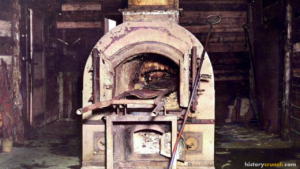
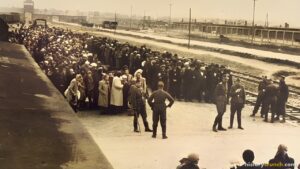
Any discussion of Nazi Germany in World War II must include the Holocaust, which was the systematic murder of approximately six million Jewish people and millions of others carried out by the Nazi regime across occupied Europe. The Holocaust was not a separate event from the war but was deeply intertwined with it. As German forces advanced through Eastern Europe and the Soviet Union, SS death squads known as the Einsatzgruppen followed behind and carried out mass shootings of Jewish people, Soviet political commissars, and others deemed enemies of the Nazi regime. From 1942 onward, the Nazi regime operated a network of death camps in occupied Poland, including: Auschwitz-Birkenau, Treblinka, Sobibor, Belzec, Chelmno, and Majdanek, where millions of people were murdered in gas chambers.
In total, the Holocaust killed approximately six million Jewish people, representing approximately two thirds of the entire Jewish population of Europe. Millions of others were also murdered, including: Soviet civilians and prisoners of war, Polish civilians, Roma people, people with disabilities, political opponents, and others. The Holocaust is considered one of the worst crimes against humanity in all of history, and the Nuremberg Trials held after the war established the principle that individuals could be held criminally responsible for war crimes and crimes against humanity.
NAZI GERMANY IN WORLD WAR II – HOME FRONT
The Nazi German home front during World War II was shaped by the demands of total war and, in the later stages of the conflict, by the direct impact of Allied bombing on German cities. The Nazi regime mobilized German society entirely in support of the war effort. Food rationing was introduced from the beginning of the war, and industrial production was directed toward military output. Women were initially encouraged to remain in the home rather than enter the workforce, reflecting Nazi ideology about the role of women in society. However, as the war dragged on and labor shortages became severe, increasing numbers of German women were directed into war industries.
Nazi Germany also relied heavily on forced labor throughout the war. Approximately 8 million foreign workers, including prisoners of war and civilians from occupied countries, were forced to work in German factories and on German farms under extremely harsh conditions. The use of forced labor was itself a war crime and a crime against humanity.
Allied bombing of German cities became increasingly intensive from 1942 onward and caused substantial destruction. For instance, the bombing of Hamburg in July and August of 1943 killed approximately 37,000 civilians in a single week. The bombing of Dresden in February of 1945 killed an estimated 22,700 civilians. By the final stages of the war, large areas of major German cities had been destroyed, and the German population was suffering from food shortages and the disruption of essential services.
Public morale in Nazi Germany declined steadily as the military situation worsened from 1942 onward. The Nazi regime used propaganda, censorship, and fear to maintain control over the German population throughout the war. The Gestapo, which was the Nazi secret police, monitored public opinion and suppressed dissent. Despite some resistance, including the failed assassination attempt against Hitler on July 20th, 1944, the Nazi regime maintained control over Germany until its final military defeat.
NAZI GERMANY IN WORLD WAR II – SIGNIFICANCE
World War II was the defining and final chapter of Nazi Germany. First, the war that Hitler started was ultimately the cause of the destruction of the Nazi regime itself. The decision to invade the Soviet Union in 1941 and to simultaneously fight Britain, the Soviet Union, the United States, and their allies was a strategic overextension that Nazi Germany’s military and industrial resources could not sustain. As such, the war that Hitler launched to expand German power and territory instead ended with Germany’s total defeat and occupation.
Second, the Holocaust stands as the most terrible consequence of Nazi Germany’s role in World War II. The deliberate murder of approximately six million Jewish people and millions of others was a crime without precedent in modern history. The Nuremberg Trials, which held senior Nazi leaders accountable for war crimes and crimes against humanity, established important principles of international law that shaped the postwar world and the development of human rights law in the decades that followed.
Third, the defeat of Nazi Germany produced a fundamental transformation of the German state and society. Germany was divided into occupation zones by the Allied Powers after the war, and the western zones eventually became the Federal Republic of Germany, a democratic nation integrated into NATO and the European community. The eastern zone became the German Democratic Republic under Soviet control, until the two halves of Germany were reunified following the fall of the Berlin Wall in 1989 and German reunification in 1990. As such, the consequences of Nazi Germany’s role in World War II shaped the history of Germany and Europe for the rest of the 20th century.