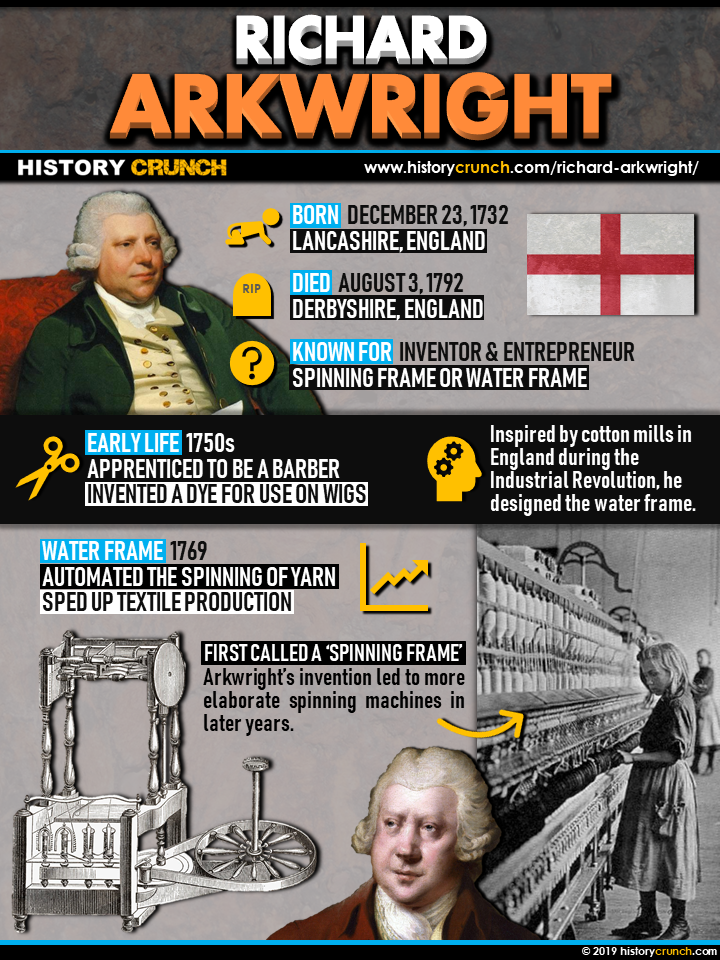
Richard Arkwright was one of the most significant inventors and entrepreneurs of the Industrial Revolution. Born in Lancashire, England in 1732, Arkwright is best remembered for developing the water frame in 1769, a spinning machine powered by water that dramatically advanced cotton production and helped establish the modern factory system. Unlike many inventors of his era, Arkwright also became enormously wealthy from his work, making him one of the most celebrated industrial figures of the 18th century. This infographic was designed for students to visually summarize the key aspects of Richard Arkwright’s life and significance and is based on the History Crunch article titled Richard Arkwright.
Richard Arkwright – Infographic
About This Infographic
This Richard Arkwright infographic was created by the History Crunch team to help students and teachers quickly understand the life and significance of one of the defining figures of the Industrial Revolution. It is designed as a visual learning and study tool, summarizing the essential information covered in our full article on Richard Arkwright. Teachers may use it as a classroom display, a discussion prompt, or a study aid for students preparing for assessments.
What This Infographic Covers
Richard Arkwright was born on December 23rd, 1732 in Lancashire, England. He was the youngest child of poor working-class parents and received no formal schooling, instead being taught to read and write by his cousin. As a young man he trained as a barber and set up his own shop in the 1750s. While running the shop he invented a dye that could be used on the fashionable periwigs of the time, making a significant profit from it. He used that money to fund further inventions, setting him on the path toward becoming one of the most important figures of the Industrial Revolution.
The centerpiece of the infographic is Arkwright’s invention of the water frame in the 1760s. The water frame was a spinning machine that used the moving force of a river or creek to power a rotating shaft, enabling the production of strong, inexpensive cotton yarn on a large scale. Unlike earlier spinning machines such as James Hargreaves’s spinning jenny, the water frame mechanized almost the entire spinning process and required very little human labor to operate. This made it a major advancement in textile manufacturing and a critical step toward large-scale industrial production.
The infographic also covers Arkwright’s role as an entrepreneur and his contribution to the development of the factory system. After patenting his water frame, Arkwright moved to Nottingham where he formed business partnerships and built mills to process cotton and other products. He developed a disciplined system of factory organization at his mills, including at the Birkacre Mill at Chorley, which became a model that was replicated in factories across England. Arkwright was also known for building housing and facilities to attract workers to his mills, recognizing that a reliable workforce was as important as the machinery itself.
Finally the infographic covers Arkwright’s death and legacy. Despite struggling with others copying his invention without payment, Arkwright was famous and wealthy in his own lifetime. He was formally knighted by the British monarch in 1786 in recognition of his contributions to the country. When he died on August 3rd, 1792, his estate was worth more than 500,000 pounds. Today he is celebrated as one of the most significant figures of the entire Industrial Revolution, remembered both as an inventor and as a pioneer of modern industrial capitalism.
How to Use This Infographic in the Classroom
This infographic works well as a visual introduction to Richard Arkwright before students read the full biography article or the article on the water frame. It can also be used as a review tool before an assessment, or as a discussion prompt asking students to compare Arkwright’s story with that of inventors like John Kay and James Hargreaves, who both failed to profit from their inventions while Arkwright became enormously wealthy. Teachers may also use it alongside related articles on the water frame, the factory system and textile manufacturing to help students understand Arkwright’s central role in the story of industrialization.
Related Articles
To learn more about the topics covered in this infographic, visit the following History Crunch articles:
- Richard Arkwright
- Water Frame Invention in the Industrial Revolution
- Industrial Revolution Overview
- Inventions and Inventors of the Industrial Revolution
- Textile Manufacturing in the Industrial Revolution
- Factory System in the Industrial Revolution
- James Hargreaves
- John Kay
- Edmund Cartwright