France was one of the central nations of World War I, fighting on its own soil for the entire duration of the conflict. As a founding member of the Triple Entente alongside Britain and Russia, France was drawn into the war in August 1914 when Germany launched its invasion through Belgium. Much of the Western Front ran directly through northern France, meaning the country bore the brunt of the most devastating fighting of the entire war. Over 8.4 million French citizens served and approximately 1.4 million died, making France’s losses among the highest of any nation in the conflict. This infographic was designed for students to visually summarize France’s role in World War I and is based on the History Crunch article titled France in World War I.
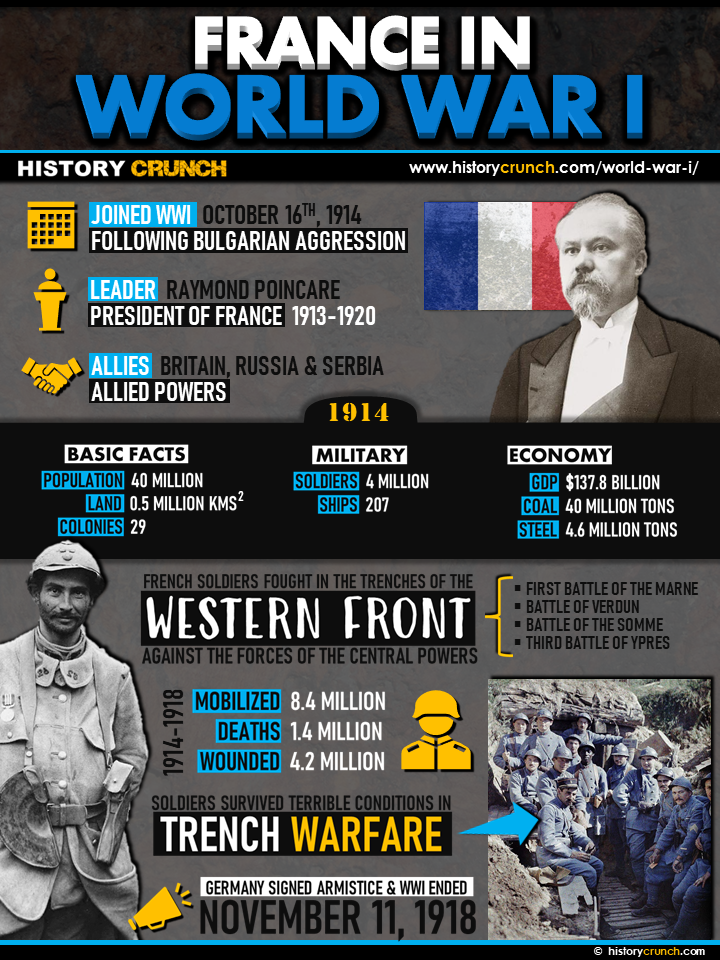
France in World War I – Infographic
About This Infographic
This France in World War I infographic was created by the History Crunch team to help students and teachers quickly understand the significance of France’s role in the First World War. It is designed as a visual learning and study tool, summarizing the essential information covered in our full article on France in World War I. Teachers may use it as a classroom display, a discussion prompt, or a study aid for students preparing for assessments.
What This Infographic Covers
The infographic begins with why France entered the war and its historical context. France was a member of the Triple Entente and had deep historical grievances toward Germany dating back to the Franco-Prussian War of 1870 to 1871, in which Prussia defeated France and took the region of Alsace-Lorraine along their shared border. Recovering Alsace-Lorraine was a major French war aim. In the decades before World War I, France and Germany engaged in an intense arms race in which both countries doubled their armies between 1870 and 1914. At the outbreak of war in 1914 France had approximately 4 million soldiers. France formally entered World War I on August 11th, 1914 after Germany launched its invasion through Belgium. France used a system of universal conscription that allowed it to mobilize its forces rapidly.
The infographic covers France’s major battles. The war opened with the Battle of the Frontiers from August to September 1914, a series of battles along France’s eastern border in which the German Schlieffen Plan drove French and British forces back with approximately 260,000 French casualties and 75,000 deaths. The German advance was finally halted at the First Battle of the Marne in September 1914, where French troops stopped the German Army just 30 miles from Paris at the cost of around 250,000 casualties and over 80,000 deaths, saving the French capital but beginning the long Western Front stalemate.
The defining French battle of the war was the Battle of Verdun, fought from February to December 1916. The longest single battle in human history at 302 days, Verdun saw Germany attempt to capture a strategically vital region of northeastern France and overwhelm French defenses. Despite coming within 2 miles of the city, Germany was never able to capture Verdun. French General Philippe Petain organized the defense and became a war hero for his role. France suffered an estimated 400,000 casualties and 163,000 deaths at Verdun. France also participated in the Battle of the Somme in 1916, suffering approximately 200,000 casualties in that campaign.
The infographic also covers the Nivelle Offensive of 1917 and its catastrophic failure. When Robert Nivelle replaced Joseph Joffre as Commander-in-Chief in late 1916, he launched a major coordinated attack against German lines in the spring of 1917 that resulted in approximately 187,000 French casualties without achieving its goals. The failure of the Nivelle Offensive triggered mutinies among French soldiers, with many refusing to participate in further suicidal frontal assaults. Nivelle was replaced by Petain in May 1917, who restored morale and stabilized the French Army.
The infographic covers the French home front, which was uniquely affected because much of the war was fought on French soil. Communities in northern France were displaced and the region’s vital coal and steel industries were severely disrupted. President Raymond Poincare led France politically throughout the war. Rationing was introduced and government propaganda was used extensively to maintain public support. The war left northern France with enormous physical destruction that took decades to repair.
How to Use This Infographic in the Classroom
This infographic works well as a visual introduction to France in World War I before students read the full article. It can also be used as a discussion prompt asking students to consider why the Battle of Verdun is such a defining event in French national memory, or to examine why the Nivelle Offensive failed and what its failure tells us about the limits of the Western Front stalemate. Teachers may also use it alongside the WWI map and Western Front map to help students understand the geographic dimensions of France’s experience of the war.
Related Articles
To learn more about the topics covered in this infographic, visit the following History Crunch articles: