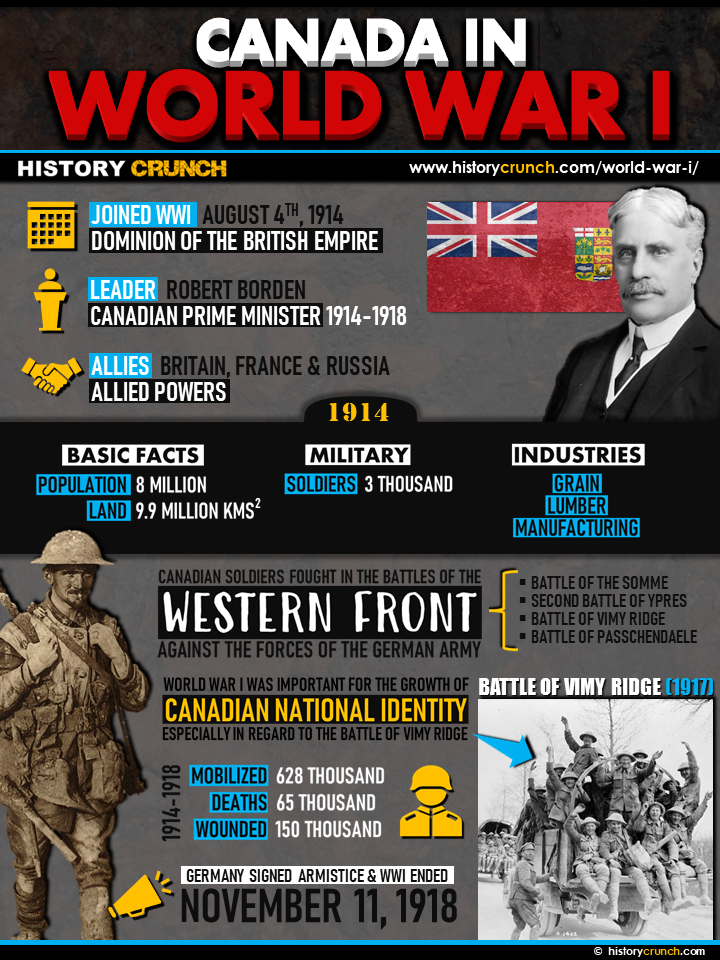
Canada’s participation in World War I was one of the most significant events in the country’s history. As a Dominion of the British Empire, Canada was automatically drawn into the conflict when Britain declared war on August 4th, 1914. Over the course of the war approximately 620,000 Canadians served and around 67,000 died. Canadian forces fought primarily on the Western Front in Europe, participating in some of the most significant battles of the war including the Battle of Vimy Ridge, which many Canadians consider to be the defining moment in the birth of Canada as an independent nation. This infographic was designed for students to visually summarize Canada’s role in World War I and is based on the History Crunch article titled Canada in World War I.
Canada in World War I – Infographic
About This Infographic
This Canada in World War I infographic was created by the History Crunch team to help students and teachers quickly understand the significance of Canada’s contribution to the First World War. It is designed as a visual learning and study tool, summarizing the essential information covered in our full article on Canada in World War I. Teachers may use it as a classroom display, a discussion prompt, or a study aid for students preparing for assessments.
What This Infographic Covers
The infographic begins with why Canada entered the war. In 1914 Canada was a Dominion of the British Empire, meaning it was automatically drawn into the conflict when Britain declared war on Germany on August 4th, 1914. Support for participation was widespread among English Canadians, many of whom felt a strong sense of connection to Britain and viewed the war as both a duty and an opportunity to prove Canada’s place on the world stage. Canada quickly mobilized its forces and sent the Canadian Expeditionary Force (CEF) to fight in Europe.
The infographic covers Canada’s major battles on the Western Front. Canadian forces participated in many of the most significant battles of the war, including the Second Battle of Ypres in 1915 where Canadian soldiers famously held the Allied line during the first major poison gas attack on the Western Front, improvising gas masks from urine-soaked cloths and preventing a catastrophic German breakthrough. Canadians also suffered over 24,000 casualties at the Battle of the Somme in 1916, earning a reputation as one of the most effective fighting forces on the Western Front.
The defining Canadian battle of the war was the Battle of Vimy Ridge, fought from April 9th to April 12th, 1917. It was the first time all four divisions of the Canadian Corps fought together as a unified force, rather than being attached separately to different British units. The Canadians successfully captured the strategically vital high ridge in northern France that both French and British forces had previously failed to take, suffering over 10,000 casualties including around 3,000 dead. The capture of Vimy Ridge is considered one of the most significant achievements in Canadian military history and became a powerful symbol of Canadian national identity and independence. Canadian forces also fought at the Battle of Passchendaele in 1917 and played a leading role in the Hundred Days Offensive in 1918, which ended the war.
The infographic also covers the Conscription Crisis of 1917. As the war continued and casualties mounted, voluntary recruitment could no longer keep pace with the army’s need for reinforcements. Prime Minister Robert Borden introduced mandatory military service, known as conscription, in 1917. The issue deeply divided Canada along linguistic and nationalist lines, with French Canadians in particular strongly opposing conscription. The crisis highlighted the fundamental tensions between English and French Canada that would persist long after the war ended.
Finally the infographic covers the lasting significance of the war for Canada. The victories at Vimy Ridge and other battles gave Canada the confidence and moral authority to demand independent representation at the Paris Peace Conference of 1919 and to sign the Treaty of Versailles as a separate nation, not merely as part of the British Empire. World War I is widely regarded as the moment when Canada began to forge its own distinct national identity separate from Britain.
How to Use This Infographic in the Classroom
This infographic works well as a visual introduction to Canada in World War I before students read the full article. It can also be used as a discussion prompt asking students to consider why the Battle of Vimy Ridge had such a profound and lasting impact on Canadian national identity, or to examine how the Conscription Crisis reflected deeper divisions within Canadian society. Teachers may also use it alongside the WWI map and Western Front map to help students understand the geographic dimensions of Canada’s contribution to the war.
Related Articles
To learn more about the topics covered in this infographic, visit the following History Crunch articles:
- Canada in World War I
- Battle of Vimy Ridge
- Western Front of World War I
- Battle of the Somme
- Second Battle of Ypres
- Trench Warfare in World War I
- Life in the Trenches
- Allied Powers of World War I
- Hundred Days Offensive
- Causes of World War I
- World War I Overview
- Australia in World War I
- Britain in World War I