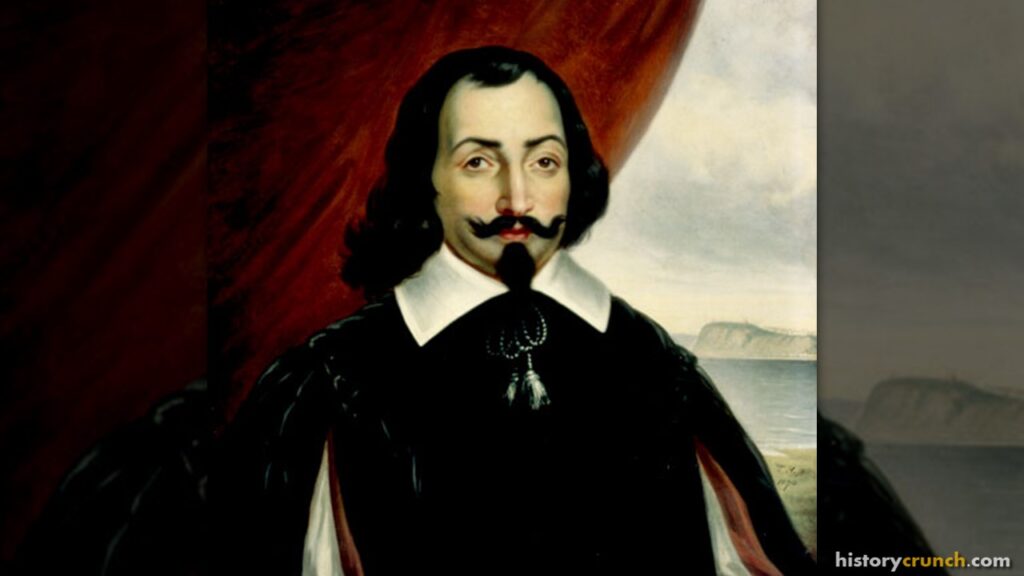
Samuel de Champlain was a French explorer, navigator, and cartographer who played a central role in establishing a permanent French presence in North America in the early 17th century. He is best known for founding the city of Quebec in 1608, which became the capital of the French colonial territory known as New France. He also explored vast stretches of the North American interior, mapped the Great Lakes region, and built important relationships with indigenous nations that shaped the development of French colonialism in Canada. For these reasons he is widely remembered today as the Father of New France, and was an important explorer in the time of the Age of Exploration.
Samuel de Champlain – Early Life
Samuel de Champlain was born around 1574 in the town of Brouage on the Atlantic coast of France, though the exact date of his birth is not known with certainty. He grew up in a coastal community where seafaring and navigation were central to daily life, and from a young age he developed a strong interest in the sea and in exploration. Very little is known in detail about his early years, but it is clear that by the time he reached adulthood he had become a skilled sailor and navigator with a particular talent for cartography, which is the art and science of making maps.
In the late 1590s Champlain sailed to the Caribbean and to the Spanish colonies in Central America as part of a Spanish expedition. He spent approximately two years in that region and used the experience to sharpen his skills as an observer and mapmaker, producing detailed accounts and drawings of the places he visited. The knowledge and experience he gained from this early voyage proved invaluable to his later career as an explorer in North America. He returned to France around 1601 and his detailed reports of what he had seen in the Spanish colonies attracted the attention of the French court and helped him secure support for future expeditions.
Samuel de Champlain – Voyages in the Age of Exploration
Champlain made his first voyage to North America in 1603, sailing to the St. Lawrence River region of what is today Canada as part of a French trading expedition. During this voyage he explored the St. Lawrence River as far as the site of present-day Montreal and gathered important information about the geography of the region and the indigenous peoples living there. This first voyage convinced Champlain that the St. Lawrence region held enormous potential for French colonization and trade, particularly in the form of the fur trade, which was already proving to be a highly profitable enterprise for those involved in it.
In 1604 Champlain returned to North America as part of an expedition to establish a French colony on the Atlantic coast. The colonists initially settled on an island in the St. Croix River, on the border between present-day Maine and New Brunswick, but the harsh winter conditions proved devastating and many colonists died. The following year the settlement was moved to a more sheltered location at Port Royal in present-day Nova Scotia. During the years he spent at Port Royal, Champlain continued his exploratory work, sailing along the Atlantic coastline and mapping the coast as far south as present-day Cape Cod in Massachusetts. He produced detailed and remarkably accurate maps of the coastline he explored, which became important resources for later European explorers and colonists.
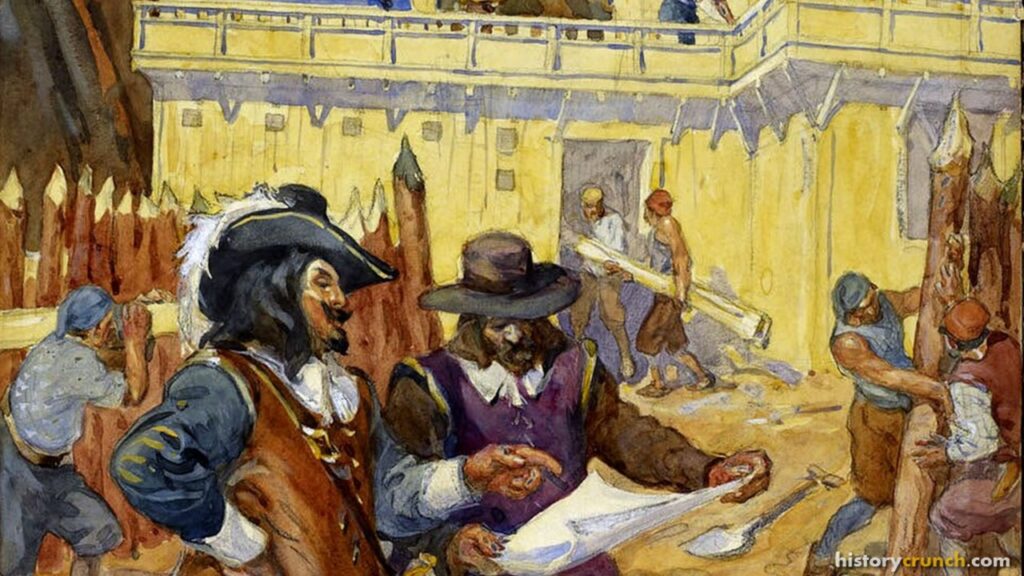
The most significant achievement of Champlain’s career came in 1608, when he established the settlement of Quebec on the banks of the St. Lawrence River. Quebec was built at a location where the river narrowed significantly, giving the settlement a strong defensive position and control over traffic along the waterway. Champlain recognized that Quebec’s location was ideal for a permanent colony that could serve as the base for further exploration and the expansion of the fur trade into the interior of the continent. The founding of Quebec is considered one of the most important events in the history of Canada, as the city became the heart of New France and the most important French settlement in North America.
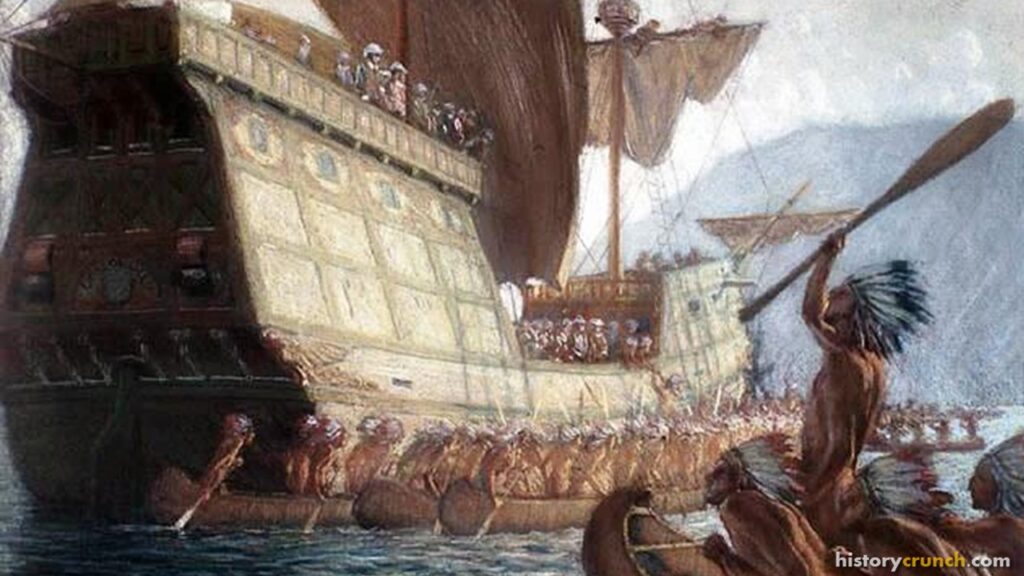
From his base at Quebec, Champlain continued to explore the North American interior. In 1609 he traveled south along the Richelieu River and became the first European to reach the large lake that today bears his name, Lake Champlain, on the border between present-day New York and Vermont. During this expedition he allied himself with the Huron and Algonquin nations against their traditional enemies, the Iroquois Confederacy, and participated in a battle in which the use of French firearms helped defeat an Iroquois war party. This alliance with the Huron and Algonquin peoples proved essential to the survival and growth of New France, as these indigenous nations provided crucial support, knowledge, and trade networks that the French colonists could not have survived without. However, the enmity it created with the Iroquois Confederacy would have long-lasting consequences for French colonial ambitions in North America.
In 1613 and again in 1615, Champlain made further expeditions into the interior of the continent, traveling up the Ottawa River and eventually reaching the Great Lakes. He became the first European to see Lake Huron and Lake Ontario, and he traveled deep into territory that no European had previously entered. Throughout these journeys he continued to produce detailed maps and written accounts of what he observed, building up a comprehensive picture of the geography, peoples, and resources of the North American interior that became enormously valuable to France and to later explorers and colonists.
Samuel de Champlain – Later Life and Death
Following his extensive explorations, Champlain devoted the later years of his life to the administration and development of New France. He made numerous trips back and forth between France and Quebec, working to secure financial support and new settlers for the colony and to defend its interests against both rival European powers and hostile indigenous nations. New France faced serious challenges during this period. The colony was always short of settlers and resources, and the English posed a growing threat to French colonial ambitions in North America.
In 1629 a major crisis struck when an English fleet under the Kirke brothers captured Quebec and forced Champlain to surrender the colony. Champlain was taken to England as a prisoner, where he spent several years before Quebec was eventually returned to France in 1632 under the terms of the Treaty of Saint-Germain-en-Laye. Champlain returned to Quebec in 1633 and threw himself back into the work of building up the colony. However, his health was declining, and in October of 1635 he suffered a stroke that left him partially paralyzed. Samuel de Champlain died in Quebec on December 25th, 1635, at approximately 61 years of age. He was buried in Quebec, where he had dedicated so much of his life to building a lasting French presence in the New World.
Samuel de Champlain – Significance
Samuel de Champlain was a highly significant figure in the history of the Age of Exploration and in the broader history of Canada and North America. His founding of Quebec in 1608 established the first permanent and successful French settlement in the interior of North America and created the foundation upon which the entire colony of New France was built. Without Champlain’s determination, skill, and vision, it is very possible that France’s colonial presence in North America would never have taken root in the way that it did.
His contributions as a cartographer were also enormously important. The maps Champlain produced of the St. Lawrence River, the Atlantic coast, and the Great Lakes region were among the most accurate and detailed that had yet been produced of the North American interior, and they guided generations of later explorers and colonists. His explorations of the Great Lakes region in particular opened up vast new territories to European knowledge and laid the groundwork for the expansion of New France deep into the heart of the continent. The relationships he built with indigenous nations, particularly the Huron and Algonquin, also shaped the character of French colonialism in North America in ways that set it apart from the more violent and exploitative approaches of other European colonial powers. For all of these reasons, Samuel de Champlain is rightly remembered as the Father of New France and one of the most important figures of the Age of Exploration.