Pan-Slavism was an important aspect of World War I. More specifically, Pan-Slavism was a significant factor in the lead up to World War I and caused the crisis to grow into a much larger conflict. As such, historians consider Pan-Slavism to be related to the long-term causes of World War I, including nationalism.
WHAT IS PAN-SLAVISM?
Pan-Slavism is a concept related to Slavic-speaking people of eastern Europe. In short, Slavic people are those which speak Slavic languages. This includes countries such as Russia, Ukraine, Serbia, Bulgaria and more. The concept of Pan-Slavism is considered to be centered around the nationalism of these Slavic people. For instance, Pan-Slavism can be considered as a nationalistic movement to unite and promote the Slavic people of eastern Europe. Therefore, Pan-Slavism was a central link between the many different nations of the region and highlighted the cultural similarities of the people.
Historians consider Pan-Slavism to have first emerged in the 17th century, while it became a more important issues in the mid-19th century. In fact, the mid-19th century saw a wave of many different kinds of nationalistic movements including the unifications of both Germany and Italy. As such, much of Europe was undergoing nationalistic changes in the decades leading up to the 1914 outbreak of World War I.
PAN-SLAVISM IN WORLD WAR I
As stated above, Pan-Slavism is considered to be an important topic in relation to the main causes of World War I. Several prominent countries that participated in World War I were made up of Slavic people. For instance, Russia was a major power in the First World War I and the largest Slavic nation in the world. Austria-Hungary was also a major contributor the events of World War I and contained many Slavic people. This is because the Austro-Hungarian Empire in 1914 was very ethnically diverse and contained many different types of people. Finally, smaller countries in the Balkans, which is the regional name for the southeastern region of Europe, participated in the events of World War I. Several examples of nations in the Balkans included Serbia and Bulgaria.
The best example of Pan-Slavism in World War I is related to the events of the July Crisis of 1914. The July Crisis occurred immediately following the assassination of Austrian Archduke Franz Ferdinand. Franz Ferdinand was the Archduke of Austria-Hungary and next in line to rule over the empire. Ferdinand and his wife Sophie were assassinated on June 28th, 1914 in Sarajevo, the capital of the Austro-Hungarian province of Bosnia and Herzegovina while there on a visit to inspect the military forces. The assassin was Gavrilo Princip. Just nineteen years old at the time, Princip was a member of the Black Hand, which was a Serbian nationalist organization that existed in the early part of the 20th century. The Black Hand was first created in August of 1901, by members of the Royal Serbian Army. It was a secret society that worked to promote Serbian nationalism. They were opposed to Austro-Hungarian influence in the Balkans.

Following the assassination, Austrian authorities determined that the murder was carried out by the Black Hand and placed the blame for the killing on Serbia. In fact, rumors swirled at the time about the role of the Serbian government in the assassination. Since many of the prominent members of the Black Hand came from the Royal Serbian Army, the Austrian government wanted to investigate within Serbia to determine the role of the Serbian leadership. This situation between Austria-Hungary and Serbia is what essentially resulted in the July Crisis of 1914.

The July Crisis of 1914 unfolded as a series of events following the assassination of Franz Ferdinand. For instance, in the days immediately after the June 28th assassination, several prominent ministers in the Austrian government called for war to be declared against Serbia. The tensions of the July Crisis heightened over the new two weeks as Austria-Hungary began preparing an ultimatum for Serbia. An ultimatum is a demand, that if not met would cause a conflict. As a result, Austria-Hungary was preparing to give Serbia a list of demands, and if not met, then Austria-Hungary would carry out a war against Serbia.
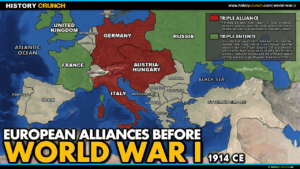
Serbia was angered by the ultimatum and immediately sought assistance from Russia and its leader Tsar Nicholas II. Russia was Serbia’s biggest ally at the time due to both nations sharing Slavic heritage. This comes from the idea of ‘Pan-Slavism’ in which the Slavic people of Eastern Europe all united nationalistically. Since Serbia was a small nation, Russia viewed itself as responsible for protecting its Slavic neighbor. As such, Russia was pulled into the fighting of World War I due to Pan-Slavism and its hope to protect Serbia. This was an important event because Russia’s entry into the conflict between Austria-Hungary and Serbia, helped escalate the tensions at the time. What resulted was the system of alliances present in Europe before World War I. Therefore, some historians consider the issue of Pan-Slavism important to the start of World War I.