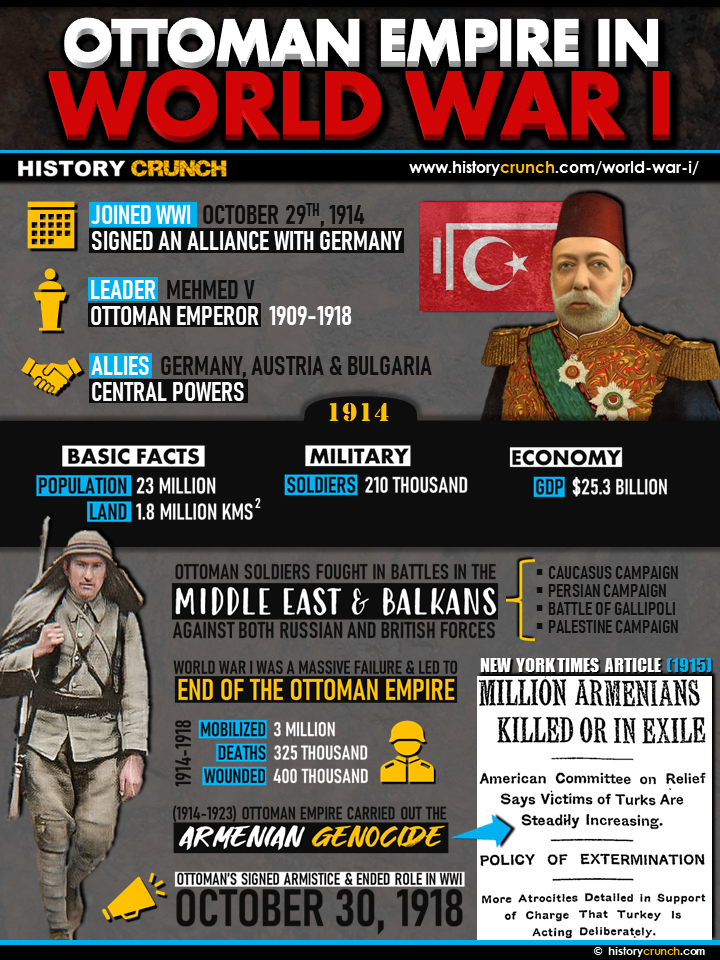
The Ottoman Empire was one of the four Central Powers of World War I, fighting alongside Germany, Austria-Hungary and Bulgaria against the Allied Powers. The empire entered the war through a combination of strategic calculation and a provocative naval incident in late 1914, and went on to fight on multiple fronts including the Caucasus, the Gallipoli Peninsula and the Middle East. World War I had a devastating and ultimately fatal impact on the Ottoman Empire, which collapsed just a few years after the war’s end in 1922. The war was also marked by the Armenian Genocide, one of the first major genocides of the 20th century. This infographic was designed for students to visually summarize the Ottoman Empire’s role in World War I and is based on the History Crunch article titled Ottoman Empire in World War I.
Ottoman Empire in World War I – Infographic
About This Infographic
This Ottoman Empire in World War I infographic was created by the History Crunch team to help students and teachers quickly understand the significance of the Ottoman Empire’s role in the First World War. It is designed as a visual learning and study tool, summarizing the essential information covered in our full article on the Ottoman Empire in World War I. Teachers may use it as a classroom display, a discussion prompt, or a study aid for students preparing for assessments.
What This Infographic Covers
The infographic begins with how the Ottoman Empire entered the war. Unlike the major European powers that were drawn in through the alliance systems triggered by the assassination of Franz Ferdinand, the Ottoman Empire was largely on the outside of these events. When war became imminent, Ottoman leaders began negotiating with both sides to determine which offered them the best strategic advantages. On July 30th, 1914 the Ottoman Empire agreed to a secret alliance with Germany against Russia. Germany offered the Ottomans two naval warships as part of the agreement. The actual trigger for Ottoman entry was the Black Sea Raid of October 29th, 1914, when the German commander of the two German warships, Admiral Wilhelm Souchon, attacked the Russian coast without clear authorization. This provoked Russia into declaring war on the Ottoman Empire on November 2nd, 1914, followed by Britain and France three days later. The Ottoman Sultan Mehmed V officially declared war on November 11th, 1914.
The infographic covers the Ottoman Empire’s three major campaigns. The first was the Caucasus Campaign, fought from October 1914 to October 1918 along the southern border of Russia near the eastern side of the Black Sea. The Ottoman Empire sought to reclaim territory lost to Russia in the earlier Russo-Turkish War of 1877 and used its Third Army in the campaign, eventually committing over 300,000 soldiers. Russia’s eventual withdrawal from the war following the Russian Revolution and the signing of the Treaty of Brest-Litovsk in March 1918 ended the campaign. The Ottoman Empire suffered an estimated 300,000 casualties in the Caucasus Campaign compared to approximately 140,000 for Russia.
The second major campaign shown in the infographic is the Gallipoli Campaign from February 1915 to January 1916, which stands as the Ottoman Empire’s most significant military victory of the war. The Allied Powers launched a major naval and land assault against the Gallipoli Peninsula near the Ottoman capital of Constantinople, aiming to secure control of the waterways connecting the Black Sea to the Mediterranean and knock the Ottoman Empire out of the war. Despite being outnumbered, with approximately 315,000 Ottoman soldiers facing an estimated 489,000 Allied troops, the Ottoman Fifth Army successfully defended the peninsula against repeated Allied attacks. The Allies abandoned their positions in December 1915. Total Allied casualties exceeded 300,000 including 46,000 deaths, while Ottoman casualties numbered approximately 250,000 including over 56,000 deaths.
The third campaign is the Sinai and Palestinian Campaign from 1915 to 1918, fought for control of Egypt and the Suez Canal in the Middle East. The Ottoman Empire raided the Suez Canal in early 1915 but was repelled by British and ANZAC forces. Over the following years Allied forces including Australian and New Zealand mounted divisions pushed Ottoman forces back through Egypt and Palestine in a series of battles ending with the Ottoman surrender on October 30th, 1918. The Ottoman Empire suffered nearly 190,000 casualties in the Sinai and Palestinian Campaign.
The infographic also covers the Armenian Genocide on the home front, one of the most significant and devastating events of the Ottoman Empire’s involvement in the war. As the empire mobilized for war, the Ottoman government persecuted and massacred the Armenian Christian minority population living within the empire’s borders. Hundreds of thousands were killed outright and millions were forced on deadly marches to concentration camps along the borders with Syria and Iraq. Historians estimate that as many as 1.5 million Armenians died during the forced marches and massacres, making it the first major genocide of the 20th century.
How to Use This Infographic in the Classroom
This infographic works well as a visual introduction to the Ottoman Empire in World War I before students read the full article. It can also be used as a discussion prompt asking students to consider why the Ottoman victory at Gallipoli is remembered so differently in different countries, or to examine the relationship between wartime policies and the Armenian Genocide. Teachers may also use it alongside the Australia in World War I infographic, since the Gallipoli Campaign is so central to Australian national memory.
Related Articles
To learn more about the topics covered in this infographic, visit the following History Crunch articles: