The Battle of Antietam was one of the most significant and deadly battles of the American Civil War. Fought on September 17th, 1862, near Sharpsburg, Maryland, it remains the single bloodiest day in American military history, with approximately 22,700 total casualties in a single day of fighting. The battle halted the Confederate invasion of Northern territory and gave President Abraham Lincoln the opportunity to issue the Emancipation Proclamation, transforming the nature of the entire war.
What Was the American Civil War?
The Battle of Antietam took place during the second year of the American Civil War, one of the most devastating conflicts in the history of the United States. The Civil War was fought between the Northern states, known as the Union, and the Southern states, known as the Confederacy, from 1861 to 1865. At its heart, the war was driven by the issue of slavery, which had divided the country for decades. The war began on April 12th, 1861, when Confederate forces bombarded the Union garrison at Fort Sumter in South Carolina. In the months and battles that followed, it became clear that the conflict would be far longer and bloodier than either side had anticipated. By the summer of 1862, Confederate General Robert E. Lee had established himself as a formidable military commander in the Eastern Theater, winning a series of victories that had kept Union forces out of Richmond, Virginia, the Confederate capital. Emboldened by these successes, Lee made the bold decision to carry the war north into Union territory, setting the stage for the Battle of Antietam.
Battle of Antietam – Background and Causes
In September of 1862, General Robert E. Lee led his Army of Northern Virginia across the Potomac River and into the state of Maryland, marking the first Confederate invasion of the North. Lee had several goals in mind. He wanted to move the fighting away from war-ravaged Virginia and into Northern territory, relieve pressure on Virginia’s farms during the harvest season, and potentially win a victory on Northern soil that might convince Britain and France to recognize the Confederacy as a legitimate nation. A Confederate victory on Northern soil could also demoralize the Northern public and influence the upcoming congressional elections of 1862.
As Lee moved north, he divided his army into several columns to carry out multiple operations simultaneously, including the capture of the Union garrison at Harpers Ferry in what is now West Virginia. This division of his forces was a significant risk. Critically, a copy of Lee’s detailed orders outlining his entire plan fell into Union hands when soldiers from the Army of the Potomac found a copy wrapped around three cigars in an abandoned Confederate campsite. The Union commander, Major General George B. McClellan, now knew exactly where Lee’s divided army was and how vulnerable it was. However, McClellan, known for his characteristic caution, delayed acting on this intelligence for nearly 18 hours, giving Lee’s forces time to regroup. It was one of the most consequential delays of the entire war.
Battle of Antietam – Major Events
On the morning of September 17th, 1862, the two armies clashed along Antietam Creek near the small town of Sharpsburg, Maryland. McClellan commanded approximately 75,000 troops but committed fewer than three quarters of his force to the fighting, while Lee had roughly 38,000 soldiers available. The battle unfolded in three distinct phases across the course of the day, moving from north to south along the Confederate line.
The first phase began at dawn when Union General Joseph Hooker’s corps launched a furious assault on the Confederate left flank, fighting through a 24-acre cornfield that changed hands repeatedly in some of the most intense combat of the entire war. Stonewall Jackson’s Confederate divisions bore the brunt of this assault and suffered enormous casualties but managed to hold their ground near a small church known as the Dunker Church. The fighting in the Cornfield was so intense that one soldier later recalled that the dead lay so thick it was almost impossible to walk without stepping on a body.
The second phase of the battle shifted to the center of the Confederate line, where Union forces attacked a sunken farm road that the Confederates used as a natural trench. The fighting along what came to be known as Bloody Lane lasted for several hours and resulted in staggering casualties on both sides before Union forces finally broke through. Despite the breakthrough, McClellan hesitated to send his reserve forces forward to exploit the gap in Lee’s center, missing a potential opportunity to split the Confederate army in two.
The third and final phase came in the afternoon on the southern end of the battlefield, where Union General Ambrose Burnside’s corps spent several hours attempting to cross a narrow stone bridge over Antietam Creek that was defended by a small force of Georgia sharpshooters. When Burnside’s forces finally crossed the bridge and began pushing toward Sharpsburg, threatening to cut off Lee’s line of retreat, Confederate General A.P. Hill’s division arrived at the last possible moment after a rapid march from Harpers Ferry and drove back the Union advance, effectively ending the battle. As night fell, both sides counted their dead. The total casualties for the day came to approximately 22,700, including around 12,400 Union and 10,300 Confederate soldiers killed, wounded, or missing.
Battle of Antietam – Aftermath
The morning after the battle, Lee kept his battered army in position at Sharpsburg, unwilling to appear to retreat under pressure. McClellan, despite having fresh reserves that had never been committed to the fighting, declined to renew the assault. On the night of September 18th, Lee withdrew his army back across the Potomac River into Virginia. The Confederate invasion of the North had been halted. McClellan did not pursue Lee aggressively, frustrating President Lincoln enormously. Six weeks after the battle Lincoln visited McClellan at his headquarters to urge him to move, but McClellan continued to delay. Lincoln finally removed him from command in November of 1862, replacing him with General Ambrose Burnside.
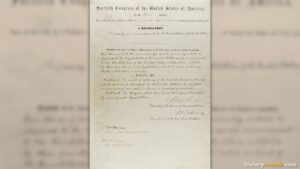
The most far-reaching consequence of the Battle of Antietam came five days after the fighting, on September 22nd, 1862, when President Lincoln issued the preliminary Emancipation Proclamation. Lincoln had drafted the document weeks earlier but had been advised by his cabinet to wait for a Union military victory before releasing it, to avoid it appearing as an act of desperation. The Union’s ability to turn back Lee’s invasion at Antietam provided that opportunity. The proclamation announced that as of January 1st, 1863, all enslaved people in states still in rebellion against the United States would be considered free. While it did not immediately free anyone, as it only applied to Confederate-held territory, the Emancipation Proclamation fundamentally changed the character of the war. It transformed the conflict from a war to preserve the Union into a war to end slavery, and made it far less likely that Britain or France would intervene on behalf of the Confederacy.
Significance of the Battle of Antietam
The Battle of Antietam stands as one of the most significant events of the American Civil War. As the single bloodiest day in American military history, it shocked both sides and the entire world with the scale of its carnage. Militarily, it halted Lee’s first invasion of the North and prevented the Confederacy from achieving the decisive victory on Northern soil that might have brought foreign recognition and support. Politically, it gave Lincoln the moment he needed to issue the Emancipation Proclamation, forever changing the meaning and purpose of the war. The battle also exposed the limitations of McClellan as a commander, eventually leading to his removal and the search for more aggressive Union leadership. For all of these reasons, historians consistently rank the Battle of Antietam as one of the great turning points of the American Civil War.