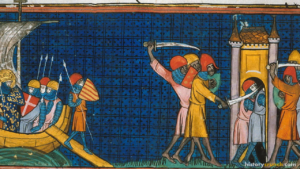
The Norman Conquest was the military conquest of England by William, Duke of Normandy, which began with his decisive victory at the Battle of Hastings on October 14th, 1066. The conquest brought an end to Anglo-Saxon rule in England and replaced it with Norman rule, resulting in profound changes to English politics, society, language, and culture. It is one of the most significant events in the history of England and the Middle Ages.
What Was the Norman Conquest?
The Norman Conquest of England took place in 1066 CE and was one of the most important events of the Middle Ages. The Middle Ages, also known as the Medieval Period, lasted for approximately 1000 years from the 5th century to the 15th century. Due to its timeframe, the Middle Ages in Europe is divided into three smaller periods referred to as the Early, High, and Late Middle Ages. The Norman Conquest took place at the start of the High Middle Ages and had a major impact on the development of England as a nation. In general, the Norman Conquest refers to the invasion and takeover of England by William, Duke of Normandy, a region in northern France, following the death of the English King Edward the Confessor in January of 1066.
Causes of the Norman Conquest
There were several main causes of the Norman Conquest, which centered on a dispute over who had the right to become King of England following the death of Edward the Confessor. Edward had been childless throughout his reign and had reportedly promised the English throne to different people at different times, which created a complicated situation when he died. For example, William of Normandy claimed that Edward had promised him the throne back in 1051. As well, William claimed that the English Earl Harold Godwinson had personally sworn an oath in Normandy in 1064 to support William’s claim. Harold, on the other hand, stated that Edward had granted him the kingdom on his deathbed, and Harold was crowned King of England on January 6th, 1066, the day after Edward died.
This dispute between Harold and William was one of the direct causes of the Norman Conquest. With that said, Harold also faced a second challenge from Harald Hardrada, the King of Norway, who believed he had his own claim to the English throne. As such, Harold found himself facing two invasions at the same time in 1066, which would prove to be a decisive factor in the events that followed.
The Battle of Stamford Bridge
Before William could invade from Normandy, Harold first had to deal with the Norwegian threat in the north. In September of 1066, King Harald Hardrada of Norway invaded northern England and joined forces with Harold’s own rebellious brother Tostig. The Norwegian forces defeated a northern English army at the Battle of Fulford on September 20th, 1066, and moved toward York. Harold marched his army north at great speed and caught the Norwegians by surprise at the Battle of Stamford Bridge on September 25th, 1066. The battle was a decisive English victory, and both Harald Hardrada and Tostig were killed in the fighting. With that said, Harold had barely finished celebrating when he learned that William had landed in the south of England. He was forced to turn his tired army around and march south immediately.
The Battle of Hastings
William had spent much of 1066 preparing his invasion carefully. He assembled an army of between 4,000 and 7,000 knights and foot soldiers and built a fleet of ships to carry them across the English Channel. As well, he secured the support of Pope Alexander II in Rome for his campaign. William crossed the English Channel on September 27th, 1066, and landed at Pevensey in Sussex in southern England on September 28th, before moving east to establish his base at Hastings.
Harold marched his army south from Yorkshire and assembled his forces near Hastings by October 13th. His men were exhausted from the rapid march of approximately 250 miles (402 kilometers) and had not fully recovered from the fighting at Stamford Bridge just weeks earlier. On the morning of October 14th, 1066, the two armies met in battle on a ridge approximately 7 miles (11 kilometers) northwest of Hastings. Harold’s army took up a strong defensive position on the ridge and formed a tight shield wall that proved difficult for the Normans to break. The battle lasted all day. For much of the fighting the English line held firm, but the Normans used a tactic of pretending to retreat in order to draw the English soldiers off the ridge and into the open, where the Norman cavalry could cut them down. Late in the afternoon Harold was killed, reportedly struck by an arrow, and with his death the English army collapsed and fled. William had won one of the most decisive battles in English history.
William Becomes King
Following his victory at Hastings, William marched his army toward London. The remaining English leaders submitted to William at Berkhamstead, and he was crowned King of England at Westminster Abbey on Christmas Day, December 25th, 1066, becoming King William I of England, later known as William the Conqueror.
With that said, resistance to Norman rule continued for several years after Hastings. The most serious revolt took place in the north of England in 1069 and 1070, which William suppressed with great brutality. His forces devastated large areas of northern England in what became known as the Harrying of the North, burning villages and destroying crops and livestock to prevent further rebellion. As well, William rapidly built castles across England to control the population and establish Norman authority. For instance, the Tower of London was begun during this period as a powerful symbol of Norman rule over the city.
Impact of the Norman Conquest
The Norman Conquest had an enormous and lasting impact on England. One of the most significant changes was the near total replacement of the old Anglo-Saxon nobility with a new Norman one. William distributed the lands of defeated English lords to his Norman followers, who became the new ruling class of England. As such, the old English nobility was almost completely swept away within a generation of the conquest.
As well, the conquest had a profound effect on the English language. Before 1066, the language spoken in England was Old English, also known as Anglo-Saxon. After the conquest, French became the language of the royal court, government, and the nobility, while Latin remained the language of the Church. Over time, these languages blended with Old English to create Middle English, which is much closer to the modern English spoken today. For example, many words in modern English related to government and law come directly from the French that the Normans brought with them.
The Norman Conquest also transformed the political structure of England. William introduced a strict and highly organized form of the feudal system. Feudalism was a form of government common during medieval Europe that involved society being structured in a very rigid and hierarchical way. It was popular in European society from the 9th century until the 15th century and was the form of government in which the country was dominated by an absolute monarch, in which all power was held within a single king. In 1086, William also ordered a comprehensive survey of all land and property in England, which was recorded in a document known as the Domesday Book. This survey was an extraordinary achievement for its time and gave William detailed knowledge of the wealth and resources of his kingdom, allowing him to tax it far more effectively.
Significance of the Norman Conquest
The Norman Conquest of 1066 is one of the most significant events in English history and one of the defining moments of the Middle Ages. It permanently changed the culture, language, government, and social structure of England and linked the country far more closely to the rest of Europe than it had ever been before. In all, the Norman Conquest transformed England in a way that very few single events in history have been able to match, and its effects on English society continued to be felt for centuries after William the Conqueror’s victory at the Battle of Hastings.