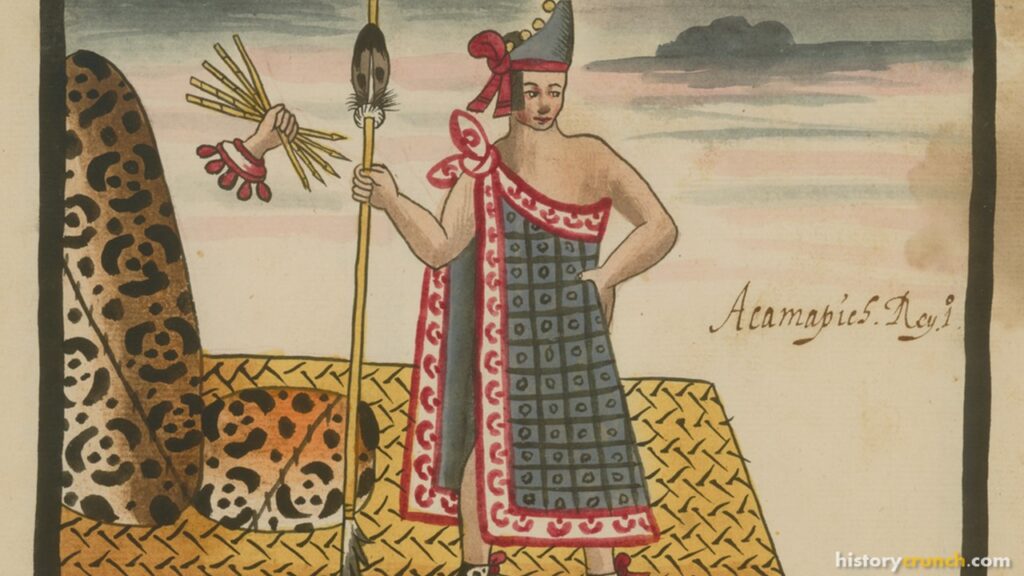
Acamapichtli was the first huey tlatoani of the Aztec Empire, ruling from 1376 to 1395 and establishing the foundation of Tenochtitlán’s power. He strengthened the Aztec capital by organizing its government, expanding its military, and initiating large-scale construction projects like temples and canals. His reign was significant because it set the stage for future development of the Aztec Empire.
EARLY HISTORY OF THE AZTEC
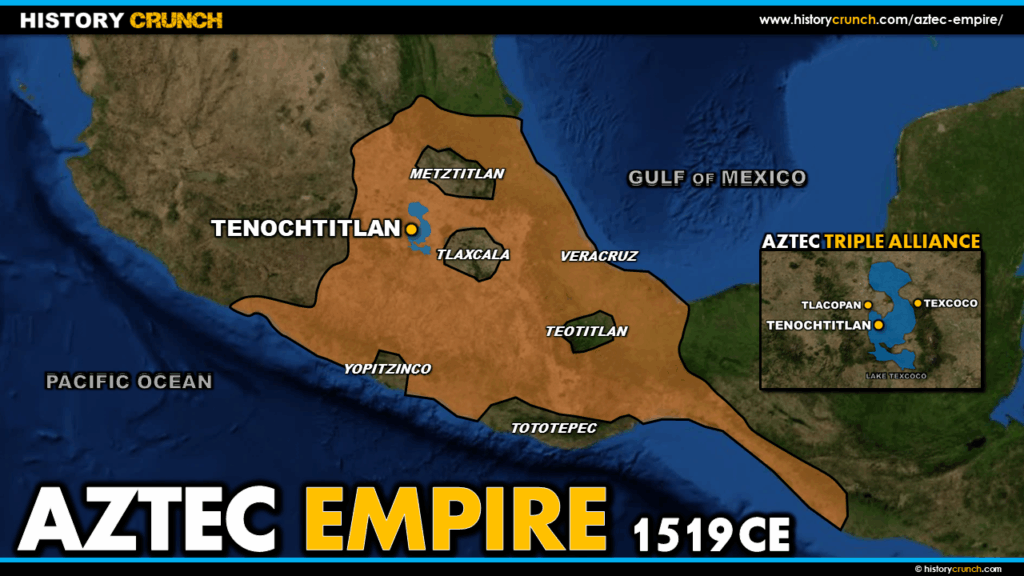
Following the Aztec’s founding and construction of Tenochtitlan in the Valley of Mexico in 1325 AD, they quickly established their authority across the other societies in the valley. Historians refer to this time period as the Aztec Empire, since the Aztec were constantly expanding throughout central Mexico. As well, for the two centuries that followed the initial construction of Tenochtitlan, the Aztec were ruled over by a series of leaders referred to as Huey Tlatoani. In the Aztec language of Nahuatl this translates to ‘Great Speaker’. Each huey tlatoani ruled in different ways but they all oversaw the expansion of both Tenochtitlan and the Aztec Empire until the arrival of the Spanish conquistadors in 1519.
ACAMAPICHTLI (AZTEC EMPEROR) – BIOGRAPHY AND SIGNIFICANCE
The first Aztec ruler of the city of Tenochtitlan was Acamapichtli. In the language of the Aztecs, called Nahuatl, he was referred to as the tlatoani or ‘one who speaks’. Essentially, the tlatoani was the leader of the Aztecs and Acamapichtli is considered to be the first in a line of eleven total tlatoanis that ended with the arrival of Hernan Cortés and other Spanish conquistadors in the first part of the 16th century. Acamapichtli is best remembered today for establishing the Aztec Empire and growing the strength and wealth of Tenochtitlan. He became ruler in 1376 following the death of Tenoch, the Aztec leader who founded the city of Tenochtitlan in 1325. Just as in other parts of the world at that time, the heritage of the Aztec leader was extremely important to the society and region around Lake Texcoco.
Acamapichtli had an advantage as leader because his father was a Mexica (Aztec) leader and his mother was the Culhuacan nobility since she was the daughter of a Culhuacan king. This connection to the Culhuacan was important because the Culhua nobility were considered to be direct descendent of the Toltecs. Among the Mesoamerican cultures of the Valley of Mexico the Toltecs were considered to be an important earlier Mesoamerican society that was exceptionally civilized. As such, it was considered important for the Mesoamerican civilizations of the time to establish a connection to the Toltecs. The Aztecs in particular, considered the Toltec civilization to be the predecessor to their own empire. Acamapichtli further established his connection to the Toltec when he married a Culhua royal princess. Despite his prestige and power, Acamapichtli struggled to expand the Aztec empire out from under the control of its neighboring societies, such as the Tepanec. Regardless, Acamapichtli improved Tenochtitlan in several key ways, including: building up the chinampa ‘floating garden’ system around the city to improve agriculture, and building temples and public buildings. Acamapichtli died in 1395 and was succeeded by his son Huitzilíhuitli.