The Battle of Atlanta was an important battle of the American Civil War that took place on July 22nd, 1864, just southeast of Atlanta, Georgia. It was part of a larger series of battles known as the Atlanta Campaign, which was General William Sherman’s effort to capture the city of Atlanta and destroy the Confederate army defending it. During the battle, Confederate General John Bell Hood launched a major attack against Union forces in an effort to stop Sherman’s advance, but the attack was defeated with heavy Confederate losses. Atlanta itself did not fall until September 2nd, 1864, following a long Union siege.
What Was the American Civil War?
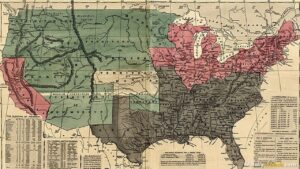
The Battle of Atlanta took place during the American Civil War, which was one of the most significant conflicts in the history of the United States. The Civil War was fought between the Northern states, known as the Union, and the Southern states, known as the Confederacy, from 1861 to 1865. The war was mainly fought over the issue of slavery, which had divided the country for many years. By the spring of 1864, the Union had developed a plan to attack the Confederacy on multiple fronts at the same time. In the Eastern Theater, General Ulysses S. Grant was pushing toward Richmond. In the Western Theater, General William Sherman was ordered to advance from Chattanooga, Tennessee, toward Atlanta, Georgia, which was one of the most important cities in the entire Confederacy. Atlanta was a major railroad hub, manufacturing center, and supply base, and its capture would be a serious blow to the Confederate war effort.
Battle of Atlanta – The Atlanta Campaign and Background
Sherman began his advance toward Atlanta in May of 1864 with approximately 112,000 soldiers organized into three armies. The Confederate Army of Tennessee, which was defending Atlanta, was commanded by General Joseph E. Johnston and numbered approximately 60,000 soldiers. Johnston chose to fight a defensive campaign, using the hills and rivers of northern Georgia to slow Sherman’s advance while avoiding costly frontal battles. Over the following weeks, Sherman repeatedly flanked Johnston’s positions, forcing the Confederates to fall back steadily toward Atlanta. This strategy preserved the Confederate army but gave up a great deal of territory.
By mid-July, Sherman’s armies were positioned just outside Atlanta. Confederate President Jefferson Davis had grown frustrated with Johnston’s continued retreating and replaced him with Lieutenant General John Bell Hood on July 17th. Unlike Johnston, Hood was an aggressive commander who believed in attacking the enemy rather than waiting for them. Just days after taking command, Hood launched a major attack at Peachtree Creek on July 20th, striking the Army of the Cumberland as it was crossing the creek. The attack was repulsed with over 2,500 Confederate casualties, but Hood was not finished. Two days later he launched his second attack, which became known as the Battle of Atlanta.
Battle of Atlanta – Hood’s Plan
Hood’s plan for July 22nd was bold. He ordered General William Hardee’s corps to leave the Atlanta defensive lines and march approximately 15 miles through the night to strike the exposed left flank of the Union Army of the Tennessee, commanded by General James McPherson. Hood believed that McPherson’s left flank was vulnerable and unprotected. If Hardee could get behind McPherson’s army and attack from the rear while other Confederate forces attacked from the front, Sherman’s left wing might be destroyed.
The night march was difficult and Hardee’s troops arrived later than planned. More importantly, McPherson had placed a reserve corps under General Grenville Dodge in just the right position to meet the Confederate attack. When Hardee’s divisions moved forward to strike what they expected to be an unprotected Union rear, they ran directly into Dodge’s veterans instead. The element of surprise was lost and fierce fighting broke out along the Union left.
Battle of Atlanta – Major Events
On the morning of July 22nd, 1864, fighting began on multiple parts of the battlefield at once. Hardee’s corps attacked from the south while other Confederate forces attacked the Union front from the east. The fighting was intense and the situation changed quickly throughout the day. Early in the battle, General James McPherson rode forward to observe the fighting and rode accidentally into Confederate lines. He was shot and killed, becoming one of the highest-ranking Union officers to die in combat during the entire war. His death was a serious blow to the Union command structure and affected both sides deeply, as McPherson had been respected by soldiers on both sides who had known him at West Point before the war.
Despite the loss of McPherson, Union forces held their positions. General John Logan temporarily took command of the Army of the Tennessee and organized a strong defense. In the afternoon, Confederate forces under General Benjamin Cheatham launched a separate attack against the Union line from the east and achieved some initial success, breaking through at one point and capturing several artillery pieces. However, Sherman quickly organized a counterattack and the Confederate breakthrough was pushed back. By the end of the day, Hood’s attacks had been repulsed across the entire battlefield and Confederate forces pulled back to the Atlanta defenses.
Battle of Atlanta – Casualties and Aftermath
The Battle of Atlanta on July 22nd resulted in approximately 3,722 Union casualties and approximately 5,500 Confederate casualties. The higher Confederate losses were particularly significant because Hood’s army was already much smaller than Sherman’s and could not afford to lose men at the same rate. Despite losing both battles at Peachtree Creek and the Battle of Atlanta, the Confederate leadership in the South portrayed these fights as victories. In reality, the cost in men had been very high and had weakened Hood’s ability to defend the city.
Following the battle, Sherman continued to push his armies around the city, trying to cut off the railroad lines that supplied Atlanta. Hood launched another attack at Ezra Church on July 28th, which was also defeated. Sherman then settled into a siege of Atlanta through August, shelling the city regularly while trying to reach the remaining railroad lines. In late August, Sherman sent his entire army on a wide flanking move toward Jonesboro, south of Atlanta, to cut the last railroad. Hood was forced to abandon Atlanta on the night of September 1st and the city fell to Union forces the following morning on September 2nd, 1864.
The total casualties for the entire Atlanta Campaign from May to September 1864 were approximately 31,687 Union and 34,979 Confederate. The fall of Atlanta had an enormous impact on the war and on American politics. It came at a critical moment when many in the North were growing tired of the war and President Lincoln’s chances of reelection looked uncertain. The capture of Atlanta gave the Northern public a major victory and helped ensure Lincoln’s reelection in November of 1864.
Significance of the Battle of Atlanta
The Battle of Atlanta and the broader Atlanta Campaign were among the most significant events of the final year of the American Civil War. The capture of Atlanta was a major blow to the Confederacy, which lost one of its most important cities and a key part of its ability to supply and support its armies. The fall of Atlanta also helped secure the reelection of President Lincoln, which ensured that the war would continue until the Confederacy was fully defeated. Following the capture of Atlanta, Sherman burned a large portion of the city in November of 1864 and then launched his famous March to the Sea, leading approximately 62,000 soldiers through Georgia to the port city of Savannah. The Battle of Atlanta and the events that followed it are therefore remembered as some of the most important steps in bringing the American Civil War to an end.