Sherman’s March to the Sea was one of the most significant and destructive military campaigns of the American Civil War. It took place from November 15th to December 21st, 1864, and saw Union General William Sherman lead approximately 62,000 soldiers on a 285-mile march from Atlanta, Georgia, to the coastal city of Savannah. Along the way, Sherman’s army destroyed railroads, factories, farms, and supplies in an effort to weaken the Confederacy’s ability to fight and to break the will of the Southern population to continue the war. The march ended with the capture of Savannah on December 21st, 1864.
What Was the American Civil War?
Sherman’s March to the Sea took place during the American Civil War, which was one of the most significant conflicts in the history of the United States. The Civil War was fought between the Northern states, known as the Union, and the Southern states, known as the Confederacy, from 1861 to 1865. The war was mainly fought over the issue of slavery, which had divided the country for many years. By the fall of 1864, the Union had captured Atlanta, Georgia, one of the most important cities in the entire Confederacy. Sherman believed that the best way to end the war quickly was not just to defeat Confederate armies in battle, but also to destroy the supplies and resources that kept those armies fighting. He convinced General Ulysses S. Grant and President Abraham Lincoln to allow him to march his army across Georgia to the sea, living off the land and destroying everything of military value along the way.
Sherman’s March to the Sea – Background and Plan
After capturing Atlanta in September of 1864, Sherman spent several weeks preparing for his next move. The Confederate Army of Tennessee under General John Bell Hood had moved away from Atlanta into Tennessee and Alabama rather than directly opposing Sherman. Sherman made the decision not to chase Hood across the South. Instead, he proposed to split his forces, sending approximately 60,000 soldiers under General George Thomas to deal with Hood in Tennessee while he led the remaining 62,000 on a march through Georgia to the Atlantic coast.
Sherman’s plan was based on the idea that the Confederacy drew its strength not just from its armies but from the civilian population and economy that supported them. Factories, farms, and railroads provided Confederate troops with the supplies and food they needed to keep fighting. If Sherman could destroy those resources, he believed the Confederate war effort would eventually collapse. He studied census records to plan his route through the most productive farming regions of Georgia, where his soldiers could find food and also cause the most economic damage.
Before leaving Atlanta, Sherman ordered the destruction of all buildings and facilities of military value in the city. Fires spread beyond the military targets and burned approximately 40 percent of Atlanta to the ground. On November 16th, 1864, Sherman’s army marched out of Atlanta and headed southeast, with the city still burning behind them.
Sherman’s March to the Sea – The March Through Georgia
Sherman divided his army into two wings that marched on parallel routes approximately 20 to 60 miles apart. This made it difficult for the small Confederate forces in Georgia to know where to defend and allowed the Union army to strip food and supplies from a much wider area. One wing moved in the direction of Augusta while the other threatened Macon, confusing Confederate defenders about Sherman’s true destination, which was Savannah.
The Confederate forces available to stop Sherman were far too small to challenge his army in open battle. General Joseph Wheeler had approximately 8,000 to 10,000 cavalry soldiers and General Gustavus Smith commanded various units of Georgia militia. Together they could slow the march with raids and skirmishes but could not stop it.
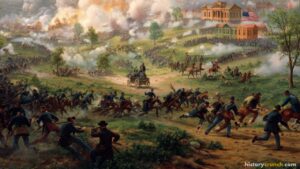
The most significant battle of the march took place on November 22nd, 1864, at Griswoldville, near Macon. A force of approximately 2,000 Georgia militiamen, many of them older men and young boys, charged a Union infantry position that was well defended by veterans armed with modern rifles. The attack was a disaster for the Confederates, who suffered approximately 650 casualties while the Union side lost only around 62. The Union veterans who examined the battlefield afterward were shocked to see how many of their attackers had been elderly men and children.
As Sherman’s army moved through Georgia, soldiers foraged widely across the countryside, taking food, livestock, and supplies from farms and plantations. Those who foraged far ahead of the main army became known as bummers. Sherman’s men also destroyed railroads by heating the rails and twisting them around trees, creating what soldiers called Sherman’s neckties, so that they could not be repaired and used to supply Confederate armies. Thousands of enslaved people in Georgia saw Sherman’s army as a path to freedom and began following the march, creating large groups of civilians moving alongside the soldiers.
On November 23rd, Sherman’s forces captured Milledgeville, the capital of Georgia. The governor and state legislature had already fled. Union soldiers briefly occupied the state capitol building before moving on. By early December, the army was approaching Savannah, having covered most of the 285-mile route through Georgia in just a few weeks.
Sherman’s March to the Sea – Capture of Savannah
Sherman’s forces reached the outskirts of Savannah on December 10th, 1864. The city was defended by approximately 9,000 to 10,000 Confederate soldiers under General William Hardee, who had built strong defensive fortifications around the city and flooded the surrounding rice fields to limit the approaches. Sherman needed to connect with Union naval vessels waiting offshore before he could surround the city completely.
On December 13th, Sherman ordered an assault on Fort McAllister, a Confederate fort that controlled access to the waterway connecting Savannah to the sea. Approximately 4,000 Union soldiers attacked the fort, which was defended by around 230 Confederate soldiers. The fort was captured in about 15 minutes. With Fort McAllister in Union hands, Sherman was able to link up with the naval fleet offshore and receive fresh supplies for his army.
On December 17th, Sherman sent a message to Hardee demanding the surrender of Savannah. Hardee refused. However, Hardee recognized that his small force could not hold the city against Sherman’s army and on the night of December 20th he evacuated his troops across the Savannah River into South Carolina. On December 21st, 1864, the mayor of Savannah formally surrendered the city to Union forces. Sherman sent a famous telegram to President Lincoln stating that he was offering Savannah as a Christmas gift, along with 150 artillery pieces and approximately 25,000 bales of cotton.
Significance of Sherman’s March to the Sea
Sherman’s March to the Sea is one of the most significant and controversial events of the American Civil War. It is remembered as one of the first major examples of total war in modern military history, in which an army deliberately targeted not just the enemy’s military forces but also the civilian economy and population that supported them. The march caused enormous damage to Georgia, destroying an estimated $100 million worth of property and disrupting the Confederate supply system across the region.
The march had a major impact on Confederate morale. It showed people throughout the South that the Confederate government could not protect them from Union forces and that the war was being lost. Combined with the earlier fall of Atlanta, the march helped to secure President Lincoln’s reelection in November of 1864 by demonstrating to Northern voters that the Union was winning the war. After capturing Savannah, Sherman turned his army north and marched through the Carolinas, continuing the same strategy of destruction that had proved so effective in Georgia. The Civil War ended just a few months later in April of 1865.