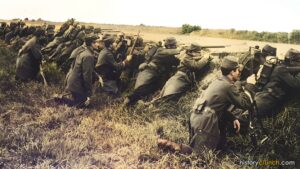
The Battle of France was an important campaign in the early phases of World War II. It took place from May 10th to June 25th, 1940, and resulted in a victory for Nazi Germany and the complete defeat of France. At the time, this was shocking because france was considered to be one of the world’s foremost military powers at the time. In fact, the speed and efficiency of the Nazi German invasion shocked the world and was a key moment in the early years of the war.
BATTLE OF FRANCE IN WORLD WAR II – BACKGROUND
World War II began on September 1st, 1939 when Nazi Germany invaded the country of Poland. Although, Britain and France declared war against Germany just a few days later, on September 3rd, no actual fighting occurred in Western Europe until Nazi Germany’s invasion of France during the Battle of France in May of 1940. This period of relative calm after the dramatic outbreak of war was surprising to many, especially considering the rapid Nazi German military aggression in the east. Historians refer to this period as the ‘Phoney War’.
During the time of the ‘Phoney War’, Britain and France began to deploy troops to the Maginot Line to build up the defenses of France. The Maginot Line was the fortified line of French defences along the border between France and Germany. It was constructed in the years after World War I as a deterrent to any future conflicts with Germany. The Allied nations believed that a Nazi German offensive into France would resemble the stalemate conditions of trench warfare, such as in World War I. As such, they focused their efforts on a defensive line to stop any German aggression. This, unfortunately, proved foolish and the Nazi German forces were easily able to maneuver around the Maginot Line. As well, most military leaders of the time assumed that the Nazi forces would attack either along the border with France or through Belgium. However, Germany instead attacked through the Ardennes Forest, which the Allied nations had assumed was impossible. As such, this set the stage for the events of the Battle of France, which began on May 10th, 1940.
BATTLE OF FRANCE IN WORLD WAR II – SUMMARY
As stated above, the Battle of France began when German forces invaded France through the Ardennes Forest near southern Belgium. France had spent the years after World War I preparing a line of defences along its border that it shared with Germany. This defensive line was called the Maginot Line and ran from the Switzerland Alps in the south to the Ardennes Forest; however it did not extend north to the British Channel. France believed that the Ardennes Forest was too thick for Germany tanks and forces to move through and did not extend the Maginot Line any further north. As well, they believed that any German attack would come directly across the border to France and that the heavily defended Maginot Line would be enough to withstand the attack. This false sense of security by France would have a profound impact on the outcome of the battle.
The German attack through the Ardennes Forest (codenamed Case Yellow) caught Belgium, Britain and France by surprise. German forces quickly overran Luxembourg, the Netherlands, and Belgium. For instance, the Nazi German forces were able to easily push their way through the Ardennes Forest and moved at a surprisingly fast pace. This is because Nazi Germany unleashed its blitzkrieg tactics during the Battle of France to great success. This tactic saw German forces move at an incredible pace and overwhelm the Allied forces wherever they met. The term ‘blitzkrieg’ refers to the speed and overwhelming force of the Nazi Germany Army.
By pushing through the Ardennes region, Germany planned on dividing the Allied forces and circling around the Allied soldiers in order to trap them and cut them off from Allied support. The French forces that defended against the German attack at Ardennes were poorly equipped and unable to stop the German advance. As such, the German tank divisions pushed through and forced the French and British forces in the north to retreat towards the British Channel. Famously, the British Expeditionary Force and some French forces were forced to group in Dunkirk, a French port town, and await an opportunity to evacuate to England. Historians refer to this as the ‘Dunkirk Evacuation’. During the end of May and early June of 1949, 200,000 British forces and 140,000 French forces were transported across the English Channel to avoid the full German attack at Dunkirk. This retreat at Dunkirk would come to be an important event in World War II, as many of these same Allied forces would play an important role in later battles of World War II, including the Invasion of Normandy.
After the Allied retreat at Dunkirk, the remainder of France was left to undergo the full German blitzkrieg attack. Italy joined the fighting on June 10th when it entered the war on the side of Germany and by June 14th, Paris was under the control of Germany troops. The Battle of France was over and Britain stood alone as the last Allied country in Europe to stand against the aggression of Germany. At the end of the Battle of France, Nazi Germany took over direct control of the northern half of France and created a puppet-state in the south called Vichy France. Germany would use the northern parts of France to help carry out its bombing runs during the Battle of Britain. In total, the Allies suffered over 360,000 casualties in the battle while the Axis suffered 163,000.
BATTLE OF FRANCE IN WORLD WAR II – SIGNIFICANCE
The Battle of France was one of the most significant conflicts during the events of World War II. For instance, the Nazi Germany victory in the Battle of France was an important shift in the balance of power in Europe. Nazi Germany now controlled most of Western Europe, which gave it access to resources and military bases. This was important because Nazi Germany was able to use northern France for its assault on Britain during the Battle of Britain. As well, the loss of France as an ally in the war was devastating for the Allied nations. The fall of France left Britain on its own in western Europe and pushed Britain to the brink of also falling to Nazi expansionism.
Historians also consider the Battle of France important because it demonstrated the superiority of Blitzkrieg tactics, with Nazi Germany achieving in six weeks what was seemingly impossible in World War I. Though a crushing defeat for the Allies, the lessons learned at Dunkirk and other events from the Battle of France would later help the Allies to defeat Nazi Germany.