Prague Spring: A Detailed Summary
The Prague Spring was a period of political and economic reform in Czechoslovakia in 1968 that was crushed by a Soviet-led military invasion. This article details the history and significance of the Prague Spring.
Konstantin Chernenko was a late Soviet leader who ruled for only a short time in 1984 and 1985. He is remembered as a symbol of the Soviet Union’s aging leadership just before Mikhail Gorbachev began a new period of reform. This article details the life and significance of Konstantin Chernenko.

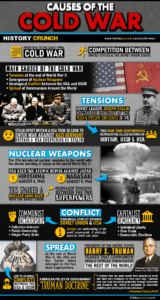
This Causes of the Cold War infographic was created by History Crunch to help students and teachers quickly understand the main factors that led to the outbreak of the Cold War between the United States and the Soviet Union after World War II. It covers post-war tensions, the ideological conflict between capitalism and communism, the emergence of nuclear weapons and the American fear of the spread of communism. Designed for students in grades 5 to 12.
Yuri Andropov was the former head of the KGB who became leader of the Soviet Union in 1982. His brief time in power came during a period of Soviet decline and helped set the stage for later changes under Mikhail Gorbachev. This article details the life and significance of Yuri Andropov.
The Cold War was a period of intense political and military tension between the United States and the Soviet Union that lasted from the end of World War II until the early 1990s. It was one of the most significant events of the 20th century and shaped the politics, culture, and history of the entire world. This article details the history and significance of the Cold War.
Propaganda in the Cold War was a central tool used by both the United States and the Soviet Union to promote their competing ideologies. This article details the history and significance of propaganda in the Cold War.
The end of the Cold War in the late 1980s and early 1990s was one of the most significant events of the 20th century, resulting in the collapse of communist governments across Eastern Europe and the end of the Soviet Union. This article details the history and significance of the end of the Cold War.

Winston Churchill remains one of the most significant figures in modern history. He is remembered above all for his leadership during World War II. This biography details the life and significance of Winston Churchill.
Leonid Brezhnev was the main Soviet leader from October 14th, 1964, until his death on November 10th, 1982, and he is remembered for détente with the United States, the Brezhnev Doctrine, and the period that later became known as the Era of Stagnation.
The first country in the world to adopt communism was Russia during the events on the Russian Revolution in 1917. This article details the history, significance and main principles of communism.