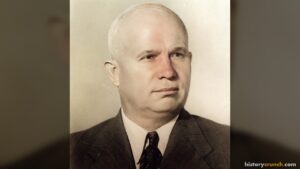
De-Stalinization was the process by which the Soviet Union under Nikita Khrushchev worked to dismantle the legacy, methods, and cult of personality of Joseph Stalin following his death in March of 1953. Stalin had ruled the Soviet Union for nearly three decades through a system of terror, purges, forced labor camps, and totalitarian control that had caused the deaths of millions of people. De-Stalinization involved releasing political prisoners, relaxing censorship, condemning Stalin’s crimes, removing his name and image from public places, and introducing a degree of political openness that became known as the Khrushchev Thaw. The process was dramatic but incomplete. It changed the Soviet Union in important ways without dismantling the communist system itself, and its effects rippled across the entire Soviet bloc, inspiring reform movements that the Soviet government would sometimes support and sometimes crush.
What Was the Cold War?
The Cold War was a period of political tension and rivalry between the United States and the Soviet Union that lasted from approximately 1947 to 1991. The two superpowers competed for global influence through military threats, economic pressure, propaganda, and support for opposing sides in conflicts around the world. De-Stalinization was an important event within the Cold War because it changed the character of Soviet leadership and sent shockwaves through the communist world, affecting the relationship between the Soviet Union and its satellite states in Eastern Europe, and influencing how the wider world perceived communism.
De-Stalinization in the Soviet Union – Background and the Death of Stalin
When Stalin died on March 5th, 1953, the Soviet Union faced a profound question: what would come next? Stalin had governed for so long and so completely that the party and state had no clear mechanism for transferring power. A collective leadership initially took over, consisting of several senior figures including Georgi Malenkov, who became Prime Minister, Lavrentiy Beria, the feared head of the secret police, and Nikita Khrushchev, who served as First Secretary of the Communist Party.
The first significant act of de-Stalinization came within weeks of Stalin’s death. Lavrentiy Beria, recognizing the enormous unpopularity of the secret police system, announced the release of some political prisoners and proposed a number of reforms. However, Beria himself was deeply distrusted by his colleagues, who feared his control of the secret police. In June of 1953, the other members of the collective leadership had him arrested and he was subsequently tried and executed. His removal was itself a sign that the era of arbitrary terror wielded by a single all-powerful figure was coming to an end.
Khrushchev gradually emerged as the dominant figure in Soviet politics in the years following Stalin’s death. He came from a humble background and had survived Stalin’s terror by remaining loyal and useful, but he had also witnessed its worst excesses and was genuinely troubled by what had been done. By 1955 he was clearly the leading figure in the Soviet government, and he began planning a dramatic break with the Stalinist past.
De-Stalinization in the Soviet Union – The Secret Speech
The defining moment of de-Stalinization was Khrushchev’s famous Secret Speech, delivered on February 25th, 1956, to a closed session of the 20th Congress of the Communist Party of the Soviet Union. The speech was titled On the Cult of Personality and Its Consequences. In it, Khrushchev systematically denounced Stalin’s crimes before an audience of senior party members who had been taught for decades to revere him as an infallible genius.
The speech was extraordinary in its content. Khrushchev condemned Stalin for creating a cult of personality, a carefully constructed false image of himself as an almost superhuman leader. He criticized Stalin for the mass terror of the Great Purge of 1936 to 1938, in which hundreds of thousands of innocent people, including loyal communist party members, had been arrested, tortured into making false confessions, and executed. He attacked Stalin for weakening the Red Army by purging its best officers, which contributed to the catastrophic early Soviet defeats when Germany invaded in 1941. He condemned the deportation of entire ethnic groups during the war and Stalin’s paranoid behavior in his final years. In fact, the speech was so shocking that some members of the audience reportedly fainted. Others were left in a state of profound disorientation by hearing their former idol condemned by one of his own successors.
The speech was supposed to remain secret but it did not. Copies were sent to Communist Party branches across the Soviet Union to be read aloud to members, and a copy eventually reached the American Central Intelligence Agency. By the spring of 1956, its contents were widely known across the Soviet bloc and beyond. The impact was enormous.
De-Stalinization in the Soviet Union – The Khrushchev Thaw
The period of political relaxation that followed the Secret Speech became known as the Khrushchev Thaw. It was not a full liberalization of the Soviet system, but it represented a significant reduction in the terror and repression that had characterized Stalin’s rule.
One of the most important changes was the release of political prisoners from the Gulag labor camp system. In the summer of 1956, Khrushchev established a special commission to review the cases of people who had been imprisoned during the purges. Millions of prisoners were eventually released and many of those who had been executed were posthumously rehabilitated, meaning that their convictions were officially overturned and their reputations restored. This was a significant act of acknowledgment that the Soviet state had committed enormous injustices against its own people.
Censorship was also relaxed, at least to a degree. The period of the Thaw produced a notable growth of Soviet literature and the arts, as writers and artists were given somewhat more freedom to explore subjects and styles that had been forbidden under Stalin. The most famous example was the publication in 1962 of One Day in the Life of Ivan Denisovich by Aleksandr Solzhenitsyn, a short novel describing life in a Gulag labor camp. Its publication was personally approved by Khrushchev and was seen as a remarkable sign of the new openness. For instance, topics such as the suffering caused by the purges and the conditions in the labor camps, which had been completely off limits for public discussion under Stalin, could now be addressed, at least cautiously.
The secret police were also reformed. The NKVD, Stalin’s feared security force, was reorganized and replaced by a new body called the KGB. Its powers were reduced significantly compared to what they had been during the worst years of Stalin’s rule, and the practice of giving secret police officers arbitrary arrest quotas to fill was ended.
De-Stalinization in the Soviet Union – Removal of Stalin’s Image
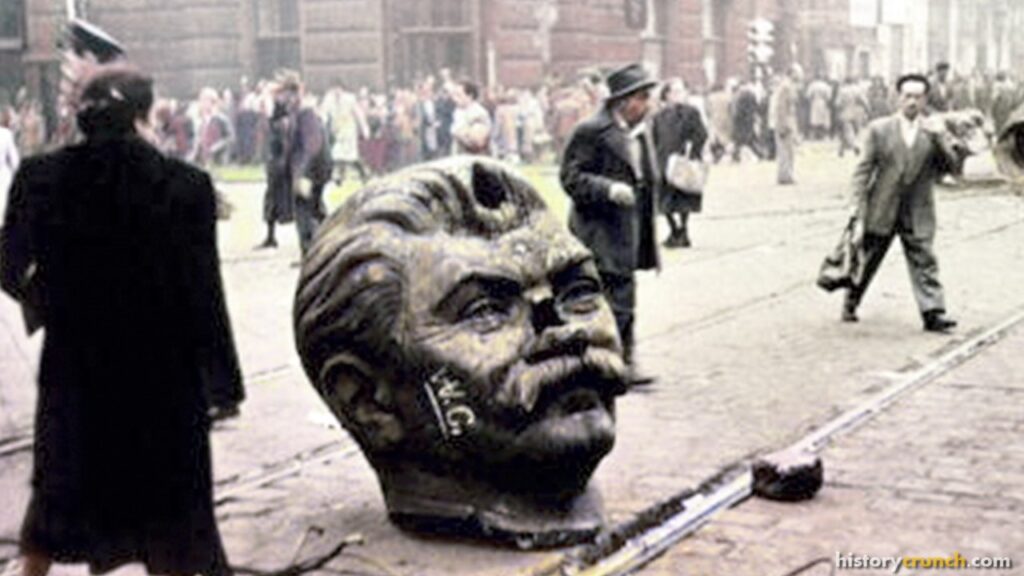
As stated above, de-Stalinization also involved a systematic effort to remove Stalin’s physical presence from public life. Hundreds of statues of Stalin were dismantled across the Soviet Union and Eastern Europe. Cities, towns, streets, and public buildings that had been named after him were renamed. Stalin Peak, the highest mountain in the Soviet Union, was renamed Communism Peak. The state anthem of the Soviet Union was changed to remove references to Stalin. In 1961, Stalin’s body was removed from the Lenin Mausoleum in Red Square, where it had lain alongside Lenin since 1953, and reburied in a simpler grave near the Kremlin Wall. These symbolic acts were intended to signal a genuine break with the past and to make clear that Stalin’s methods would not be repeated.
De-Stalinization in the Soviet Union – Impact in Eastern Europe
The impact of de-Stalinization in Eastern Europe was profound and in some cases dangerous for the Soviet Union. The message that Stalin’s methods had been wrong and that his cult of personality was unacceptable gave hope to people across the Soviet satellite states who had been living under Stalinist-style regimes of their own. If the Soviet Union itself was condemning these methods, many people reasoned, perhaps it was now possible to demand change at home.
In Poland, political unrest in the summer of 1956 led to a change of leadership and a degree of internal reform that the Soviet Union accepted without military intervention. In Hungary, the situation was far more explosive. In October of 1956, a student demonstration in Budapest rapidly grew into a full-scale revolution. Protesters tore down a statue of Stalin, attacked the secret police headquarters, and demanded genuine independence from Soviet control. The Soviet Union initially seemed uncertain about how to respond, but ultimately sent tanks and troops into Budapest in November of 1956 to crush the revolution. Tens of thousands of people were killed or wounded in the fighting, and hundreds of thousands of Hungarians fled the country. The crushing of the Hungarian Revolution demonstrated that de-Stalinization had limits. The Soviet Union was willing to reform its own internal methods but was not willing to allow its satellite states to escape from the communist bloc.
De-Stalinization in the Soviet Union – Limits and Legacy
De-Stalinization was a genuine and important change in the character of Soviet government, but it had clear limits. Khrushchev was not trying to dismantle communism or the one-party state. He was trying to reform it, to make it more humane and more efficient, while keeping its essential structure in place. The Communist Party remained the only political party. The Soviet state continued to suppress genuine political opposition. The KGB, while less murderous than the NKVD, remained a powerful instrument of political control. Censorship was relaxed but not abolished. The Gulag was reduced but not entirely eliminated.
Furthermore, de-Stalinization created tensions within the communist world that the Soviet Union struggled to manage. China under Mao Zedong condemned Khrushchev’s denunciation of Stalin as a betrayal of communist principles and a dangerous weakening of communist authority. The Sino-Soviet split, the breakdown in relations between the Soviet Union and China, was partly triggered by de-Stalinization and had enormous consequences for the history of the Cold War.
Khrushchev himself was removed from power in October of 1964 by colleagues who felt that his impulsive leadership style and his reforms had created unnecessary instability. His successor, Leonid Brezhnev, quietly rehabilitated Stalin’s reputation to a degree, stopping short of openly reversing de-Stalinization but allowing a more positive image of Stalin to gradually re-emerge in public culture. The process of de-Stalinization stalled during the Brezhnev years and did not resume in a significant way until Mikhail Gorbachev introduced his policies of glasnost and perestroika in the mid-1980s.
De-Stalinization in the Soviet Union – Significance
The significance of de-Stalinization in the history of the Soviet Union and the Cold War is considerable. It represented the most important internal reform of the Soviet system since the revolution itself, acknowledging for the first time at the highest level of government that the communist state had committed enormous crimes against its own people.
De-Stalinization changed the character of Soviet rule in ways that, while limited, were real. The mass terror that had defined the Stalin era did not return. The Gulag, while it continued to exist, never again imprisoned millions of people on the scale of the 1930s and 1940s. Soviet citizens lived with greater personal security than they had under Stalin, even if they remained subject to significant political control.
At the same time, de-Stalinization planted seeds that would eventually contribute to the collapse of Soviet communism itself. By acknowledging that the system had produced monstrous abuses, Khrushchev undermined the legitimacy of the communist state in ways that could not be entirely controlled. The reforms he introduced, limited as they were, encouraged expectations for further change that the Soviet system ultimately proved unable to satisfy. As such, de-Stalinization stands as one of the most consequential and complex events in the history of the Cold War, a turning point that changed the Soviet Union without saving it.