The founding of Rome is one of the most famous stories in the ancient world, combining legend, mythology, and genuine historical fact. According to Roman tradition, the city of Rome was founded on April 21st, 753 BCE, by a man named Romulus, who became its first king. The story of how Romulus and his twin brother Remus came to build the city is a central part of Roman culture and identity. At the same time, archaeologists and historians have found evidence that the area around Rome was home to settled communities long before 753 BCE, suggesting that the real founding of Rome was a gradual process rather than a single dramatic event. Both the legend and the history together tell an important story about how one of the greatest civilizations in world history began.
WHAT WAS ANCIENT ROME?
Ancient Rome was one of the most powerful civilizations in world history. It began as a small settlement on the Italian peninsula and grew over many centuries into a vast empire that stretched from Britain in the northwest to Egypt in the southeast. At its height, the Roman Empire controlled much of Europe, North Africa, and parts of the Middle East. Roman civilization left lasting contributions to law, government, architecture, language, and culture that continue to shape the modern world. Understanding how Rome began is the starting point for understanding how all of that became possible.
FOUNDING OF ROME – THE LEGEND OF ROMULUS AND REMUS
The most famous account of Rome’s founding comes from the legend of Romulus and Remus, twin brothers whose story was recorded by the Roman historians Livy and Plutarch and celebrated by the poet Virgil. According to the legend, the twins were born to Rhea Silvia, a princess who was also a Vestal Virgin, a priestess forbidden from having children. Their father was said to be Mars, the Roman god of war.
At the time of their birth, the kingdom of Alba Longa was ruled by a king named Amulius, who had seized the throne from his brother Numitor, the twins’ grandfather. Amulius feared that the boys would one day grow up and challenge his rule, so he ordered them to be drowned in the Tiber River. A servant placed the infants in a basket and set them on the river, but rather than drowning, they were carried safely to the riverbank.
At the foot of the Palatine Hill, the story tells that a she-wolf discovered the two babies and nursed them, keeping them alive. A woodpecker, also considered a sacred animal of Mars, helped to bring them food. Eventually, a shepherd named Faustulus and his wife Acca Larentia found the boys and raised them as their own. The twins grew up to be strong, brave, and natural leaders among the local shepherds.
When Remus was captured and brought before Amulius, the truth of his identity came out. Romulus gathered a group of supporters, freed his brother, and killed Amulius in the rescue. They restored their grandfather Numitor to the throne of Alba Longa. However, rather than staying to rule there, the brothers decided to found their own city on the hills near the Tiber River, close to where they had been raised.
FOUNDING OF ROME – THE DISPUTE AND THE DEATH OF REMUS
The brothers could not agree on which hill their new city should be built on. Romulus wanted to build on the Palatine Hill, while Remus preferred the Aventine Hill. To settle the matter, they agreed to observe the flight of birds as a sign from the gods, a practice the Romans called augury. Remus saw six vultures fly over the Aventine Hill. Then Romulus claimed to have seen twelve vultures over the Palatine Hill. Both brothers claimed victory in the contest, and the argument grew into a violent confrontation.
Different versions of the legend tell the story slightly differently, but in most accounts, Romulus built a wall around the Palatine Hill to mark the boundary of his new city. Remus mocked his brother by jumping over the low wall to show how easily it could be crossed. Romulus was furious. In a rage, he struck Remus and killed him. With his brother dead, Romulus continued building his city alone.
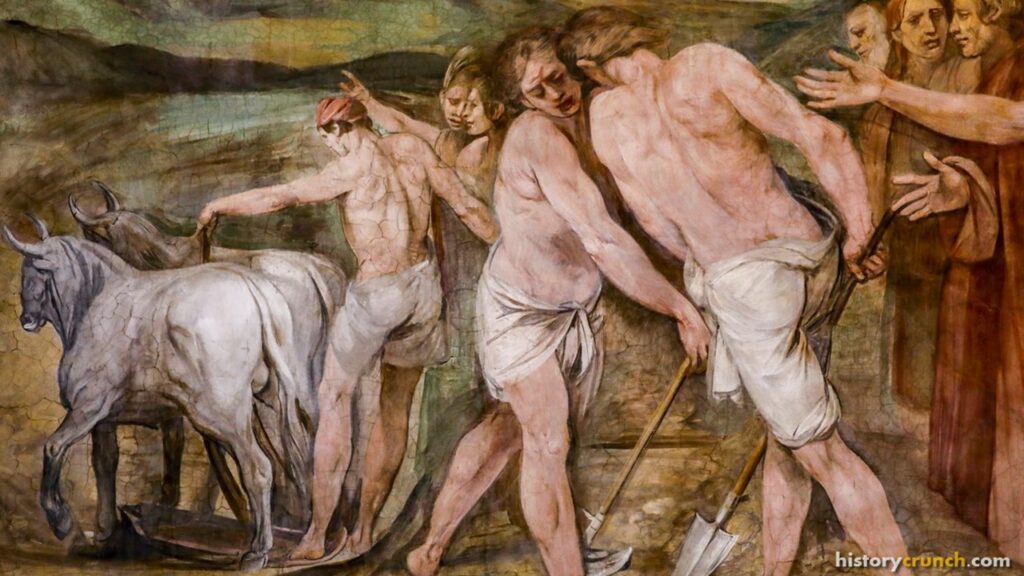
According to Roman tradition, the city was officially founded on April 21st, 753 BCE. Romulus named it Rome after himself. He plowed a sacred furrow around the base of the Palatine Hill to mark the city’s boundary, a line called the pomerium, which defined the sacred limits of the city. Anyone who crossed this boundary without permission was considered an enemy. Remus, in jumping over the wall, had violated this sacred line, which in the legend provided the justification for his death.
FOUNDING OF ROME – ROMULUS AS THE FIRST KING
After founding Rome, Romulus set about organizing his new city and building its institutions. He divided his followers into groups and established the basic political structure that would shape Roman government for centuries. He created the Senate, a council of one hundred elder men drawn from the most respected families, who would advise the king. These senior men were known as Patricians, meaning the noble class, and the people they led were called the Plebeians, or common people.
Romulus also established the Roman legions, organizing his fighting men into military units. One of the most famous stories from this early period is the Rape of the Sabine Women. Rome’s new population was made up mostly of men, and Romulus needed to find wives for them to build a stable community. He invited the neighboring Sabine people to a festival and, during the celebration, had his men seize the Sabine women and take them as wives. The Sabine men went to war against Rome to reclaim them, but the women themselves, who had by then married and had children with Roman men, intervened and made peace between the two groups. The Sabines and Romans eventually merged into a single people, with the Sabine king Titus Tatius ruling alongside Romulus for a time.
Romulus ruled Rome for many years. According to the legend, he disappeared during a storm and was believed to have been taken up to the heavens by the gods. The Romans worshiped him after his death under the name Quirinus, as a divine protector of the city. The date traditionally assigned to his death or disappearance is around 716 BCE.
FOUNDING OF ROME – THE LEGEND AND ROMAN IDENTITY
The story of Romulus and Remus was deeply important to the Romans, not because they necessarily believed every detail of it, but because it served as a powerful foundation myth that explained who the Romans were and what values they stood for. The involvement of Mars as the twins’ father connected Rome directly to the god of war and gave the Roman people a divine origin. The she-wolf that nursed the boys became one of the most recognized symbols of Rome, and sculptures and images of the wolf with the twins appeared throughout the city and the empire.
The legend also addressed some of the tensions within Roman society. The killing of Remus by Romulus was used to explain and justify the idea that Rome’s laws and boundaries had to be respected absolutely. The mixing of Romans and Sabines through marriage was used to explain how Rome grew by absorbing other peoples rather than simply conquering them, a pattern that was central to Roman expansion throughout its history.
FOUNDING OF ROME – THE ARCHAEOLOGICAL EVIDENCE
Modern archaeologists have found that the area around Rome was inhabited long before 753 BCE. Excavations on the Palatine Hill have uncovered evidence of small huts and settlements dating to the ninth and eighth centuries BCE, and some traces of earlier occupation go back even further, to around the tenth century BCE or earlier. The area that later became the Roman Forum contains evidence of a burial ground in use by at least 1000 BCE, suggesting that communities were already well established in the region.
The picture that archaeology paints is one of gradual development rather than a sudden founding. Small separate communities of Latin, Sabine, and Etruscan peoples lived on and around the seven hills of Rome from an early period. Over time, these communities grew closer together, began to share infrastructure and trade, and eventually merged into a single organized settlement. The date of 753 BCE likely marks a significant moment in this process, perhaps the establishment of the first shared institutions or the drawing of a recognized boundary, but it was the culmination of a much longer history rather than a starting point from nothing.
The Etruscans, who lived to the north of Rome, had a particularly important influence on the early development of the city. Etruscan kings, known as the Tarquins, ruled Rome during part of the period of the Roman Kingdom, and their influence on Roman architecture, religion, and government was significant. The last Etruscan king, Tarquinius Superbus, was expelled from Rome in 509 BCE, an event that led directly to the founding of the Roman Republic.
SIGNIFICANCE OF THE FOUNDING OF ROME
The founding of Rome, both as a legend and as a historical event, shaped the identity of Roman civilization for over a thousand years. The story of Romulus and Remus gave the Romans a divine origin, a set of foundational values, and a mythological past that connected them to the gods and to the great civilizations of the eastern Mediterranean. The date of 753 BCE became the anchor point for all of Roman history, a fixed moment from which everything else was measured.
The gradual, historically real process by which small communities on the hills of Latium grew into the city of Rome is equally significant. It demonstrates how Roman civilization developed through a process of mixing, absorbing, and building on the peoples and cultures that surrounded it, a pattern that would continue as Rome expanded across the Mediterranean world and beyond. The founding of Rome was not the work of a single man on a single day. It was the beginning of a long story that would eventually shape the history of the entire western world.