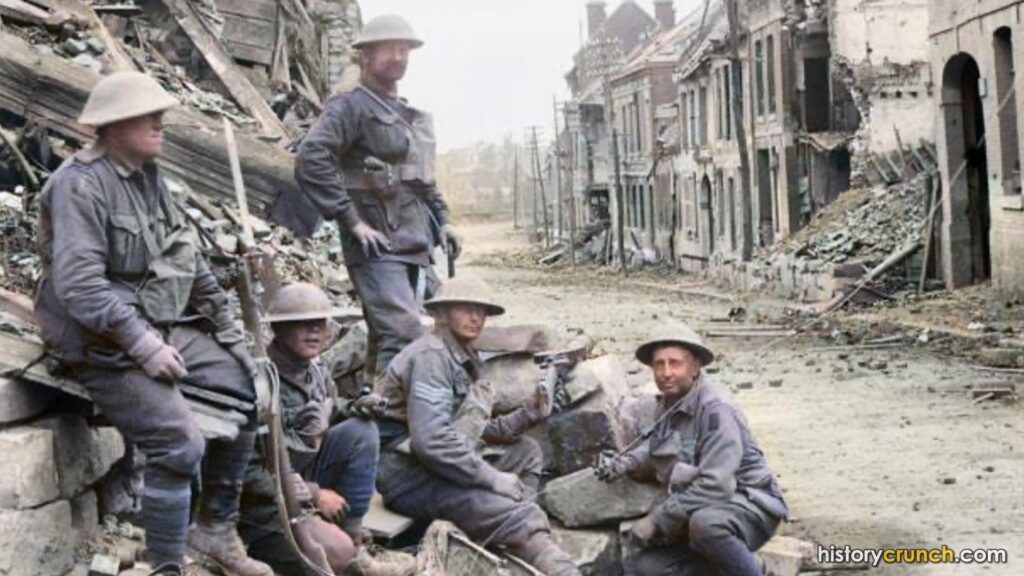
The last major Western Front battle from World War I was the Hundred Days Offensive, which was a major push by Allied forces, near the end of World War I, against the German and Austro-Hungarian forces in northern France. The Western Front, was the line of fighting that occurred along the trenches that stretches through Belgium and northern France. The Hundred Days’ Offensive took place from August 8th to November 11th in 1918. The Allied victories of the Hundred Days Offensive eventually led to the end of World War I, when Germany agreed to the November 11th armistice in 1918.
WHICH NATIONS PARTICIPATED IN THE HUNDRED DAYS OFFENSIVE?
As stated above, the Hundred Days Offensive was undertaken by the Allied nations against Germany and Austria-Hungary. In total, the Allied nations that participated in the Hundred Days Offensive, included: France, United States, Belgium, Italy, Portugal and the British Empire. In fact, the Hundred Days Offensive was important to both the British Army and the armies from the British Dominions. For instance, both Canadian and Australian forces participated in the battles of the Hundred Days Offensive. For instance, the Hundred Days Offensive was so important to Canadian history in World War I, that Canada refers to it as ‘Canada’s Hundred Days’. Furthermore, British, Canadian and Australian forces spearheaded several significant operations on the Western Front, such as the Battle of Amiens. The battle took place from August 8th to the 12th in 1918 and was fought just east of the city of Amiens in France. The attack was so successful by the Allied nations at Amiens that the frontline of the war shifted dramatically for the first time in years. In fact, the Germans referred to the August 8th, 1918 attack at Amiens as a ‘black day’ in reference to their losses.
WHAT HAPPENED DURING THE HUNDRED DAYS OFFENSIVE?
The Allied armies participated in a series of other battles during the Hundred Day’s Offensive, including: Second Battle of the Somme, Battle of Mont Saint Quentin, Battle of Cambrai, Battle of the Selle, and several other conflicts. The goal of these battles for the Allied forces was to push throughout the German defensive line known as the ‘Hindenburg Line’. The Germans had established the Hindenburg Line along the Western Front in late 1916 and early 1917 as a means of preventing an Allied push into German-held territory. However, the Allied forces advanced past the Hindenburg Line in September of 1918, which ultimately pressured Germany to seek an armistice that ended the fighting of World War I.

WHAT WAS THE OUTCOME OF THE HUNDRED DAYS OFFENSIVE?
In all, the Hundred Days offensive was significant in pushing the German Army back and forcing the end of World War I. For instance, the Allied victories with the Hundred Days Offensive was a major factor in the November 11th armistice, which ended the fighting of World War I. However, the Hundred Days Offensive was significant due to the losses it causes for the armies involved. For instance, historians estimate that France suffered approximately 531,000 casualties in the offensive. As well, the British casualties during the Hundred Days Offensive, in all of the battles that they participated in, totaled 412,000. The American casualties are estimated to have been 127,000. On the other hand, Germany endured over 1.1 million casualties including over 100,000 deaths during the offensive.