The Industrial Revolution is one of the most significant events in all of world history and had a profound impact on the modern world. It began first in Britain in the 1700s before spreading to the rest of Europe and North America. It transformed production through the introduction of the factory system but also created major societal challenges including poor working conditions and child labor. This infographic was designed for students to visually summarize the key aspects of the Industrial Revolution and is based on the History Crunch article titled Industrial Revolution Overview.
Industrial Revolution Overview – Infographic
About This Infographic
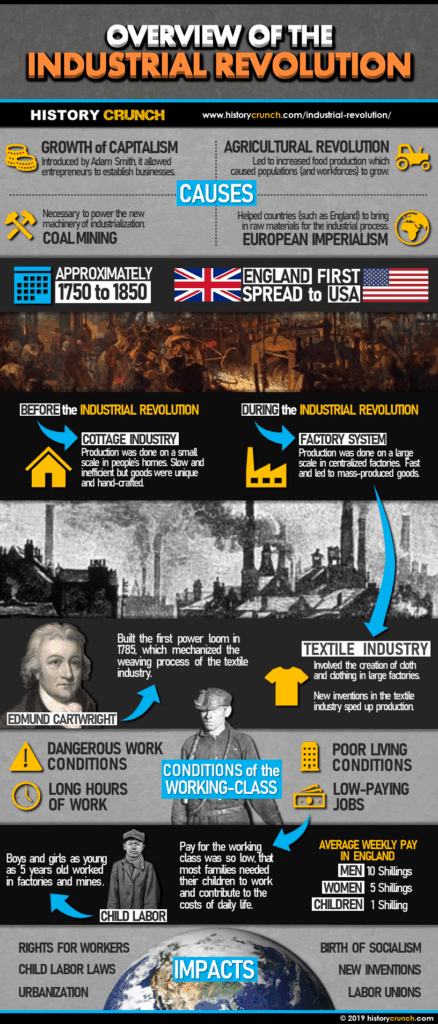
This Industrial Revolution overview infographic was created by the History Crunch team to help students and teachers quickly understand the most important aspects of this transformative historical event. It is designed as a visual learning and study tool, summarizing the essential information covered in our full article on the Industrial Revolution Overview. Teachers may use it as a classroom display, a discussion prompt, or a study aid for students preparing for assessments.
What This Infographic Covers
The Industrial Revolution began in Britain in the mid-1700s and is considered one of the most important turning points in all of human history. Before the Industrial Revolution, most goods were produced by hand in people’s homes in a system known as the cottage industry. The shift to machine-based manufacturing in factories changed everything, including how goods were made, how people worked, where they lived, and how societies were organized.
This infographic highlights the major causes of the Industrial Revolution, including Britain’s abundant coal and iron resources, its stable government and growing empire, its access to global trade networks, and the rapid pace of scientific invention during this period. Each of these factors played an important role in making Britain the birthplace of industrialization.
The infographic also identifies some of the most important inventions of the Industrial Revolution. The steam engine, developed and improved by James Watt, is perhaps the single most important invention of the era. It powered factories, locomotives and ships, transforming both production and transportation. Other key inventions include the spinning jenny, the power loom and the cotton gin, each of which dramatically increased the speed and scale of textile manufacturing.
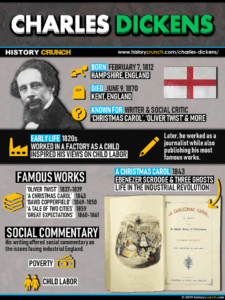
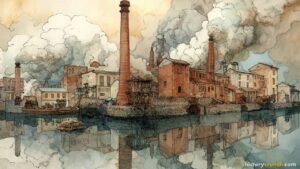
The human impact of the Industrial Revolution is also represented in the infographic. While industrialization brought significant economic growth and rising living standards over time, it also created serious hardships for working people. Factory workers, including children, faced dangerous conditions, long hours and very low wages. Industrial cities grew rapidly but were often overcrowded, polluted and lacking in basic sanitation. These conditions eventually led to major social reform movements and new political ideas about workers’ rights and the role of government in society.
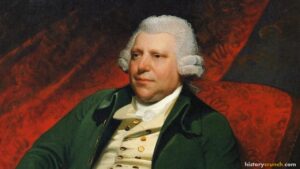
Finally, the infographic touches on the key figures of the Industrial Revolution. Inventors such as James Watt, Richard Arkwright and George Stephenson transformed production and transportation, while thinkers such as Adam Smith and Karl Marx developed competing ideas about how economies should be organized in an industrial world. These ideas continue to influence politics and economics to this day.
How to Use This Infographic in the Classroom
This infographic works well as a visual introduction at the start of an Industrial Revolution unit, helping students build a mental map of the topic before diving into individual articles and readings. It can also be used as a review and study tool before an assessment, or as a discussion prompt asking students to identify which aspect of the Industrial Revolution they think had the greatest impact on modern life. Teachers may also use it alongside primary source documents or reading comprehension activities to help students make connections between the visual summary and the deeper content of the topic.
Related Articles
To learn more about the topics covered in this infographic visit the following History Crunch articles: