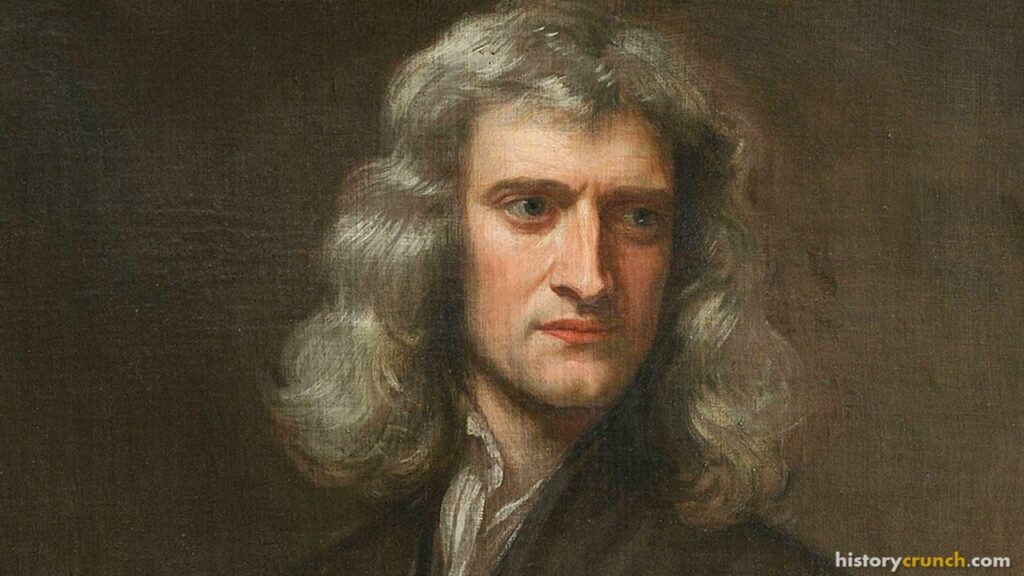
Isaac Newton was an English mathematician, physicist, and astronomer who lived during the 17th and early 18th centuries. He is best known for developing the laws of motion and the law of universal gravitation, which together explained how objects move both on Earth and throughout the universe. His most famous work, ‘Philosophiae Naturalis Principia Mathematica’, or simply the ‘Principia’, is considered one of the greatest scientific texts ever written. His contributions helped lay the foundation for classical physics and shaped scientific thinking for more than two centuries. Due to the timeframe of his life, he is most often associated with achievements in relation to the Scientific Revolution and the Age of Enlightenment.
Isaac Newton – Early Life
Isaac Newton was born on January 4th, 1643, in Woolsthorpe, Lincolnshire, England. He was born prematurely and was a small and sickly infant. His father, also named Isaac Newton, had died three months before his birth. When Newton was just three years old, his mother, Hannah Ayscough, remarried and moved away to live with her new husband, leaving young Newton in the care of his grandmother. This separation had a lasting effect on him and is thought to have contributed to the somewhat difficult and withdrawn personality he displayed throughout his life.
Newton attended the King’s School in Grantham, where he showed an early talent for building mechanical devices, such as model windmills and sundials. However, his mother pulled him out of school around the age of 12 with the intention of making him a farmer. Newton proved to be a poor farmer with little interest in the work, and his old headmaster eventually persuaded his mother to allow him to return to school. In 1661, he enrolled at Trinity College, Cambridge, where he would go on to do much of his most important work.
Isaac Newton – Education at Cambridge
At Cambridge, Newton studied a wide range of subjects, including mathematics, optics, and natural philosophy. He was initially exposed to the traditional ideas of ancient Greek thinkers such as Aristotle, but he quickly became far more interested in the newer ideas of thinkers like Galileo Galilei, René Descartes, and Johannes Kepler. These men had already made significant advances in understanding the natural world, and Newton set out to build on their work.
In 1665, Cambridge was forced to close temporarily due to an outbreak of the bubonic plague. Newton returned home to Woolsthorpe for roughly two years. In reality, this period turned out to be one of the most productive stretches of his entire life. Working largely on his own, he made major advances in mathematics, developed his early ideas about gravity, and conducted experiments with light and color. It was during this time, according to the famous story, that he observed an apple falling from a tree and began thinking about the force that caused it to fall. While the apple story is almost certainly exaggerated, the underlying point is accurate: Newton used this period away from Cambridge to develop the ideas that would eventually change the course of science.
Isaac Newton – Laws of Motion and Universal Gravitation
Newton returned to Cambridge after the plague years and continued developing his ideas. In 1687, he published the ‘Principia’, which laid out his three laws of motion and his law of universal gravitation in full mathematical detail. These ideas were a landmark achievement in the history of science.
His three laws of motion described how objects behave when forces are applied to them. The first law stated that an object at rest stays at rest, and an object in motion stays in motion, unless acted upon by an outside force. The second law explained how the force applied to an object determines how quickly it accelerates, based on its mass. The third law stated that for every action there is an equal and opposite reaction. Together, these three laws provided a framework for understanding the movement of objects that had never existed before.
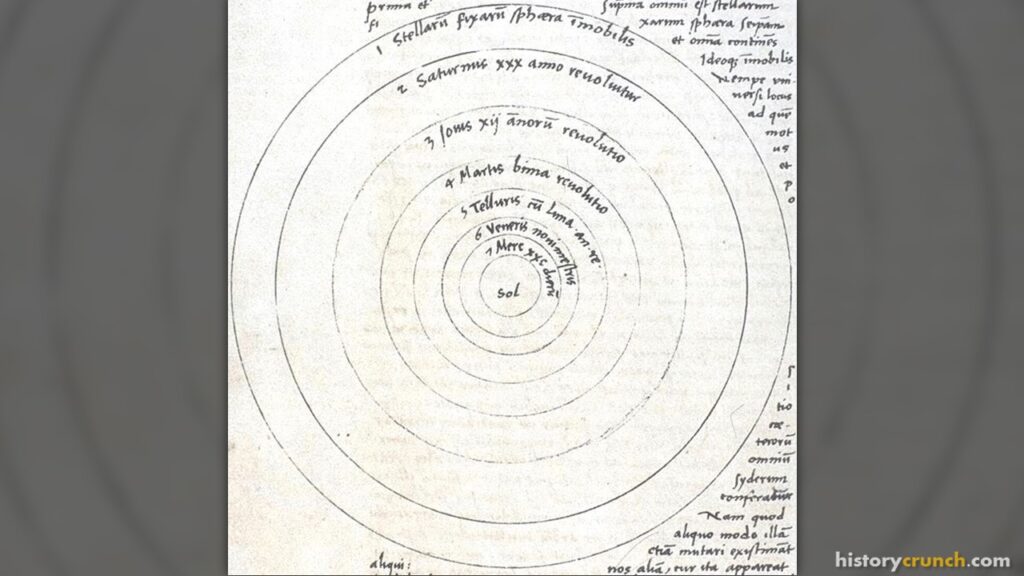
His law of universal gravitation went even further. Newton argued that every object in the universe attracts every other object with a force that depends on their masses and the distance between them. More specifically, this single law explained why objects fall to the ground on Earth, why the Moon orbits the Earth, and why the planets orbit the Sun. It unified the physics of the Earth and the heavens under a single set of rules for the first time. Furthermore, Newton’s gravitational law confirmed and explained the heliocentric model that Copernicus had proposed and Galileo had defended, providing the mathematical proof that had previously been missing.
Isaac Newton – Work on Light and Mathematics
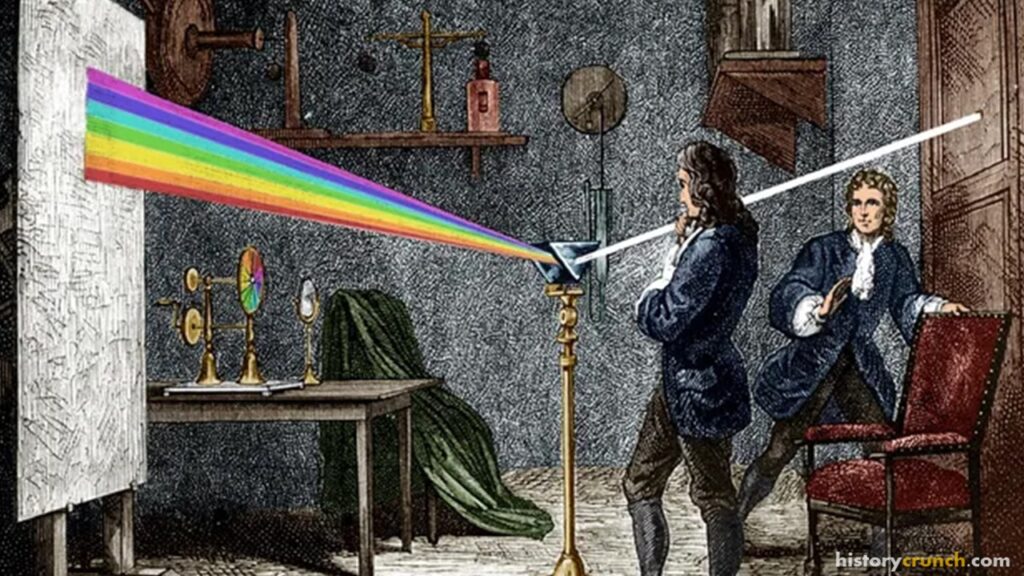
Beyond his work on motion and gravity, Newton made major contributions in two other areas: light and mathematics. In his experiments with light, he discovered that white light is not a single color but is instead made up of a full spectrum of colors. He demonstrated this by passing a beam of sunlight through a glass prism, which separated the light into a rainbow of colors. This finding overturned the previously held belief that color was a property of objects themselves rather than of light.
In mathematics, Newton developed a new branch of mathematics known as calculus, which provided a way of calculating rates of change and areas under curves. He did this independently and at roughly the same time as the German mathematician Gottfried Wilhelm Leibniz, which led to a bitter dispute between the two men and their supporters over who deserved credit for the discovery. Today, both men are recognized as having developed calculus independently of one another.
Newton also designed and built the first practical reflecting telescope, which used mirrors instead of lenses to focus light. This design allowed for a much more compact and powerful instrument than the refracting telescopes that had been used previously, and it became the standard design for large telescopes that continues to be used to this day.
Isaac Newton – Later Life
Newton’s later career took him away from pure scientific research and into public life. In 1696, he was appointed Warden of the Royal Mint in London, a position that gave him responsibility for overseeing England’s currency. He took the job seriously and worked energetically to crack down on the widespread problem of coin counterfeiting. In 1700, he was promoted to Master of the Mint, a role he held for the rest of his life. He also served as a Member of Parliament for Cambridge on two occasions, though he reportedly never spoke during his time in the House of Commons.
Newton was elected president of the Royal Society, one of the most prestigious scientific organizations in the world, in 1703, and was reelected every year until his death. In 1705, he was knighted by Queen Anne, becoming Sir Isaac Newton. He never married and had no children. In his final years, he devoted a significant amount of time to the study of theology and biblical history, though these works were not published during his lifetime.
Isaac Newton – Death
Isaac Newton died on March 31st, 1727, in Kensington, London, at the age of 84. He was given a state funeral and was buried in Westminster Abbey, an honor typically reserved for monarchs and the most celebrated figures in English public life. The French writer Voltaire, who was in London at the time and witnessed the funeral, reportedly remarked that England honored its great thinkers in the same way other nations honored their kings.
Isaac Newton – Significance
The significance of Isaac Newton is difficult to overstate. His laws of motion and universal gravitation unified the physics of the Earth and the heavens and provided scientists with tools that remained at the heart of physics for more than 200 years. In reality, it was not until the early 20th century, when Albert Einstein published his theory of general relativity, that Newton’s model of gravity was shown to have limitations at the largest scales of the universe. Even so, Newton’s laws remain accurate and useful for the vast majority of everyday situations and continue to be taught and applied today.
Newton himself, in a famous letter to his rival Robert Hooke, wrote that if he had seen further than others, it was because he had stood on the shoulders of giants. He was referring to the contributions of Galileo, Kepler, Copernicus, and others who had come before him. As such, Newton is best understood not just as an isolated genius but as a significant figure of a long chain of scientific progress that stretched back through the Renaissance and transformed the way humans understood the universe. As such, historians consider the ideas brought forward by Newton to be significant to the development of the Scientific Revolution and the outbreak of the Age of Enlightenment. For this reason, historians consider him to be important to the development of Enlightenment ideals of rationalism and reason through the scientific method.