John Kay: A Detailed Biography

Facebook
X
Reddit
Pinterest
LinkedIn
John Kay
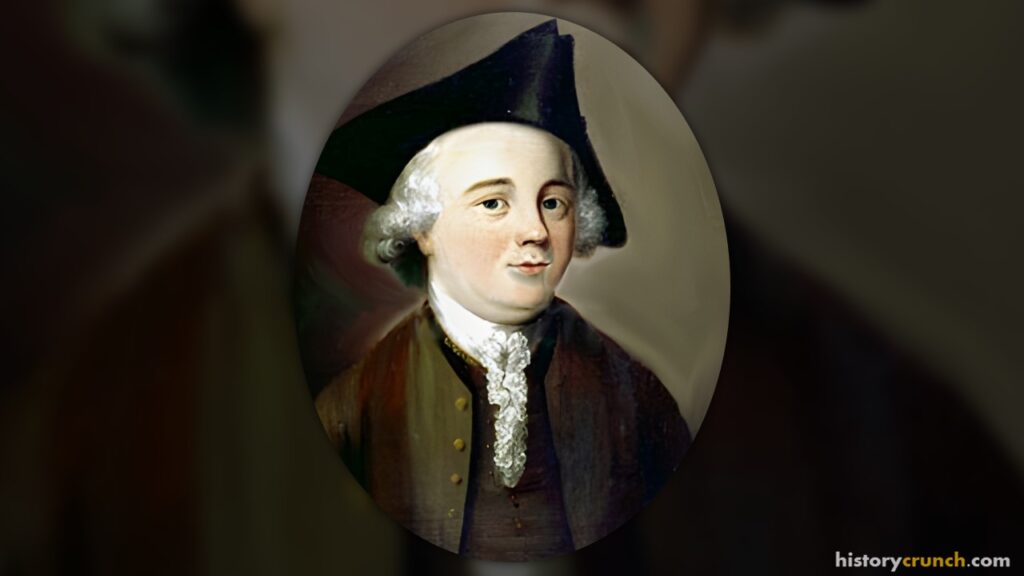
'Portrait of John Kay' by an Unknown Artist (18th Century)

TABLE OF CONTENTS

John Kay was an English inventor who significantly advanced the textile industry with his invention of the flying shuttle in 1733, which greatly sped up the weaving process and was a key development in the Industrial Revolution.

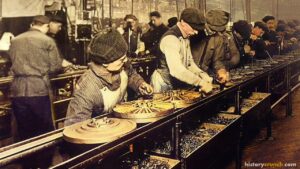
John Kay was a significant figure in the timeframe of the Industrial Revolution and is remembered today as a noted inventor.  For example, he invented the flying shuttle, which had a profound impact on production in England and around the world during the time of the Industrial Revolution.  For example, John Kay’s flying shuttle transformed the textile industry by speeding up production.​

JOHN KAY – EARLY LIFE

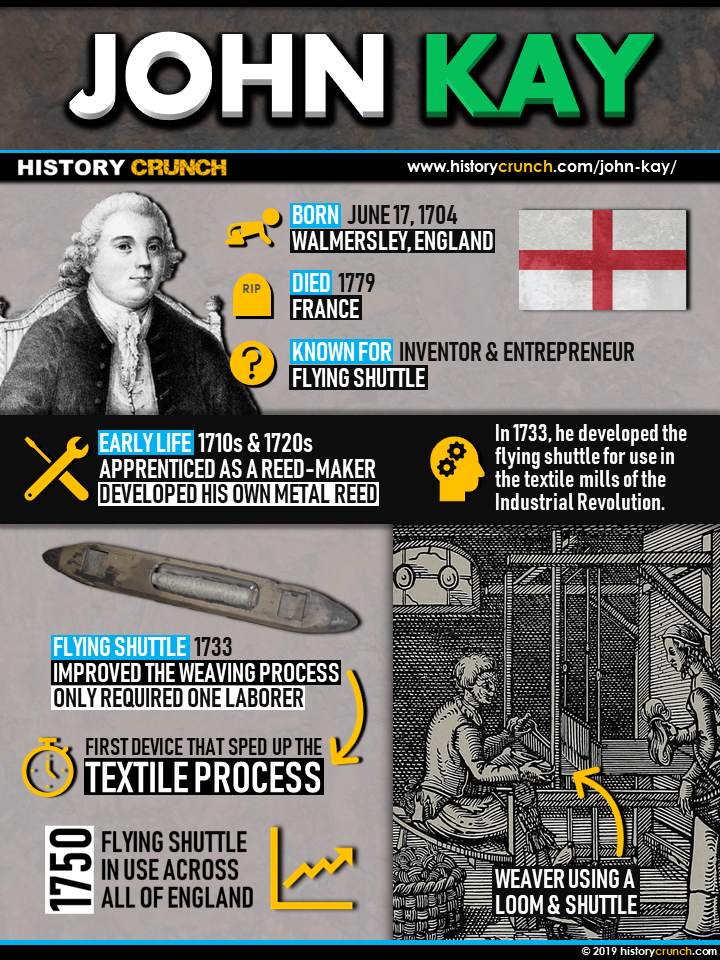
John Kay was born on June 17th, 1704 in Walmersley, England. His father was a yeoman and owned an estate in Walmersley, but died before Kay was born. The estate was left to Kay as he was the oldest son. As a child Kay attended school and became an apprentice hand-loom reed-maker at the age of fourteen. Kay left the apprenticeship after only one month after saying that he had mastered the craft. Once home he developed a metal reed that he sold across the country.  On June 29th, 1725, John Kay married Anne Holte from Bury, England.  The couple had several children together.​

JOHN KAY – INVENTION OF THE FLYING SHUTTLE

Kay continued to come up with ideas and improvements for textile machines, and in 1733 he developed a wheel shuttle, later known as a flying shuttle.  The flying shuttle was used for the traditional hand-loom and helped improve weaving efficiency and reduced labor needs because it could be operated with only one operator.  In fact, the flying shuttle was the first device in the modern era that significantly improved the productivity and efficiency of the textile process.​

The flying shuttle was first manufactured in Essex, England. However, labourers did not like the machine, and petitioned to have it stopped, as it put their livelihoods at risk.  This is likely related to the Luddite Movement that emerged in England during the timeframe of the Industrial Revolution.  This movement opposed new technologies, which threatened the jobs of industrial workers.  Kay improved his machine, and also developed other machines such as one for cloth ribbon weaving, and one for spinning.  In reality, he made very little money from his invention and instead struggled due to copyright infringement of his original design.

​Kay left England in 1747 because France was known to support textile innovations. Kay sold his patent to the flying shuttle to French manufacturers and it allowed for the mechanization in French textile production which allowed the French to make lots of fabric and textiles to clothe the population.  In return, he was paid an ongoing pension. Kay adopted France as his country, although he did visit England a couple of times during the 1750s.
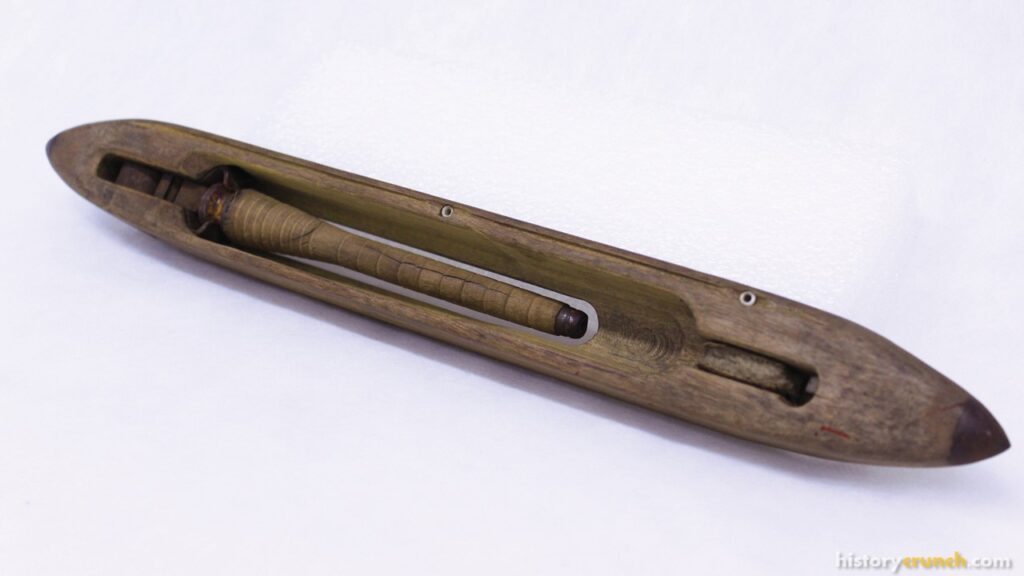
Flying Shuttle Invention in the Industrial Revolution
Flying Shuttle Invention in the Industrial Revolution (Wikimedia Commons)

JOHN KAY – DEATH AND LEGACY

John Kay died in 1779.  Today he is best remembered for his invention of the flying shuttle and the impact his innovation had on textile production during the Industrial Revolution.

JOHN KAY – INFOGRAPHIC
John Kay Infographic
John Kay Infographic by History Crunch

We strive to produce educational content that is accurate, engaging and appropriate for all learners. If you notice any issues with our content, please contact us and let us know!

AUTHOR INFORMATION
Picture of Elias Beck

Elias Beck

I'm a passionate history and geography teacher with over 15 years of experience working with students in the middle and high school years. I have an Education Degree with a focus in World History. I have been writing articles for History Crunch since 2015 and love the challenge of creating historical content for young learners!
Scramble for Africa
Age of Imperialism

Scramble for Africa: A Detailed Overview

The Scramble for Africa was a major historical event during the time of the
Age of Imperialism. It saw the European powers of the 19th century colonize Africa for its economic opportunities, among other things.

Mercantilism: A Detailed Summary

Mercantilism was an important aspect of life during the time of the Age of Exploration. This article details the history and significance of mercantilism.

Slavery in the United States

Slavery in the United States: A Detailed Summary

Slavery in the United States began in the early 1600s when Africans were brought to the American colonies to provide forced labor, especially on Southern plantations. This article details the history and significance of slavery in the United States, especially in relation to Colonial America and the American Civil War.

Indian National Congress
Age of Imperialism

Indian National Congress: A Detailed Summary

The Indian National Congress, founded in 1885, was the main organization of the Indian Independence Movement against British rule. It played a pivotal role in mobilizing mass support for independence and later became a major political party in post-independence India.

Lend-Lease Act: A Detailed Summary

The Lend-Lease Act was an important piece of legislation that had significant impacts on the events of World War II. This article details the history and significance of the Lend-Lease Act.

Magna Carta: A Detailed Summary

The Magna Carta, signed in 1215, was a historic English document that limited the power of the king and established the principle that everyone, including the monarch, is subject to the law. This article details the history and significance of the Magna Carta.