Textile Manufacturing in the Industrial Revolution: A Detailed Summary

Textile Manufacturing in the Industrial Revolution
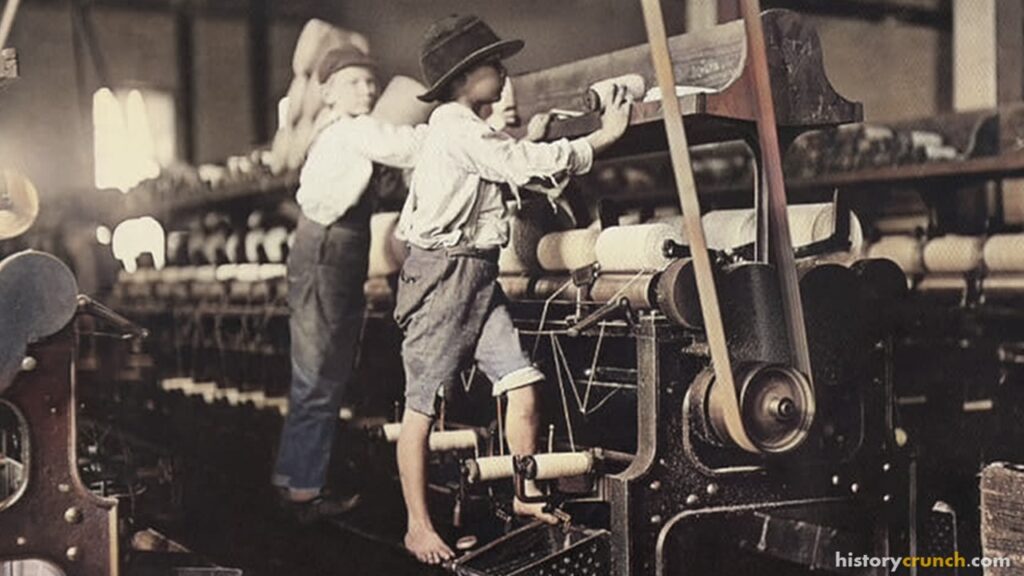
Child laborers in a textile factory in Georgia in 1909. (Colorized by historycrunch.com)
Textile manufacturing in the Industrial Revolution underwent a dramatic transformation with the introduction of mechanized equipment like the spinning jenny, power loom, and cotton gin, significantly increasing production efficiency and output.

Table of Contents

Textile manufacturing in the Industrial Revolution underwent many changes due to the advent of mechanization and the factory system. In fact, the development of the factory system was one of the main impacts of the Industrial Revolution. It led to more efficient and cost-effective production that benefitted several different industries. For instance, one of the main industries that benefitted from the effects of the Industrial Revolution was the textile industry.

WHAT WAS THE TEXTILE INDUSTRY IN THE INDUSTRIAL REVOLUTION?

The textile industry was based on the development of cloth and clothing.  Before the start of the Industrial Revolution, which began in the 1700s, the production of goods was done on a very small scale.  Historians refer to this method of production as the ‘cottage industry’.  Simply put, the cottage industry refers to a period of time in which goods for sale were produced on a very small scale, usually in a home.  In this system, people produced goods, such as wool, in their homes or on their own farms and then sold it to local communities since long distance transportation was uncommon.  This method of production was slow and inefficient and struggled to keep pace with the growing demand caused by the increased population.  In contrast, industrialization allowed goods to be produced in a central location and on a mass scale.  It also led to the creation of inventions that helped speed up the production method of many goods, but most noticeably in the textile industry.
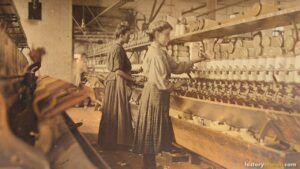
Women in the Industrial Revolution
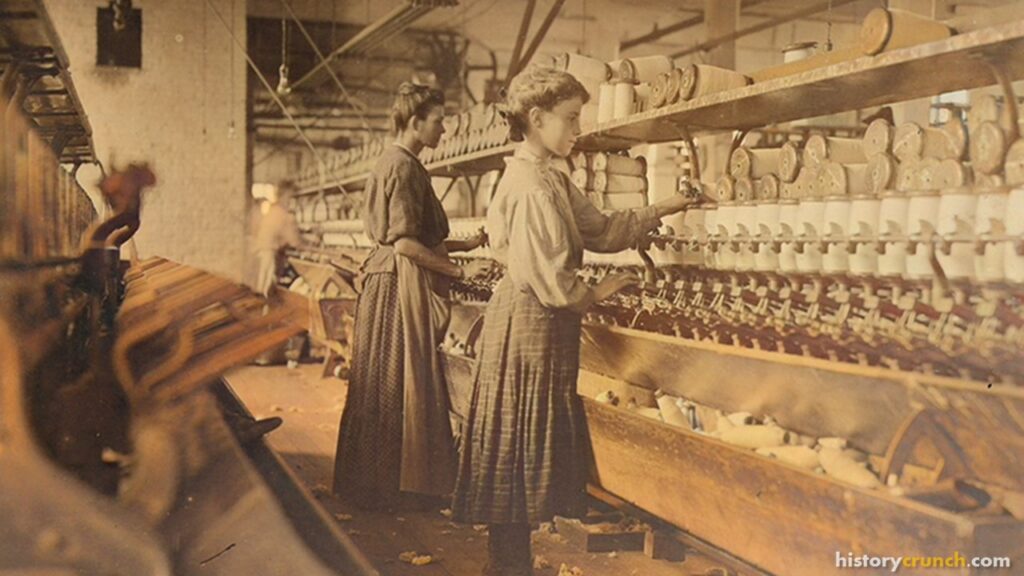
Women and a girl working in a textile mill in the Industrial Revolution. Photograph by Lewis Hine in Georgia in 1909. (Colorized by historycrunch.com)

INVENTIONS THAT IMPACTED TEXTILE MANUFACTURING

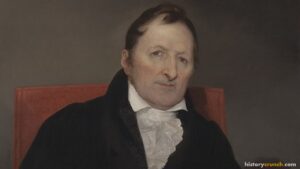
Throughout the 1700s, inventors such as Richard ArkwrightEli WhitneyJames HargreavesJohn Kay and Edmund Cartwright, developed machines and techniques that helped improve production, especially in terms of the textile industry.  For example, in 1733 John Kay developed a wheel shuttle, later known as a flying shuttle. The machine improved weaving efficiency and reduced labor needs because it could be operated with only one operator.  James Hargreaves created the spinning jenny in 1764, which allowed a machine with many spindles of thread to be spun at one time.  Richard Arkwright added to this by developing the water frame in 1769.  The water frame allowed over one hundred spindles of thread to be spun at one time but was so large and needed so much energy that he built it next to rivers and creeks in order to use the force of the water to spin the machine.  For his part, Edmund Cartwright developed the power loom in 1785 which allowed quicker production of cloth.  Finally, American inventor, Eli Whitney developed the cotton gin in 1793, which allowed for quicker production of cotton.  Previously, cotton had to be hand cleaned in order to remove fibers and seeds.  Whitney’s cotton gin sped up this process and allowed for much faster harvesting of the resource.  In all, these inventions mechanized the textile industry and led to the establishment of factories throughout Britain, which was the first country to industrialize.
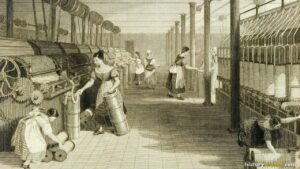
Power Loom Invention in the Industrial Revolution
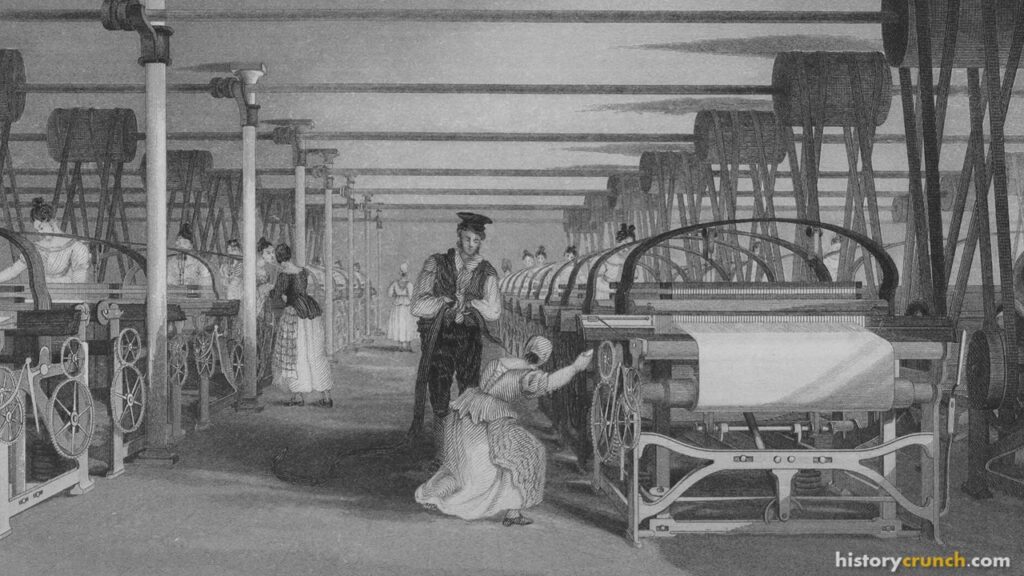
‘Illustration of power loom weaving’ by T. Allom, Engraver J. Tingle. The Power Loom was an important invention during the time of the Industrial Revolution.
Facebook
X
Reddit
Pinterest
LinkedIn

We strive to produce educational content that is accurate, engaging and appropriate for all learners. If you notice any issues with our content, please contact us and let us know!

AUTHOR INFORMATION
Picture of Elias Beck

Elias Beck

I'm a passionate history and geography teacher with over 15 years of experience working with students in the middle and high school years. I have an Education Degree with a focus in World History. I have been writing articles for History Crunch since 2015 and love the challenge of creating historical content for young learners!
Gilded Age in the United States
Industrial Revolution

Gilded Age in the United States: A Detailed Overview

The Gilded Age in the United States, spanning the late 19th century, was characterized by rapid economic growth, industrialization, and stark social inequality. As a historical period, it is closely linked with the events of the Industrial Revolution.

Thomas Newcomen
Industrial Revolution

Thomas Newcomen: A Detailed Biography

Thomas Newcomen was an English inventor who developed the first practical steam engine, known as the Newcomen atmospheric engine, in 1712, which was primarily used for pumping water out of mines.

Laissez-faire Capitalism: A Detailed Summary

Laissez-faire capitalism first emerged during the Enlightenment and promoted free markets, private ownership, and limited government. This article details the history and significance of laissez-faire capitalism.

James Hargreaves
Industrial Revolution

James Hargreaves: A Detailed Biography

James Hargreaves was an English weaver, carpenter, and inventor who developed the spinning jenny in 1764, a multi-spindle spinning frame that significantly increased yarn production and became a key invention during the early Industrial Revolution.

Alexander Graham Bell Infographic
Infographics

Alexander Graham Bell: Infographic

This Alexander Graham Bell infographic was created by History Crunch to help students and teachers quickly understand the life, inventions and historical significance of the Scottish-born inventor best known for developing the first practical telephone. It covers his early life, his invention of the telephone, the founding of AT&T and his lasting legacy. Designed for students in grades 5 to 12.