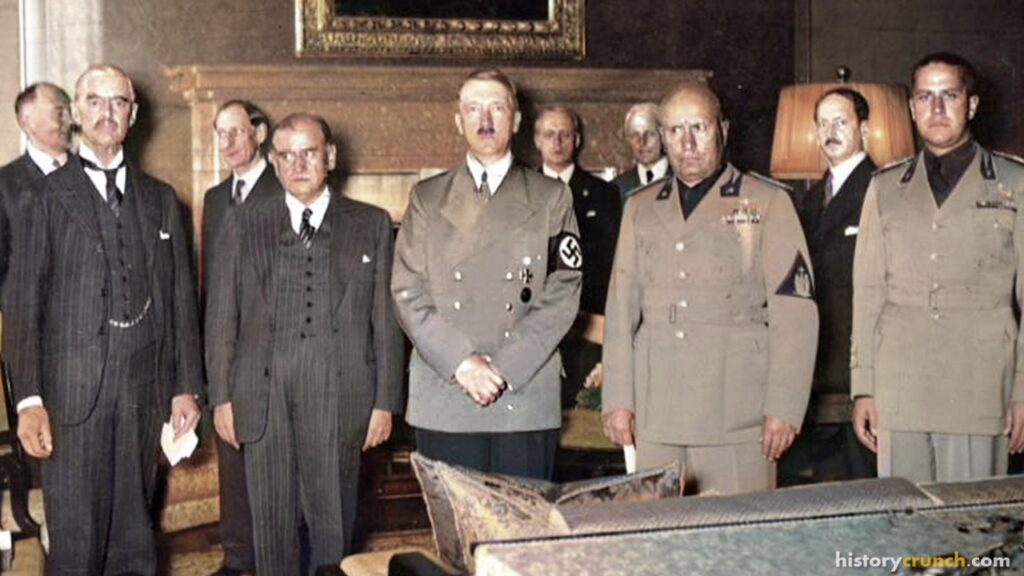
The Munich Conference was held on September 29th and 30th, 1938, in Munich, Germany. It was an important event in the lead up to World War II, and had significant historical impacts. In general, it was a diplomatic meeting between the leaders of Germany (Adolf Hitler), Great Britain (Neville Chamberlain), France (Édouard Daladier), and Italy (Benito Mussolini). The main issue of the Munich Conference was to discuss Hitler’s demand that Nazi Germany receive the Sudetenland of Czechoslovakia.
MUNICH CONFERENCE – BACKGROUND
The years immediately before the outbreak of World War II, in September of 1939, saw the western democracies of Britain and France, utilize a foreign policy strategy called ‘appeasement‘. In fact, the mid-1930s was the general time frame for when the Nazi Party and Adolf Hitler rose to power and took control of Germany. After rising to power in Germany, Hitler began to carry out aggression towards other nation-states in Europe and Hitler carried out actions that went against the general terms of the Treaty of Versailles.

The Western European democracies of Britain and France did not want to enter into a military conflict with Germany at this time as both had been reducing their armies and ability to wage war. Furthermore, the two countries also were facing economic struggles that made them reluctant to go to war. This lack of will to fight pushed both countries towards the policy of appeasement which involved giving into the demands of an aggressive country in the hopes that the aggression could be contained. The policy is closely linked to Neville Chamberlain who was the British Prime Minister at the time, as he is the one who proposed it as the best means of containing Nazi aggression and avoiding a world war.
With that said, appeasement was a failure as a foreign policy strategy, because it did not prevent the devastation and destruction of World War II. As such, historians consider the failure of appeasement as a significant cause of World War II, and the Munich Conference was one of several examples of the failure of appeasement, alongside: the remilitarization of the Rhineland, annexation of Austria, and the occupation of Czechoslovakia.
The policy of appeasement unfolded again with the German aggression towards Czechoslovakia in 1938. Czechoslovakia, as a country, was created after World War I and parts of it included German-speaking people, such as the Sudetenland. Again, Hitler pressured Europe with his military aggression in the goal of uniting all German-speaking peoples under the control of the Nazi’s. This is what ultimately led to the events of the Munich Conference.
MUNICH CONFERENCE – SUMMARY
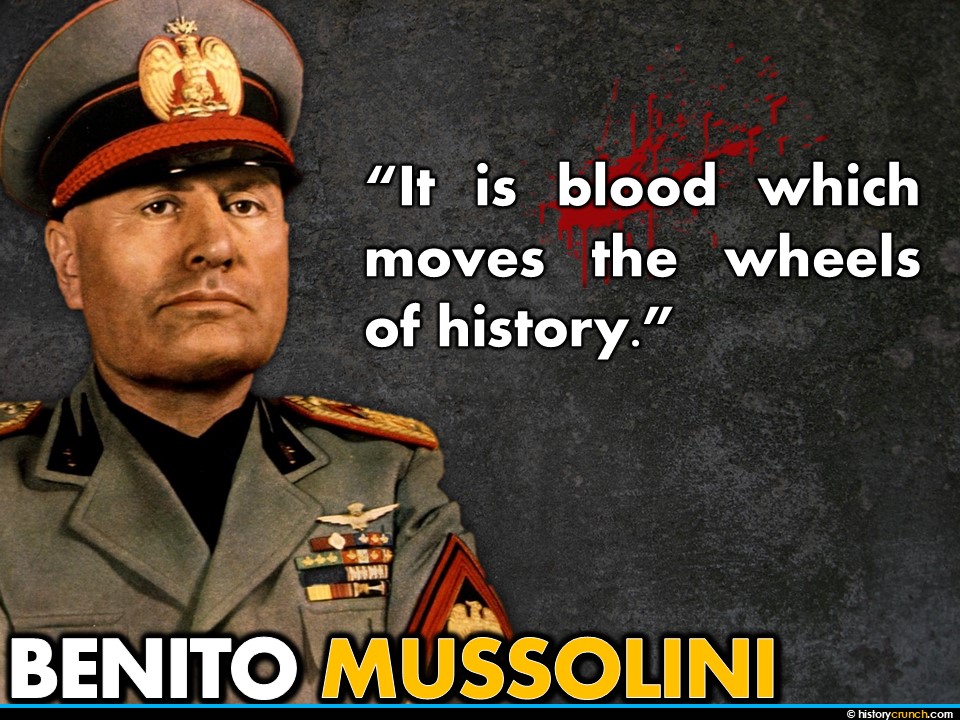
The Munich Conference was a two-day conference held in 1938 (September 29th and 30th) in which the leaders of Britain, France, Italy and Germany met to discuss Germany’s desire to take over the Sudetenland region of Czechoslovakia. Germany wanted to annex the Sudetenland to ‘unite’ German-speaking people and regain its territories that were lost due to the agreement of the Treaty of Versailles. Also, the leaders of Britain and France sought to avoid war at almost any cost, following the policy of appeasement, which was mentioned previously. Italy, for its part, acted as a mediator but was largely supportive of Hitler. In fact, the fascism of Nazi Germany was largely inspired by the earlier growth of fascism in Italy by Benito Mussolini. Furthermore, Czechoslovakia, who controlled the Sudetenland, was not invited to the Munich Conference. Many viewed this as disastrous, since the other European leaders were essentially forfeiting Czechoslovakian territory without consent.
After hours of discussions, Britain and France ultimately agreed to Hitler’s demands, which allowed Nazi Germany to occupy the Sudetenland immediately. More specifically, the agreement, which was signed on the morning of September 30th, 1938, allowed Germany to take control of the Sudetenland without any military action and caused Czechoslovakia to lose important defense and resources that weakened it militarily. This, unfortunately, made it difficult for Czechoslovakia to defend itself in the aftermath of the Munich Conference, which had devastating consequences in 1939 when Nazi German forces invaded and occupied the rest of Czechoslovakian nation-state.
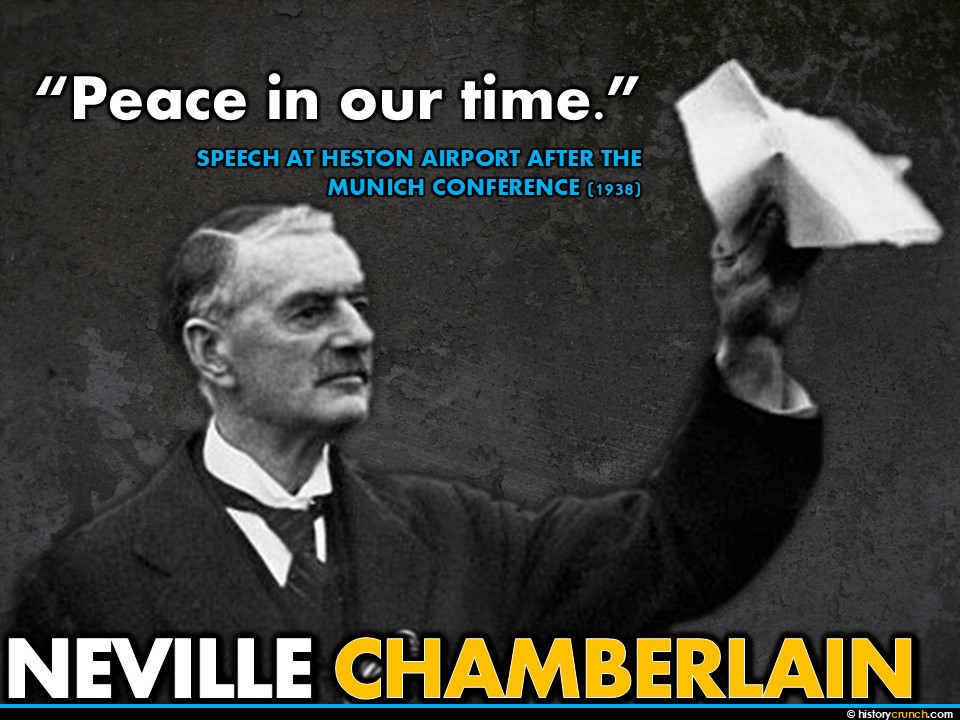
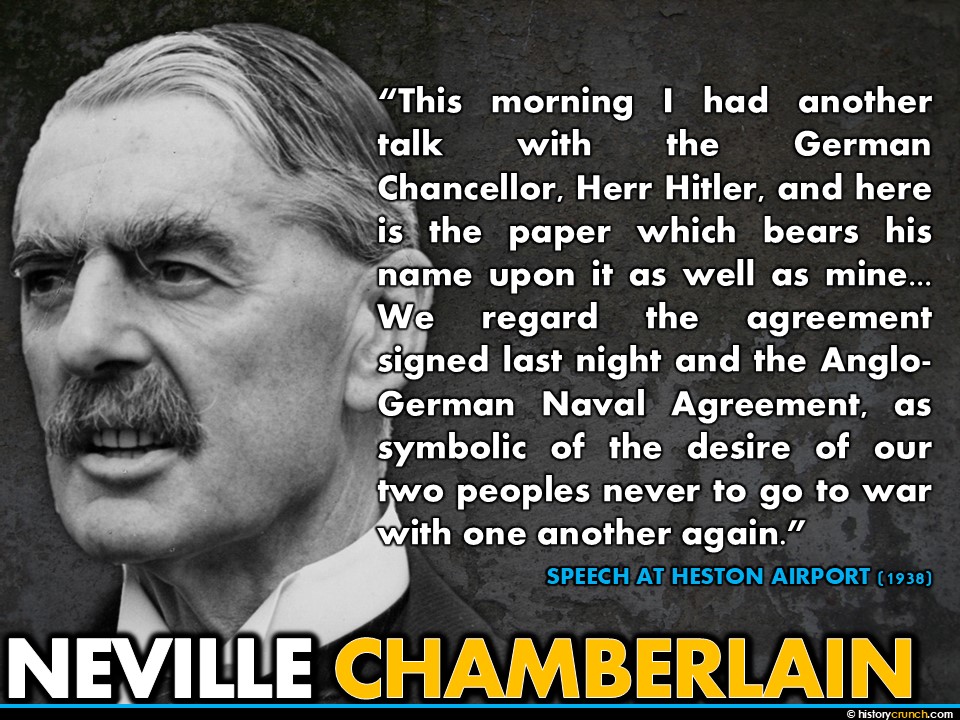
The Munich Conference was an embarrassment for Neville Chamberlain, who returned to Britain and announced that he had helped ensure ‘peace in our time’ while holding up the agreement signed by Hitler. Essentially, Hitler agreed to receiving the Sudetenland, in exchange for an end to his aggressive demands for territorial expansion. For Hitler though, the outcome of the Munich Conference furthered his belief that the Western democracies were weak and that they would not act in the face of Nazi aggression. Germany soon took control over the remainder of Czechoslovakia through a series of invasions.
MUNICH CONFERENCE – SIGNIFICANCE
The Munich Conference was a highly significant event. The deal was seen as a defeat for the Western powers, as they allowed Hitler, with no resistance, to take over the Sudetenland region. As such, historians view the Munich Conference of 1938 as one of the main examples of the failure of appeasement. Furthermore, the failure of appeasement is considered to be one of the main causes of World War II.
As well, the outcome of the conference angered Czechoslovakia as they were not allowed to represent themselves and their interests at the time. Western powers had pledged to protect Czechoslovakia, but failed to follow through and left the meeting relying on Hitler’s written promise that Germany will not seek any more territory in Europe. In reality, Hitler had no intentions of abiding by the terms of the Munich Agreement. In fact, Despite promises that he had ‘no more territorial demands’, Hitler violated the terms of the Munich Conference just six months later. On March 15th, 1939, German troops invaded and occupied the rest of Czechoslovakia, including Bohemia and Moravia. Meanwhile, Slovakia was forced to declare independence as a German puppet state. This displayed the failure of appeasement as a foreign policy, as Hitler’s ambitions were clearly not limited to German-speaking lands. The stage was set for the outbreak of World War II, just months later, in September of 1939, when Hitler ordered the Nazi Germany invasion of Poland.