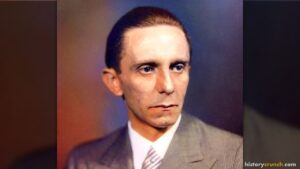
Oliver Cromwell was an English military commander and politician who rose from relative obscurity to become the dominant figure in one of the most dramatic periods in British history. He played a central role in the English Civil War, leading parliamentary forces to victory over King Charles I and signing the king’s death warrant in 1649. He then governed England, Scotland, and Ireland as Lord Protector from 1653 until his death in 1658, making him the only non-royal ruler of England in modern history. Cromwell remains one of the most debated figures in British history. To some he was a champion of Parliament and religious freedom who checked the tyranny of an absolute monarch. To others he was a military dictator whose brutal campaigns in Ireland left a legacy of destruction and resentment that lasted for centuries.
Early Life of Oliver Cromwell
Oliver Cromwell was born on April 25th, 1599, in Huntingdon, a market town in East Anglia, England. He came from a modest branch of a gentry family with distant connections to Thomas Cromwell, the chief minister of King Henry VIII. His father Robert Cromwell was a small landowner and local official, and the family was comfortable but not wealthy. Oliver was raised in a strongly Protestant household and received his early education at the local grammar school in Huntingdon before attending Sidney Sussex College, Cambridge, a college with a strong Puritan atmosphere. He left Cambridge in 1617 following the death of his father, without completing his degree, in order to take care of his mother and family.
In August 1620, Cromwell married Elizabeth Bourchier, the daughter of a wealthy London fur trader. The marriage was happy and produced nine children, though three died young. In 1628, Cromwell was elected to Parliament for the first time, representing Huntingdon. His early parliamentary career was unremarkable, and he spent most of his thirties as a small farmer and local figure of modest importance. He went through a period of significant personal difficulty in the early 1630s, selling much of his land following a local dispute and reportedly suffering from bouts of depression. He also underwent a deep religious conversion during this period, becoming a committed Puritan and developing the intense Calvinist faith that would shape his entire subsequent career.
Oliver Cromwell – Entry into the Civil War
When the English Civil War broke out in August 1642 between King Charles I and Parliament, Cromwell was 43 years old and had no military experience whatsoever. He raised a small troop of cavalry from his local area and joined the parliamentary forces. What happened next was remarkable. Cromwell proved to be a natural military commander of exceptional ability, rising from captain to colonel within a year and demonstrating from the outset a talent for organizing, training, and leading cavalry that set him apart from most of his contemporaries.
Cromwell understood that the parliamentary forces needed a different kind of army from the one they had. Most cavalry of the period were drawn from the gentry and nobility, men who fought for reasons of social tradition and whose reliability under pressure was uncertain. Cromwell preferred to recruit soldiers of genuine religious conviction, men who believed they were fighting for a righteous cause and who would hold their discipline even in the heat of battle. He famously argued that he would rather have a plain captain who knew what he fought for than a gentleman who was nothing else, and he promoted officers on the basis of military ability rather than social rank.
His cavalry proved their worth at the Battle of Marston Moor in July 1644, where the combined parliamentary and Scottish forces defeated the Royalists in the north of England. Cromwell’s cavalry performed decisively in the battle, helping to turn what had threatened to become a defeat into a major parliamentary victory. He was wounded in the engagement but continued to direct his forces effectively. More specifically, Cromwell earned a reputation in the battle for being able to rally his cavalry and return them to the fight after a successful charge, a skill that eluded most cavalry commanders of the era.
Oliver Cromwell – The New Model Army and Victory
In 1645, Parliament reorganized its forces into the New Model Army, a professional national force trained to a high standard and paid regularly. Cromwell was appointed commander of the cavalry under the overall command of Sir Thomas Fairfax. The New Model Army proved immediately effective, winning a decisive victory over the Royalists at the Battle of Naseby in June 1645, which effectively ended the first phase of the Civil War. Charles I surrendered to Scottish forces in 1646 and was subsequently handed over to Parliament.
Even after the first Civil War ended, the conflict was not over. Charles I negotiated secretly from captivity with the Scots, promising to establish Presbyterianism in England in exchange for their military support. This triggered a Second Civil War in 1648. Cromwell commanded the parliamentary forces that defeated the Scottish invasion at the Battle of Preston in August 1648, crushing Royalist resistance. The resumption of war after what many had hoped was a settled peace convinced Cromwell and others in the army that no lasting settlement was possible while Charles I remained alive.
In December 1648, the army purged Parliament of members who were still willing to negotiate with the king, leaving a reduced body known as the Rump Parliament. A special court was established to try Charles I for treason. Cromwell was one of the signatories of the king’s death warrant, and Charles I was executed on January 30th, 1649. It was the most dramatic political act in English history, and Cromwell’s role in it defined his reputation ever afterward.
Oliver Cromwell – Ireland and Scotland
Following the execution of Charles I, Cromwell led military campaigns to bring Ireland and Scotland firmly under parliamentary control. His campaign in Ireland, beginning in August 1649, remains the most controversial episode of his career. Ireland had seen years of bloody conflict since the Irish Rebellion of 1641, and a complex alliance of Irish Catholics and English Royalists opposed parliamentary authority there. Cromwell’s forces stormed the town of Drogheda in September 1649, killing the garrison and a significant number of civilians. A similar massacre followed at Wexford. Cromwell justified the killings on military grounds, arguing they would hasten surrender and ultimately save lives. In Ireland, his campaign is remembered as a brutal atrocity whose consequences, including mass displacement, land confiscation, and the suppression of Catholic Irish culture, shaped Irish history for centuries.
In Scotland, Charles II, the executed king’s eldest son, had been crowned and was gathering an army. Cromwell invaded Scotland in 1650 and defeated the Scottish forces at the Battle of Dunbar in September 1650. When Charles II led a combined Scottish and English Royalist army into England in 1651, Cromwell pursued and destroyed it at the Battle of Worcester on September 3rd, 1651, the last major battle of the Civil Wars. Charles II fled into exile in Europe, and parliamentary authority over England, Scotland, and Ireland was secured.
Oliver Cromwell – Lord Protector
Following the military victories, Cromwell returned to England and found himself in an increasingly dominant position in a country that struggled to find stable civilian government. He grew frustrated with the Rump Parliament’s failure to agree on reforms and dissolve itself in favor of new elections. In April 1653, he entered the House of Commons with a body of soldiers and forcibly dissolved the Parliament, reportedly declaring that it was not fit that they should sit as a Parliament any longer.
A series of attempts to establish workable governments followed. A hand-picked assembly known as Barebone’s Parliament was established but proved unworkable and dissolved itself in December 1653. At that point Cromwell was offered the position of Lord Protector under a written constitution called the Instrument of Government, and he accepted. As Lord Protector he was effectively the head of state and head of government of England, Scotland, and Ireland, governing with a council and a Parliament but holding an authority that many observers compared to that of a king.
As Lord Protector, Cromwell pursued an active foreign policy that restored England to a prominent position in European affairs. He allied with France against Spain and waged a successful naval war against the Dutch Republic. He also promoted a degree of religious tolerance that was unusual for the time, allowing Jews to return to England for the first time since their expulsion in 1290 and permitting a range of Protestant denominations to worship freely, though Catholics and Anglicans were excluded from this tolerance. In 1657, Parliament offered him the title of King, which he declined after long deliberation, choosing to remain Lord Protector.
Later Years and Death of Oliver Cromwell
By the mid-1650s Cromwell’s health was declining. He suffered from recurring illness, believed to have included malaria contracted during the Irish campaigns, as well as kidney disease. The death of his favorite daughter Elizabeth in August 1658 affected him deeply, and his own health collapsed shortly afterward. Oliver Cromwell died on September 3rd, 1658, in London, at the age of 59. The date was significant, being the anniversary of his great victories at Dunbar and Worcester. He was given a lavish state funeral and buried in Westminster Abbey.
His son Richard succeeded him as Lord Protector but proved entirely unsuited to the role and resigned within months. Without the authority and military backing that Cromwell had commanded, the republican government fell apart rapidly, and in May 1660 Charles II was invited to return from exile and the monarchy was restored. The Restoration government took a grim posthumous revenge on Cromwell. In January 1661, his body was exhumed from Westminster Abbey, subjected to a symbolic execution, and his head displayed on a spike above Westminster Hall, where it remained for more than twenty years.
Significance of Oliver Cromwell
Oliver Cromwell was significant for several reasons. First, he was the central military figure of the English Civil War, whose organizational genius and personal leadership were indispensable to Parliament’s victory over Charles I. Without Cromwell, it is difficult to see how the parliamentary cause could have prevailed against the initial advantages the Royalists held in experienced cavalry and noble military leadership.
Second, Cromwell’s role in the execution of Charles I and the establishment of republican government permanently changed the nature of the English monarchy. No subsequent English monarch ever seriously attempted to govern without Parliament or to claim the kind of absolute authority that Charles I had asserted, partly because the Civil War had demonstrated so dramatically where such claims could lead. In this sense Cromwell’s revolution, however temporary its direct results, had lasting constitutional consequences.
Third, Cromwell’s campaigns in Ireland left a legacy of destruction, land confiscation, and Catholic suppression that shaped Irish history and Irish attitudes toward England for centuries afterward, making him one of the most hated figures in Irish historical memory while he was simultaneously celebrated in English and Protestant tradition. As such, Oliver Cromwell remains one of the most complex, consequential, and debated figures in the history of Britain and Ireland.