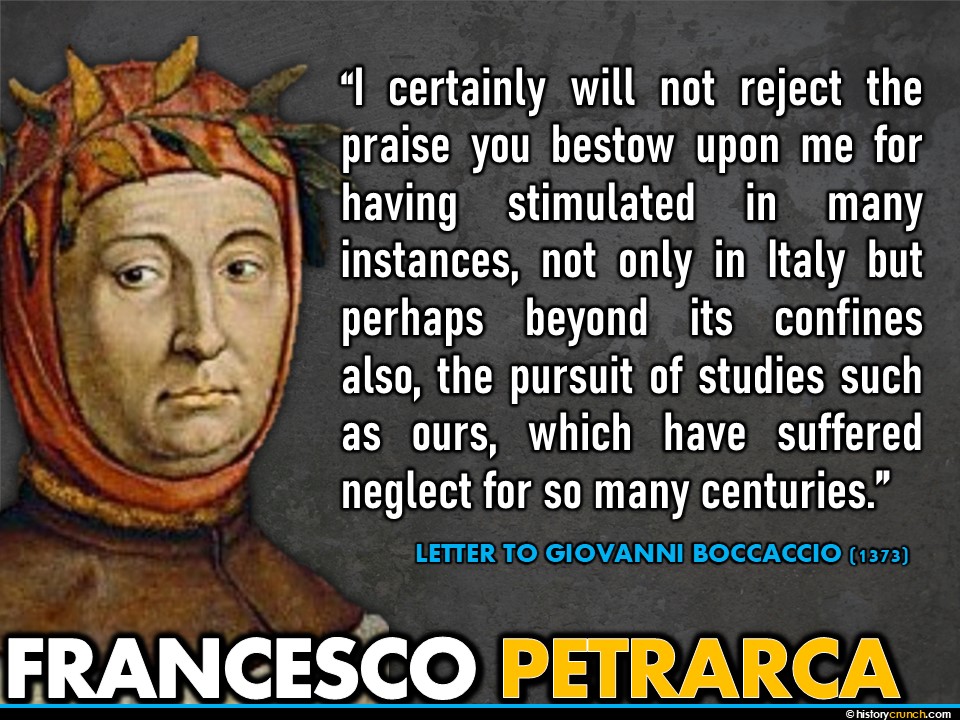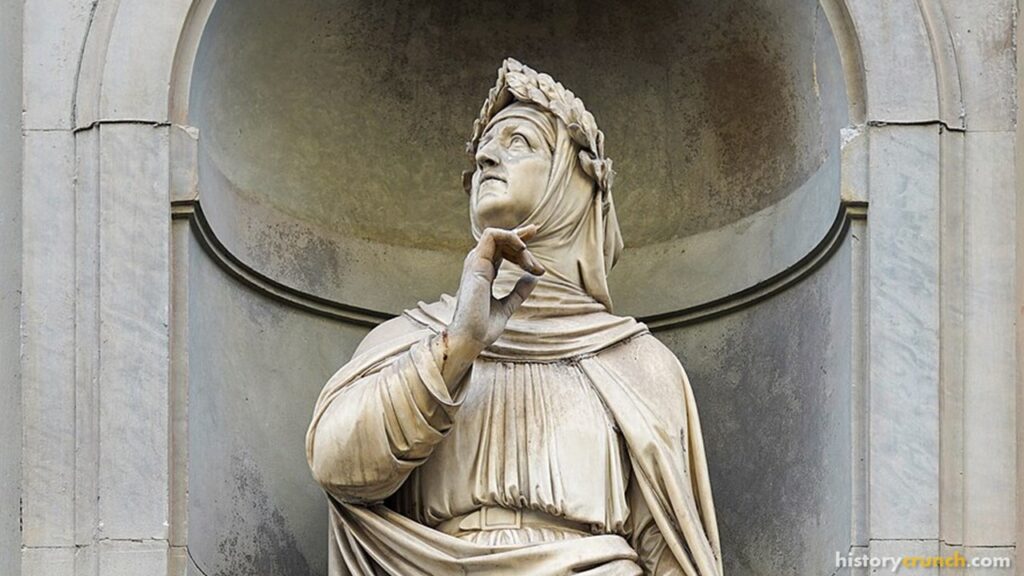
Petrarch was a scholar from the time of the Renaissance and is often referred to as the ‘Father of Humanism’. He gained this label for his role in sparking the Renaissance’s focus on classical learning and individual expression. For example, he rediscovered and preserved many ancient Greek and Roman texts, inspiring a renewed interest in ideas from the ancient past.
WHAT WAS THE RENAISSANCE?
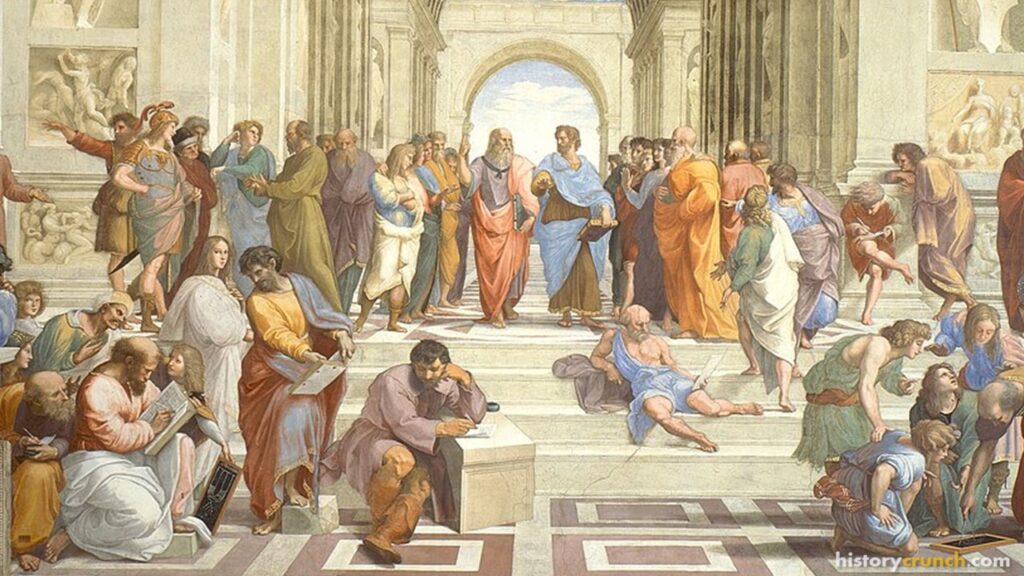
The Renaissance is an important event in European history that stretched from the 14th century to the 17th century. It was preceded by the Middle Ages in Europe and eventually led to the major events of the Age of Enlightenment. In historical terms the Renaissance is important because it led to a major shift in European thought and worldview. The most significant changes that emerged as a result of the Renaissance can be seen in European architecture, art, literature, mathematics, music, philosophy, politics, religion and science. Intellectual thought in these fields flourished during the timeframe of the Renaissance and led to many people questioning long held beliefs about each. This created an environment of discovery and curiosity in which new ideas were constantly being introduced and tested. One such new idea or worldview that developed during the time of the Renaissance was called humanism. In order to better understand Renaissance Humanism it is first important to learn about how it developed and the influential people associated with it, such as Petrarch. He is considered to be one of the most influential writers and scholars of the time period of the Renaissance and had a profound impact on Renaissance Humanism.
PETRARCH – EARLY LIFE
Petrarch (Francesco Petrarca) was born on July 20th, 1304 in Arezzo, Italy. He grew up near the Renaissance city-state of Florence, but also spent time in Avignon, France when the Papacy was moved there from Rome in 1309. As a student, he was primarily interested in studying Latin literature but was trained professionally as a lawyer. With that said, he didn’t enjoy studying law or being a lawyer and instead wanted to devote himself to his writing.
In 1326, he began working in several clerical offices. The work allowed him time to carry out his writing. For instance, it’s at this time that he wrote the epic poem ‘Africa’, which tells the story of Carthage General Hannibal and his invasion of the Italian peninsula against the Roman Empire. This work made his well known and renown for his writing. For example, he was made poet laureate on April 8th, 1341, in Rome.
PETRARCH – RENAISSANCE HUMANISM
Besides his writing, Petrarch was also known for his travels, and has even been referred to as ‘the first tourist’ due to his travels for enjoyment. It was during these travels that he famously began to collect Latin manuscripts. Also, he advocated for the collection and study of Ancient Greek and Ancient Roman texts. For example, Petrarch famously rediscovered letters written by Cicero.
Cicero was born in Italy in 106 BC and died in 43 BC. He is regarded as one of the most masterful writers of his time and the Latin language. Petrarch’s rediscovery in the 14th century of Cicero’s letters is considered to be the spark of the Italian Renaissance and inspired other European scholars to do the same and look to ancient texts. Petrarch considered the ideas present in Cicero’s and other ancient texts as superior to the ideas present in Europe at the time of the Middle Ages. As well, Petrarch is considered to be the founder of the humanist movement during the Renaissance. In general, Renaissance Humanism was the study of ancient Greek and Roman texts with the goal of promoting new norms and values in society. These norms and views varied from those at the time because they focused less heavily on a religious worldview. Instead, Renaissance humanists such as Petrarch used ancient texts to promote a worldview based on logic and reason. This was to be accomplished through the study of the ‘studia humanitatis’, which today is known as the humanities and includes topics such as: grammar, history, poetry, and philosophy. Renaissance humanists such as Petrarch promoted the idea that citizens should be educated in these topics in order to allow them to participate in the social and political life of their society. This was a fundamental shift from the feudalistic and religious life that was the reality for most people in the Europe in the Middle Ages. As such, Petrarch’s actions are considered to be important to the emergence and growth of the overall Renaissance.
PETRARCH – DEATH AND SIGNIFICANCE
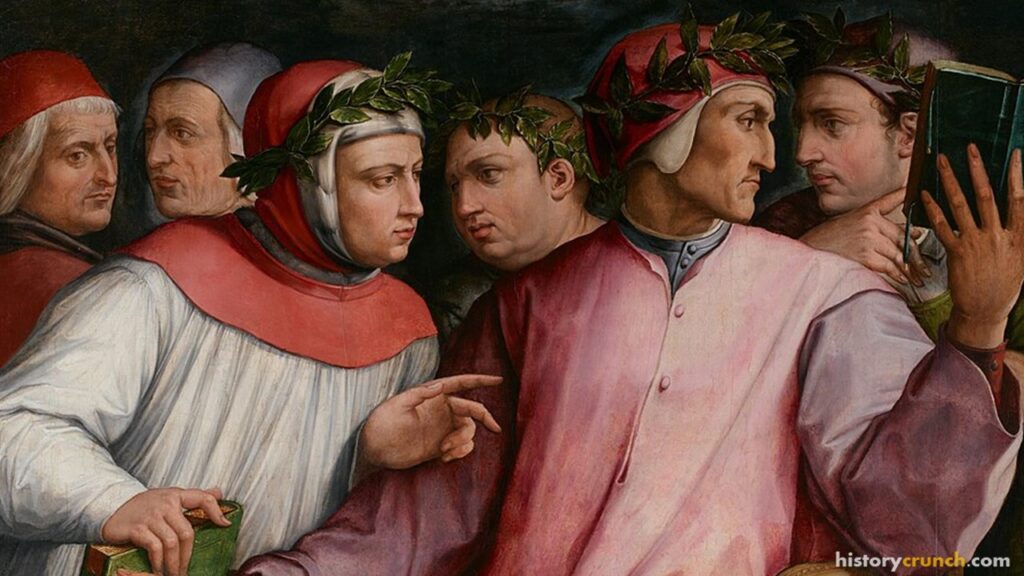
He died on July 20th, 1372 in his house in the town of Arqua in Northern Italy near the city-state of Venice. Today he is best remembered as the father of Renaissance Humanism and for his own written works, many of which were done in Latin. His work went on to inspire other prominent Renaissance Humanists, such as: Erasmus, Bude and Montaigne.